Fourteen years ago, when Social Media was fresh and new and full of hope, I started teaching Social Media for Environmental Communications at Duke University. The internet was bursting with potential and we wanted to help ocean campaigners tap into that cognitive surplus for the good of the planet.
This was a data driven course, guided by metrics and informed by analytical tools that helped our students understand how and why certain topics move swiftly through online spaces while others fall flat, that looked at how institutions and individuals used the structure of social media platforms to shift public opinion. We read books like Cognitive Surplus, Like War (which hilariously drops David Shiffman’s campaign against fake shark photos into the middle of a complex discussion on how ISIS uses Twitter to build influence), and Dataclysm. We read your blogs. We deconstructed the Mueller Report.
I ran that course from 2012 all the way until last year, when the program that the course was hosted through came to an end. For 11 years, I was steeped in the structural milieu of the social web, and yet I’m glad the course ended when it did. I don’t even remotely have a handle on what social media has become or where it’s going.
Though, for the record, I will extoll the advice me and Amy and David and Craig and Miriam and Rick and Kevin and Holly issued in our very first paper on how scientists and science activists can use social media to shape environmental narratives:
It is important to remember that the medium isn’t the message. Although these discussions occur on defined platforms, the overall message is independent of these platforms… In an ecosystem as dynamic as the Internet, becoming entrenched in one or two platforms is a guaranteed way to be left behind.
Digital environmentalism: tools and strategies for the evolving online ecosystem
This is not an article about social media. This is an article about epoxy river tables.
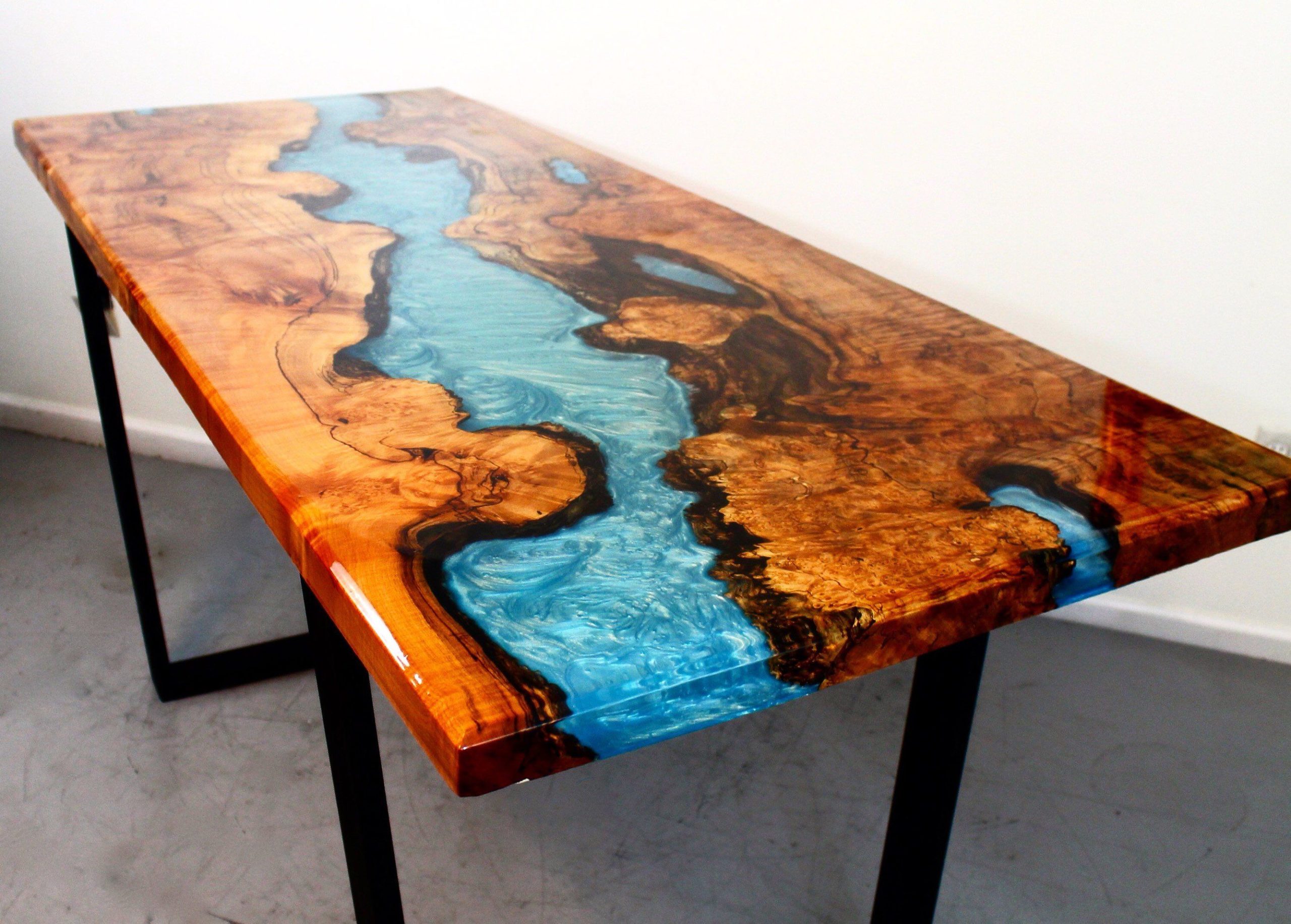
If you’ve spent any time on woodworking YouTube, or WoodTok, or Woodstagram, you’ve no doubt seen some of your favorite craftspeople making epoxy river tables. These thick tables, made usually of live edge slabs with deep-set epoxy poured down a central channel, have supplanted the pallet furniture of the 2010s as the go-to craft project for online creators.
And for good reason. Epoxy river tables can be stunning works of art. The blend of natural wood and plastic creates a powerful contrast. And they aren’t technically difficult, or rather, they don’t need to be. You can make an epoxy river table from a lightly finished live edge slab and a set of hardware store hairpin legs (or you can craft an elaborate structure of chemistry and joinery). The videos are really fun to watch. Who doesn’t love a smooth epoxy pour.
I don’t like them. From a practical standpoint, epoxy river tables are plastic. When you sand them, you release microplastics into the environment. Wood, once impregnated with plastic, isn’t reusable in the same way a nice, stout mission table is. While the chemistry of epoxies are getting better, the material was never really designed for these kinds of deep pours. Within the heart of a slab of cured epoxy, isolated from the atmosphere, the chemical reaction continues, sometimes for years. Eventually, all those crystal clear tables will yellow and fade, from the inside out. No amount of sanding or finishing can fix that.
As an aside, the resin within pine lumber behaves very similarly, taking up to 50 years to fully cure. This is why pine lumber from the mid-century seems so much harder than modern two by fours. It literally is.
But I’m just one curmudgeon who likes working in walnut and cherry. Make what you love. Furniture is revolution. If you are on team river table, for the love of wood, please wear a respirator.
If you spend as much time as I do watching woodworking videos, you might be under the impression that epoxy river tables are The Thing. They are the dominant expression of the artform online. The biggest YouTube woodworkers have either made epoxy river tables, or made fun of epoxy river tables. Clearly, these things are very popular.
Here’s the thing about epoxy river tables: I have never seen an epoxy river table in the wild. I am willing to bet that you have never seen an epoxy river table in the wild. I have never met someone who said “you know what I really want? An epoxy river table!” I have never talked with someone who thought “an epoxy river table would look really great right here!”.
The joy of the epoxy river table is, more than anything else, in the making. It’s a way to tell a story about wood, craftsmanship, and art, but that story exists in their creation. Once cured, the table itself is a sterile thing, a slab of plastic that was once alive. Epoxy river tables are all about the pour, that vibrant moment where liquid resin flows across a well-shaped surface, rather than the cure.
Despite their near total ubiquity across woodworking social media, epoxy river tables have limited appeal offline.
I lied. This is not an article about epoxy river tables. This is an article about social media.
One of the skills I tried to instill in my students is figuring out which trends exist solely online and which manifest into action. We talk about activation energy–posting on social media requires the minimum amount of energy for someone who cares about a topic to expend. Showing up at a protest, writing to a representative, chaining yourself to a fence, those all require much greater activation energy. While online campaigns very much do manifest into protests, boycotts, coordinated actions, voter registration drives, and realized political change, many more are epoxy river tables. Vibrant and abundant online, but rarely expressed as action offline.
Epoxy river tables are real. People do make them. Some of you will encounter them. Likewise, online trends that live online are real. They represent genuine issues people care about, but just because a topic is trending online, does not mean it will translate offline.
As social media and the internet at large becomes increasingly fractured over the next few years, stuffed with LLM pattern-recognition text salads and manufactured controversies, it will become increasingly difficult to determine what trends are tangible and what trends are epoxy river tables.
Featured Image: A very lovely epoxy river table from Aesthetics of Design.
Southern Fried Science is free and ad-free. Southern Fried Science and the OpenCTD project are supported by funding from our Patreon Subscribers. If you value these resources, please consider contributing a few dollars to help keep the servers running and the coffee flowing. We have stickers.