Skip to content

Southern Fried Science

Over 15 years of ocean science and conservation online

  • Home
  • About SFS
  • Authors
  • Support SFS

Biodiversity Wednesday: Ngorongoro Crater

Posted on February 9, 2011February 9, 2011 By David Shiffman
Uncategorized

Located in the East African nation of Tanzania, Ngorongoro Crater (pronounced just like it’s spelled, 😉 ) is one of the coolest places I’ve ever had the privilege to visit. Technically a caldera, the remnants of a collapsed volcano, the floor of Ngorongoro provides over 100 square miles of habitat surrounded by steep walls to more than 25,000 animals.
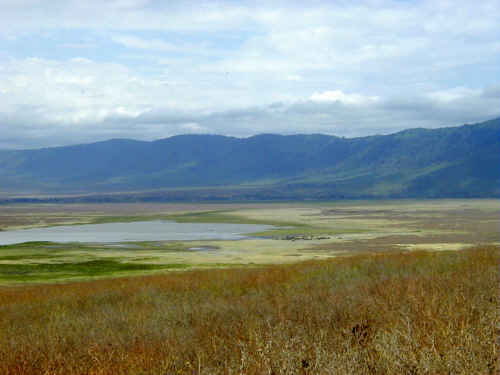
Ngorongoro Crater- what looks like mountains in the distance actually surrounds the habitat. Photo credit: David Shiffman, 2001

The steepness of the surrounding 2,000 foot mountains acts as a natural enclosure for many of the animals, though some of the occupants are capable of migrating out during the dry season. The result is a series of  inbred populations, including a resident population of larger-than-normal lions. It is considered by many to be the densest population of lions in the world, made possible by the large supply of food.
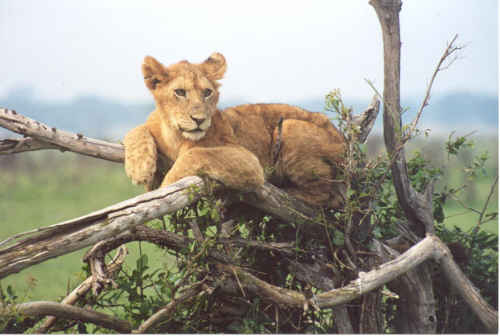
Possibly the best picture I've ever taken. Photo Credit: David Shiffman, 2001

Ngorongoro crater is managed as part of the Ngorongoro Conservation Area, a UNESCO World Heritage Site that includes the famous Olduvai Gorge. Many of the resident animals are endangered, including black rhinos. Many local populations of other animals, such as cheetahs and wildebeeste have been severely depleted in the past few decades.
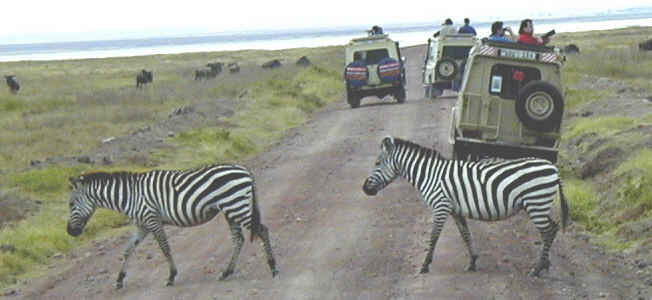
Why did the zebras cross the road? Photo credit: David Shiffman, 2001

This area is is also host to one of the world’s most unique ecotourism operations. Far from anything that could be described as a city, the crater is still a huge tourist attraction. A large hotel, complete with an animal-viewing telescope in every room, is built into the side of the caldera wall. Each morning, a small army of land rovers take tourists down 1,000 feet into the crater.

From your balcony you can watch animals below you. Image from TanzaniaOdyssey.com

Since 2001, conservation area managers have instituted a policy of controlled burns of the grassland. In addition, local Maasai herdsmen have had their access to grazing lands in the crater restricted, and non-subsistence agriculture is now banned. This appears to be helping some populations to rebound, but climate change (drying up limited water sources) and poaching of endangered species remain huge problems. The significance of the region to local culture, human evolution, endangered species, and a growing ecotourism economy make me optimistic that the government will come up with a workable plan to save Ngorongoro Crater’s ecosystem.

Share this:

  • Share on Bluesky (Opens in new window) Bluesky
  • Share on Facebook (Opens in new window) Facebook
  • Share on Reddit (Opens in new window) Reddit
  • Share on Threads (Opens in new window) Threads
  • Share on WhatsApp (Opens in new window) WhatsApp
  • Share on Mastodon (Opens in new window) Mastodon

Related

Tags: ngorongoro crater

Post navigation

❮ Previous Post: State of the Field: Is catch-and-release fishing harmful to sharks?
Next Post: SFS Gear Reviews: When the current changes, you have to adapt – Digipower Universal Travel Adapter ❯

Popular Posts

At least 74 practicing shark researchers: How a silly thing I said online raised thousands for conservationAt least 74 practicing shark researchers: How a silly thing I said online raised thousands for conservationFebruary 26, 2025David Shiffman
What Ocean Ramsey does is not shark science or conservation: some brief thoughts on "the Shark Whisperer" documentaryWhat Ocean Ramsey does is not shark science or conservation: some brief thoughts on "the Shark Whisperer" documentaryJuly 2, 2025David Shiffman
That's not a blobfish: Deep Sea Social Media is Flooded by AI SlopThat's not a blobfish: Deep Sea Social Media is Flooded by AI SlopDecember 19, 2025Andrew Thaler
Here are some ocean conservation technologies that I'm excited aboutHere are some ocean conservation technologies that I'm excited aboutFebruary 19, 2026David Shiffman
I turned my woodshop into a personal solar farm.I turned my woodshop into a personal solar farm.June 21, 2021Andrew Thaler
Alberta, Canada is the proud owner of the largest man-made pyramid on the planetAlberta, Canada is the proud owner of the largest man-made pyramid on the planetOctober 16, 2012Andrew Thaler
The Urgency Does Not Exist: My statement on Deep-sea Mining to the Subcommittee on Energy and Mineral ResourcesThe Urgency Does Not Exist: My statement on Deep-sea Mining to the Subcommittee on Energy and Mineral ResourcesJanuary 24, 2026Andrew Thaler
Here's what I teach my students about finding jobs in marine biology and conservationHere's what I teach my students about finding jobs in marine biology and conservationApril 10, 2024David Shiffman
Shark of Darkness: Wrath of Submarine is a fake documentaryShark of Darkness: Wrath of Submarine is a fake documentaryAugust 10, 2014Michelle Jewell
What is a Sand Shark?What is a Sand Shark?November 12, 2017Chuck Bangley
Subscribe to our RSS Feed for updates whenever new articles are published.

We recommend Feedly for RSS management. It's like Google Reader, except it still exists.

Southern Fried Science

  • Home
  • About SFS
  • Authors
  • Support SFS


If you enjoy Southern Fried Science, consider contributing to our Patreon campaign.

Copyright © 2026 Southern Fried Science.

Theme: Oceanly Premium by ScriptsTown