
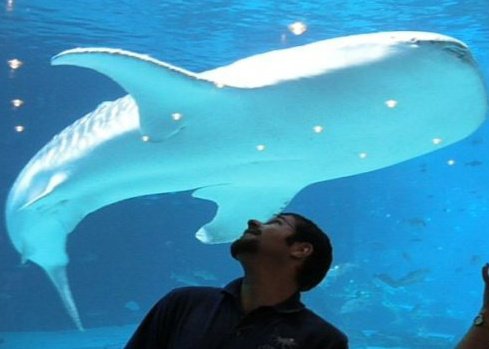
The world’s largest shark eats only plankton, couldn’t bite a human if it wanted to, and is one of the few sharks that could be reasonably described as beautiful. Globally, SCUBA divers pay an estimated $50 million each year for the chance to swim with these incredible fish. Their long migrations through international waters makes international cooperation necessary to protect them, which is particularly important because the 30 years it can take for these animals to reach reproductive maturity means that populations will take a long time to recover if they are overexploited. They’re listed by the IUCN Shark Specialist Group as Vulnerable globally. Between their charismatic nature, their inability to harm humans, and their value to ecotourism, it should be easy to convince governments to protect whale sharks *, making two recent reports all the more shocking.
At the recent Western and Central Pacific Fisheries Commission meeting, Australia introduced a proposal to ban intentionally setting tuna nets around whale sharks. You read that correctly: it is currently legally permissible (and not uncommon) for fishing vessels to intentionally deploy tuna purse seine nets around whale sharks. As was discussed in my dolphin-safe tuna post, schools of tuna will often aggregate around anything, including buoys, logs, or fifty foot long sharks that are extremely valuable for ecotourism and extremely vulnerable to overexploitation. Being caught in a tuna net and dragged onto the deck of a fishing vessel is often lethal, and an estimated 75 whale sharks have died since 2009. Those that survived undoubtedly experienced extreme stress, as fish that large aren’t used to supporting their own weight out of water. Unfortunately, Australia’s common-sense proposal was stalled by the Japanese delegation and was not enacted this year. According to Sonja Fordham of Shark Advocates International, it will be discussed again when the WCPFC meets again in December.
““We are perplexed and dismayed by continuing delays in adopting such basic and sensible safeguards for these globally threatened and economically important species,” said Rebecca Regnery, Deputy Director of Wildlife for the Humane Society International of the failure of this proposal. That’s putting it mildly.
Although whale sharks are protected from harvest in many countries, new research shows that whale shark fishing is on the rise in China. Between 1980 and 2003, only 17 whale shark landings were officially recorded in China. Since 2003, there have been 167 recorded landings- though interviews with shark processing plant employees indicate that over 1,000 whale sharks are landed annually. While there is a limited market for whale shark meat (see here for a disturbing image of whale shark shark processing) , it is the fins that are the biggest draw. Whale shark fins, not surprisingly, are enormous, and therefore fetch the highest price at market. Some of the huge whale shark fins are used to make shark fin soup, while others are placed in the windows of shark fin stores to serve as billboards.
Logs and buoys will attract tuna just as effectively as whale sharks, and a sign will advertise the presence of a shark fin store just as effectively as a whale shark fin. Our current inability to protect these charismatic, harmless, and vulnerable sharks from being killed as tuna bait and billboards is one of many reminders that nothing about marine conservation is easy.
* There have been some conservation successes, including a CITES Appendix II listing, a Convention on Migratory Species listing, and assorted national-level bans on harvest.
killers!!
I belief there is no excuse for the killing of whales either for food or for science to investigate. Stop the killing now !
Having swam beside whale sharks, within 4 feet of them, I know the majesty and spiritual feeling one has when one of these behemoths gently looks at you and swims by at 4 mph. This is a gentle animal, an animal not made to provide soup for some wealthy persons. We must save these wonderful beings.
This is disgusting. These are beautiful creatures which need to be protected, not used as bait or billboards!
Hi, thanks for you post, you might be interested in our conservation-based whale shark expeditions on the Ningaloo, trying to do our bit to help preserve this amazing species!
http://www.oceanwise.com.au
Facebook:oceanwise expeditions
It’s stuff like this that makes me disgusted by our species.
How can a few dollars be worth killing these magnificent gentle creatures?
For eons they have survived in peace and harmony, we come along and in just a few hundred years we do more damage because of greed than they have experienced in millenia.
Really wish I could help more, but it does give me hope that guys like David and others have taken the fight on.
You guys are heroes, keep fighting the good fight!
You might not hear it often enough, especially when things get frustrating, but you are appreciated and loved by people all over the world – don’t stop fighting!
Yet another unecessary waste of life! Please repost this article to put pressure on the countries who do not protect this innocent being!
This is just human being…everything will be destroyed one day! dolphins, whales, sharks…no more trees or water…if we accept that some people are doing such things! So we should never stop to fight for our beautiful animals and the nature¨!!
I hope that one day the fishing for and exploitation of Whale sharks and all other sharks is made illegal and stopped !
As someone who loves the whale sharks, I am alarmed at how much I have seen stories in the news recently, about how so many of these magnificent creatures are being killed off.
You know that whale sharks are not whales, right?
I’ve been to Australia 3 times and have never made it to Ningaloo. One day I hope to get out there.
Thanks Ryan!
Shark fin is for losers… sad that our species has so many losers 🙁
Even though the full WCPFC membership did not approve the Australian proposal for a Western Pacific region-wide ban on setting purse-seine nets around (or near) whale sharks last week, the countries that are Parties to the Nauru Agreement (PNA) have already banned the purse-seiners that they licence from setting on whale sharks. This ban has been in place from the start of 2011, and since PNA countries licence almost all the purse-seiners operating in the Western Pacific, the Australian proposal only had the effect of tying up remaining loose ends. These loose ends are (a) the USA purse-seine fleet (which is not currently bound by PNA rules due to a pre-existing treaty) and (b) the Philippines group-seiners which were recently re-admitted by WCPFC to Western Pacific high seas enclave #1.
We have to do something. Humans are not the owners of fish and animals.
Hi all,
Open your eyes and look like the planet earth is so fragile and beautiful.
It gives food to our children and brings us joy and love in our hearts …
But alas the reign is given to money and power, and it is so easy to destroy it just for what we call the economy …
What it important for your children to discover? money and selfishness? or the beauty and bounty of Mother Nature.
May Peace come back to this earth in the respect it deserves.