 Welcome to Dear Shark Man, an advice column inspired by a ridiculous e-mail I received. You can send your questions to me via twitter (@WhySharksMatter) or e-mail (WhySharksMatter at gmail).
Dear Shark Man,
I know that sharks that live close to the coast sometimes use “nursery areas” when they are young. Do open ocean sharks also use nursery areas?
Sincerely,
Nosey in North Carolina
Dear Nosey,
Thanks for a great question that allows me to talk about nursery areas! Most people think of sharks as big, scary animals at the top of the food chain, but they don’t start off that way. During my Masters research at the College of Charleston, I worked with the South Carolina Department of Natural Resources Coastal Shark Survey. We were part of COASTSPAN, the Cooperative Atlantic States Pupping and Nursery survey, which focused on shark nursery areas along the eastern seaboard. It was really interesting for me to get to see so many newborn shark pups, sometimes called “neonate” or “young of year,” of so many different species! I’ve often wondered if people would feel the same way about sharks if images of shark pups were as widely shared as news stories about adult sharks biting people.
However, I didn’t know anything about nursery areas for offshore sharks, so I asked an expert! Dr. Michelle Heupel is Principal Research Scientist at the Australian Institute of Marine Science (AIMS), and she literally wrote the book on shark nursery areas. Well, the highly-cited paper defining this concept, anyway. Here’s what Dr. Heupel had to say:
Coastal shark nurseries have been studied for several decades, in part based on our easy access to catching and studying coastal species. Early studies of coastal shark nurseries were simply based on whether juvenile sharks were seen or captured in the area. In 2007 a set of criteria were developed to define a nursery and help guide research, management and protection of nurseries. The criteria are that: 1) young sharks are more commonly seen in the area than in other areas, 2) young sharks remain in the area for extended periods, and 3) the area is used by young sharks repeatedly across years. These criteria are designed to help define what is a nursery rather than an area a group of young sharks swam through.
For open ocean sharks there have been some reports of capturing large numbers of young sharks in some areas, especially for blue and silky sharks. However, these reports have not been assessed against the nursery criteria. Given the wide ranging nature of open ocean sharks and the potential influence of currents and ocean conditions on where they go, coastal nursery criteria may not be applicable. That means no open ocean nurseries have been fully defined, and indicates we need more research into whether these sharks use and rely on nurseries they way their coastal cousins do.
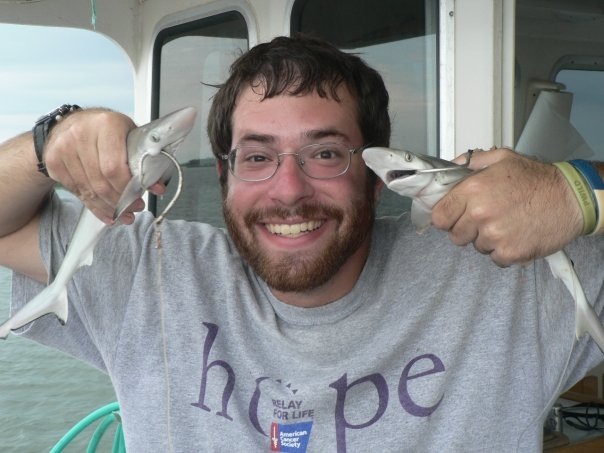
So, the short answer to your question, Nosey, is “maybe, but we’re not sure yet!” So in the meantime, please enjoy this photo of me with Atlantic sharpnose shark pups in a South Carolina nursery area.
If you appreciate my shark research and conservation outreach, please consider supporting me on Patreon! Any amount is appreciated, and supporters get exclusive rewards!