Skip to content

Southern Fried Science

Over 15 years of ocean science and conservation online

  • Home
  • About SFS
  • Authors
  • Support SFS

Fun Science Friday – “Trolls Just Wanna Have Fun”

Posted on March 14, 2014 By Kersey Sturdivant
Blogging

I have to admit, I love this title, but cannot claim it as my own. It is the title of the research paper that forms the basis for today’s FSF, internet trolling.
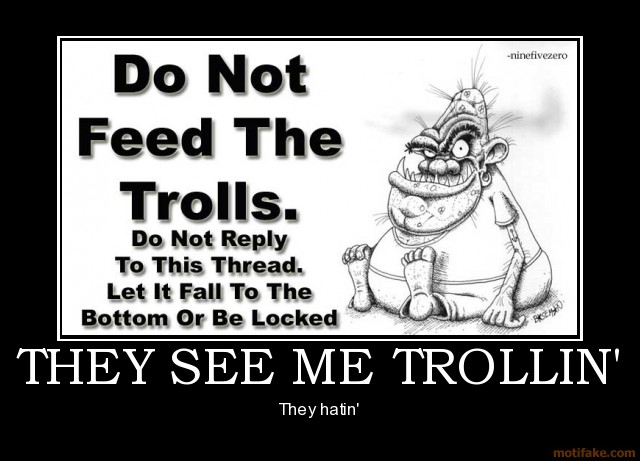
They see me Trollin. Photo Credit: NineFiveZero
They see me Trollin.
Photo Credit: NineFiveZero

Anyone who has ever spent remotely anytime reading the comments section of pretty much anywhere on the internet has likely observed a Troll (why some of you reading may even have engaged in Troll-like behavior). While these Trolls do not physically hide under bridges and/or steal sheep, their actions parallel many of the annoyances of their fairy tale  counterparts.  As defined by wikipedia, an Internet Troll “is a person who sows discord on the Internet… with the deliberate intent of provoking readers into an emotional response or of otherwise disrupting normal on-topic discussion.”

Thanks to Erin Buckels, from the University of Manitoba in Canada, and her team, we now have some insight into the psychology of Trolls.  Buckels and her colleagues attempted to determine if  people who engage in trolling are characterized by “Dark Tetrad” personality traits: Machiavellianism (willingness to manipulate and deceive others), narcissism (egotism and self-obsession), psychopathy (the lack of remorse and empathy), and sadism (pleasure in the suffering of others).

Their study found, as I have always suspected, Internet Trolls are corrupted by the Dark Side.  There were significant correlations between “Dark Tetrad” traits and trolling, though it is important to note that correlation does not mean causation:
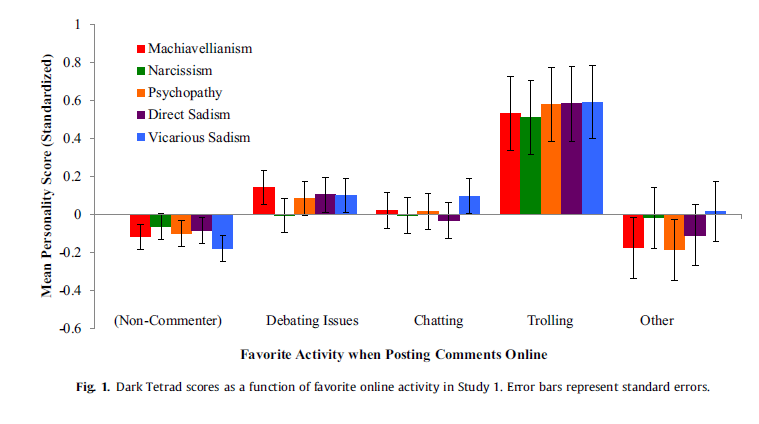
Photo Credit: Buckels et al. 2014

In their study only 5.6% of  respondents identified themselves as Internet Trolls. By contrast, 41.3% of respondents were “non-commenters,” meaning they generally did not engage (i.e. comment) online at all. So trolls are, as has often been suspected, a minority of online commenters, and an even smaller minority of the overall number of people on the Internet.

While Buckels and her team do not present a solution of how to deal with Internet Trolls, they do identify the personality traits common in Trolls. My suggestion, if you see a Troll, do not engage them; Trolls feed off attention.


Happy Fun Science Friday all, and while surfing the World Wide Web remain vigilant and remember:

Photo Credit: mememachine, community102.com


You can read the full article by Buckels and her team in the journal of Personality and Individual Differences.

Props to Leah Segui for indirectly giving me the inspiration to write about internet trolling. Good luck with your presentation!

Share this:

  • Click to share on Bluesky (Opens in new window) Bluesky
  • Click to share on Facebook (Opens in new window) Facebook
  • Click to share on Reddit (Opens in new window) Reddit
  • Click to share on Threads (Opens in new window) Threads
  • Click to share on WhatsApp (Opens in new window) WhatsApp
  • Click to share on Mastodon (Opens in new window) Mastodon

Related

Post navigation

❮ Previous Post: Southern Fried Science Has A NEW Header Image
Next Post: A field guide to ocean science and conservation on Twitter, volume 2 ❯

Popular Posts

What Ocean Ramsey does is not shark science or conservation: some brief thoughts on "the Shark Whisperer" documentaryWhat Ocean Ramsey does is not shark science or conservation: some brief thoughts on "the Shark Whisperer" documentaryJuly 2, 2025David Shiffman
That's not a blobfish: Deep Sea Social Media is Flooded by AI SlopThat's not a blobfish: Deep Sea Social Media is Flooded by AI SlopDecember 19, 2025Andrew Thaler
The story of the pride flag made from NASA imagery: Bluesky's most-liked imageThe story of the pride flag made from NASA imagery: Bluesky's most-liked imageSeptember 27, 2024David Shiffman
What can the funniest shark memes on the internetz teach us about ocean science and conservation?What can the funniest shark memes on the internetz teach us about ocean science and conservation?November 8, 2013David Shiffman
The Trouble with Teacup PigsThe Trouble with Teacup PigsOctober 14, 2012Andrew Thaler
I can serve on your graduate thesis committee. Here’s what you can expect of me, and what I expect in return.I can serve on your graduate thesis committee. Here’s what you can expect of me, and what I expect in return.October 16, 2025David Shiffman
Shark of Darkness: Wrath of Submarine is a fake documentaryShark of Darkness: Wrath of Submarine is a fake documentaryAugust 10, 2014Michelle Jewell
Nodules, Lost Mines, and Dark Oxygen: A new documentary on deep-sea mining asks important questions about the future of the industry.Nodules, Lost Mines, and Dark Oxygen: A new documentary on deep-sea mining asks important questions about the future of the industry.July 24, 2025Andrew Thaler
Norway and Cook Islands put their deep-sea mining plans on pause.Norway and Cook Islands put their deep-sea mining plans on pause.December 3, 2025Andrew Thaler
Blackfish: the Science Behind the MovieBlackfish: the Science Behind the MovieSeptember 18, 2013Chris Parsons
Subscribe to our RSS Feed for updates whenever new articles are published.

We recommend Feedly for RSS management. It's like Google Reader, except it still exists.

Southern Fried Science

  • Home
  • About SFS
  • Authors
  • Support SFS


If you enjoy Southern Fried Science, consider contributing to our Patreon campaign.

Copyright © 2025 Southern Fried Science.

Theme: Oceanly Premium by ScriptsTown