Skip to content

Southern Fried Science

Over 15 years of ocean science and conservation online

  • Home
  • About SFS
  • Authors
  • Support SFS

Fun Science FRIEDay – Weaponized Insulin

Posted on April 3, 2015March 31, 2015 By Kersey Sturdivant
Uncategorized

Most people have heard of cone snails. They are the genus of venomous marine snails that shoot a poisonous “dart” (hypodermic-like modified radula tooth attached to a venom gland) to attack and paralyze their prey before feeding on it. Smaller cone snails primarily hunt and prey on marine worms, while the larger ones hunt fish. To humans the sting of a smaller cone snail is similar to that of a bee, but contact with larger cone snails can be fatal! Basically they are the badasses of the snail world.
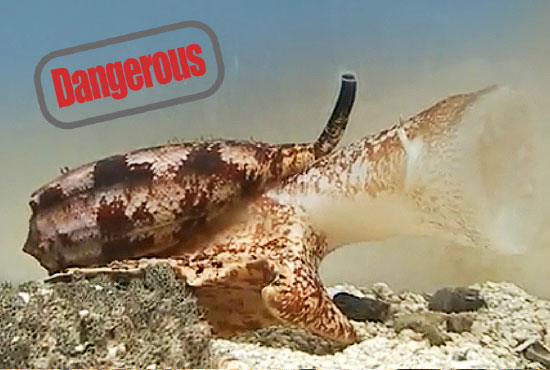
Cone snails are venomous! Their toxin is estimated to be 1,000 times more powerful than morphine. (Photo credit: http://www.siart.karoo.net)

What is interesting and the focus of todays FSF, is the recent discovery that one species of cone snail, Conus geographus, uses weaponized insulin to restrict its prey before engulfing it. Why is this cool and important? Insulin is a hormone produced in the pancreas that regulates blood sugar levels. A failure to control insulin levels, commonly seen in diabetics, can result in decreases in blood glucose levels, which can result in lethargy, dizziness, and lost of consciousness among other things.

So now back to C. geographus badass. This snail releases its cocktail of toxins into the water, insulin forms part of a poison mixture evocatively known as “nirvana cabal”, allowing the snail to immobilize whole schools of fish by sending them into “hypoglycaemic shock”, a condition brought on by plummeting blood sugar levels. Once paralyzed the snail can gore to its hearts content.
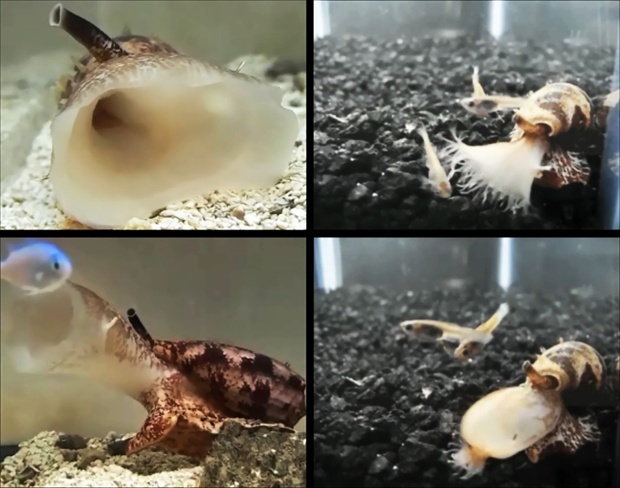
The cone snail, C. geographus attacking a fish in sequence (sequence: top left, bottom left, top right, bottom right). (Photo credit: Jason Biggs and Baldomero Oliver)

C. geographus is one of the most venomous creatures on Earth, and is known to have killed dozens of people in accidental encounters. Now researchers have a better sense of how and why this snail’s toxin is so potent.

You can read more about this cool snail, and the study to uncover its toxic properties in the journal Proceedings of the National Academy of Sciences.


Happy FSF!

Share this:

  • Click to share on Bluesky (Opens in new window) Bluesky
  • Click to share on Facebook (Opens in new window) Facebook
  • Click to share on Reddit (Opens in new window) Reddit
  • Click to share on Threads (Opens in new window) Threads
  • Click to share on WhatsApp (Opens in new window) WhatsApp
  • Click to share on Mastodon (Opens in new window) Mastodon

Related

Tags: cone snail Conus geographus weaponized insulin

Post navigation

❮ Previous Post: What Conservationists Need to Know About Surveys
Next Post: Fish at Night: Announcing a symposium focused on nocturnal fish ❯

Popular Posts

What Ocean Ramsey does is not shark science or conservation: some brief thoughts on "the Shark Whisperer" documentaryWhat Ocean Ramsey does is not shark science or conservation: some brief thoughts on "the Shark Whisperer" documentaryJuly 2, 2025David Shiffman
That's not a blobfish: Deep Sea Social Media is Flooded by AI SlopThat's not a blobfish: Deep Sea Social Media is Flooded by AI SlopDecember 19, 2025Andrew Thaler
Shark of Darkness: Wrath of Submarine is a fake documentaryShark of Darkness: Wrath of Submarine is a fake documentaryAugust 10, 2014Michelle Jewell
10 Myths About Social ScienceOctober 6, 2011Bluegrass Blue Crab
Here's how to help identify Important Shark and Ray Areas in North America!Here's how to help identify Important Shark and Ray Areas in North America!January 19, 2026David Shiffman
Reflections on the Boundary of Science and PolicyJune 20, 2016Bluegrass Blue Crab
Marine Biology Career AdviceMarine Biology Career AdviceMay 30, 2025David Shiffman
What can the funniest shark memes on the internetz teach us about ocean science and conservation?What can the funniest shark memes on the internetz teach us about ocean science and conservation?November 8, 2013David Shiffman
My "Follow ocean science and conservation experts on Bluesky and Instagram" assignmentMy "Follow ocean science and conservation experts on Bluesky and Instagram" assignmentNovember 19, 2024David Shiffman
No, we didn't find the Loch Ness Monster with Apple MapsNo, we didn't find the Loch Ness Monster with Apple MapsApril 18, 2014Andrew Thaler
Subscribe to our RSS Feed for updates whenever new articles are published.

We recommend Feedly for RSS management. It's like Google Reader, except it still exists.

Southern Fried Science

  • Home
  • About SFS
  • Authors
  • Support SFS


If you enjoy Southern Fried Science, consider contributing to our Patreon campaign.

Copyright © 2026 Southern Fried Science.

Theme: Oceanly Premium by ScriptsTown