Skip to content

Southern Fried Science

Over 15 years of ocean science and conservation online

  • Home
  • About SFS
  • Authors
  • Support SFS

Giant manta rays protected by Convention on Migratory Species

Posted on November 25, 2011December 9, 2011 By David Shiffman 6 Comments on Giant manta rays protected by Convention on Migratory Species
Conservation, Science

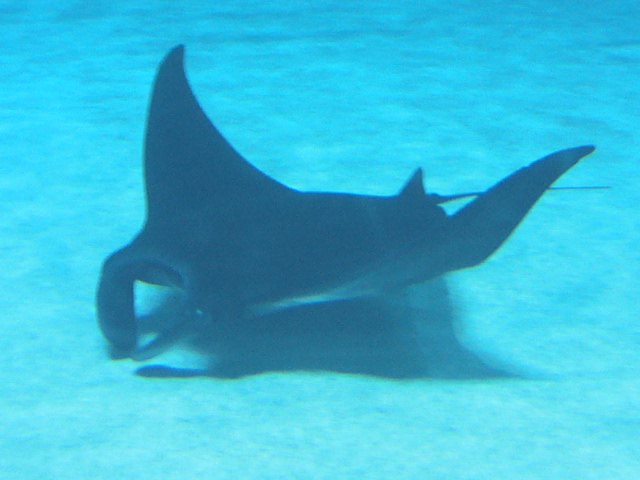
Photo credit: David Shiffman (Georgia Aquarium)

A few weeks after they were listed as Vulnerable on the IUCN Red List, giant manta rays (Manta birostris) have received major international legal protection. The Parties to the Convention on Migratory Species of Wild Animals (CMS) just agreed to list giant mantas on Appendix 1 and II of CMS at their tri-annual meeting in Bergen, Norway.  An Appendix I listing requires that any of the 116 CMS Party nations who have giant manta rays in their waters to protect them along with their habitat, while an Appendix II listing encourages global and regional cooperation. This proposal was introduced by Ecuador, and was supported by the European Union, United States, Australia, Senegal, Madagascar, Mozambique, Chile, and Uruguay. This year’s host country, Norway, also supported the proposal and proposed discussing the reef manta (Manta alfredi) at the next CMS meeting in 2014.

“We are elated that the CMS Parties have embraced Ecuador’s proposal for protecting the magnificent and exceptionally vulnerable giant manta ray,” said Sonja Fordham, President of Shark Advocates International. “CMS is an excellent vehicle for facilitating much needed national and international safeguards for this wide-ranging, globally threatened species and its key habitats.”

Giant mantas (the giant is appropriate as they can grow more than 7 meters across) are the target of directed fisheries for their gill rakers, which are used in traditional Chinese medicine. Their large size, predictable movement patterns, and relatively slow swimming speed makes them easy to catch, while many of their widely-distributed subpopulations number only a few hundred individuals. A listing under CMS appendices I and II is a welcome first step in the conservation of these gentle giants.
Share this:

  • Share on Bluesky (Opens in new window) Bluesky
  • Share on Facebook (Opens in new window) Facebook
  • Share on Reddit (Opens in new window) Reddit
  • Share on Threads (Opens in new window) Threads
  • Share on WhatsApp (Opens in new window) WhatsApp
  • Share on Mastodon (Opens in new window) Mastodon

Related

Tags: convention on migratory species manta rays

Post navigation

❮ Previous Post: What is seen cannot be unseen.
Next Post: An homage to greatness. ❯

You may also like

Blogging
A guide to following shark and ray conservation at this week’s Convention on Migratory Species meeting
November 4, 2014
Uncategorized
Shark protections, shark careers, and sharky grammar: Dear Shark Man, Volume 1
November 8, 2017
Science
European Union officials propose stronger finning ban, sign UN migratory shark initiative
November 22, 2011
Uncategorized
Invasion of the Mantas?
August 23, 2010

6 thoughts on “Giant manta rays protected by Convention on Migratory Species”

  1. Al Dove says:
    November 25, 2011 at 11:19 am

    Hey David, that’s great news. Have you got a link to the original announcement?

  2. Mark Bradfield says:
    November 25, 2011 at 11:47 am

    Great news! So pleased for Mark Harding, Andrea Marshall and all the other people working hard to raise the plight of mantas worlwide. Just need the relevant countries to step up with some appropriate enforcement action now…

  3. Sam Orrange says:
    November 25, 2011 at 5:04 pm

    I’m so happy to hear this! More countries really need to get on board though and do more. It seems like fishing or protection policies, even in the countries that do sign these treaties, are never quite enforced or strong enough, but at least this is a good step for the mantas!

  4. Sue Ferguson says:
    November 25, 2011 at 7:26 pm

    Great news for the manta rays! They grow slowly, and only have one pup a year. Thank goodness something is being done to protect these gentle giants.

  5. Paul Crooks says:
    November 25, 2011 at 10:39 pm

    Brilliant, but where you say Australia and where F.A.O zone 57 extends 77˚.00’E and throughout the bay of Bengal does this include Sri Lanka?
    I understand it that these critters are a favourable target of Sri Lanka.

  6. WhySharksMatter says:
    November 25, 2011 at 10:44 pm

    From another article:
    “Today‟s decision marks the first international agreement aimed at conserving manta rays and should spark new protections in key Range States such as Mozambique, India, Sri Lanka, and Peru.”

    http://www.elasmo.de/component/content/article/2-deg/124-nations-agree-protect-manta-ray

Comments are closed.

Popular Posts

What Ocean Ramsey does is not shark science or conservation: some brief thoughts on "the Shark Whisperer" documentaryWhat Ocean Ramsey does is not shark science or conservation: some brief thoughts on "the Shark Whisperer" documentaryJuly 2, 2025David Shiffman
Here's how to join my IMCC8 symposium, "Ocean Science Communication: What's New and What's Next?"Here's how to join my IMCC8 symposium, "Ocean Science Communication: What's New and What's Next?"April 22, 2026David Shiffman
That's not a blobfish: Deep Sea Social Media is Flooded by AI SlopThat's not a blobfish: Deep Sea Social Media is Flooded by AI SlopDecember 19, 2025Andrew Thaler
Here are some ocean conservation technologies that I'm excited aboutHere are some ocean conservation technologies that I'm excited aboutFebruary 19, 2026David Shiffman
Fun facts and FAQs about Megalodon, Maryland's new (and definitely extinct) official state sharkFun facts and FAQs about Megalodon, Maryland's new (and definitely extinct) official state sharkApril 15, 2026David Shiffman
Reflections on science and my role in it, ten years since my Ph.D. defenseReflections on science and my role in it, ten years since my Ph.D. defenseApril 1, 2026David Shiffman
What is a Sand Shark?What is a Sand Shark?November 12, 2017Chuck Bangley
Urea and Shark OsmoregulationUrea and Shark OsmoregulationNovember 15, 2010David Shiffman
I turned my woodshop into a personal solar farm.I turned my woodshop into a personal solar farm.June 21, 2021Andrew Thaler
Join Me at Upwell: A Wave of Ocean Justice — Our Fourth Year!Join Me at Upwell: A Wave of Ocean Justice — Our Fourth Year!March 24, 2026Angelo Villagomez
Subscribe to our RSS Feed for updates whenever new articles are published.

We recommend Feedly for RSS management. It's like Google Reader, except it still exists.

Southern Fried Science

  • Home
  • About SFS
  • Authors
  • Support SFS


If you enjoy Southern Fried Science, consider contributing to our Patreon campaign.

Copyright © 2026 Southern Fried Science.

Theme: Oceanly Premium by ScriptsTown