
Sammy Andrzejaczek grew up ocean obsessed in Western Australia and knew from an early age she wanted to be a marine biologist. She completed her Bachelor of Science Degree in Queensland and developed a fascination with all things shark. Her Honours thesis on whale sharks fed that fascination and she has now moved onto a PhD where she is looking at the vertical movements of sharks and other pelagic predatory fishes. She hopes her project on tiger sharks will become the cornerstone of her thesis and enable her to compare findings with other species of shark around the world. In her (limited) spare time she can be found outside – surfing, diving, camping and hiking. She also loves martial arts and is a black belt in Zen Do Kai.
We live in the age of computers and information. While technology advances, the devices we use are getting smaller and more compact, and we are able to carry a world of information in our pockets. The same can be said for animal-borne tagging devices. Tags no longer just record where an animal is going; rather they are capable of telling us how an animal is moving, measure the physical environment that the animal passes through and record the physiological state of the animal as it undergoes movement. Some tags even have embedded video cameras that effectively carry us along for the ride as animals go about their daily behaviours. These advances in tagging technology offer a huge potential for researchers to gain an understanding of drivers behind movement patterns, i.e. not just where an animal goes, but how it moves and why it moves to get to a particular destination. For sharks – my study species – most movement research to date has largely focused on horizontal scales i.e. movements across ocean basins or along coastlines. However, marine animals live in a three dimensional environment, moving up and down through the water column as well as across it. It is fair to say that unless we understand how and why animals move in these three dimensions, then we have little chance of getting a real insight into their ecology.
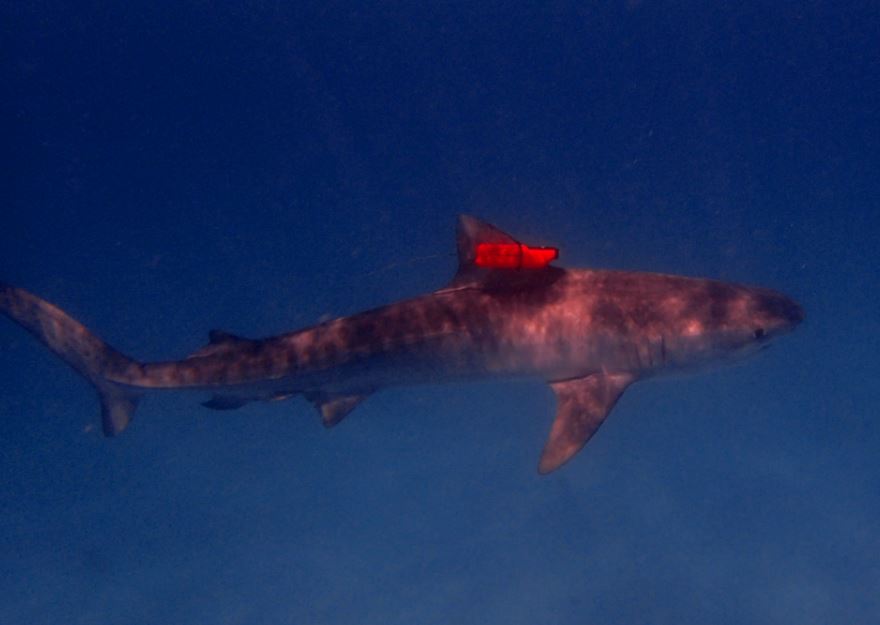
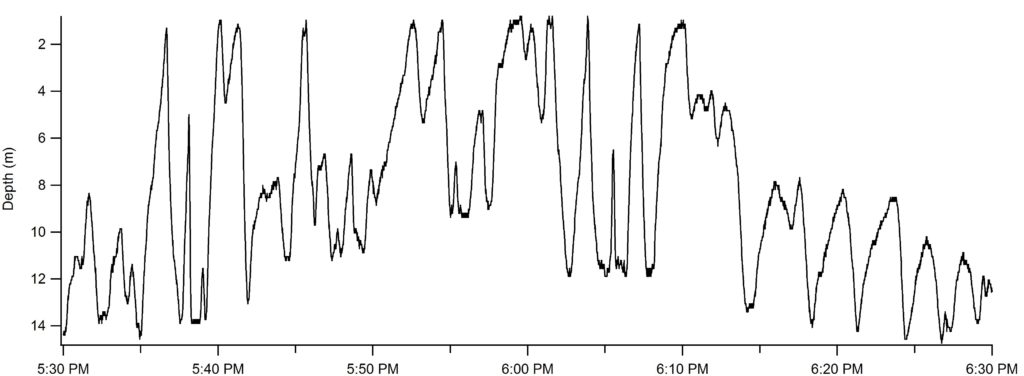
The tiger shark, a keystone predator in coastal marine ecosystems, is known to move up and down through the water column almost continuously in what we call “yo-yo” movements. For the moment we have no clear idea as to why they do this. Is it for foraging, energy saving, navigation, metabolic reasons or some combination of lots of different factors? My project aims to answer this question. We are now tagging tiger sharks at Ningaloo Reef, in Western Australia. Our tags will allow sharks to sample their environment for us, recording video, depth, temperature, acceleration and direction. We can even work out how much energy the sharks are using to make their movements as well as explore any hunting strategies they may be using. By recording video we can examine if yo-yo movements (see graph) are being used to search for prey and at what depths they prefer to feed.
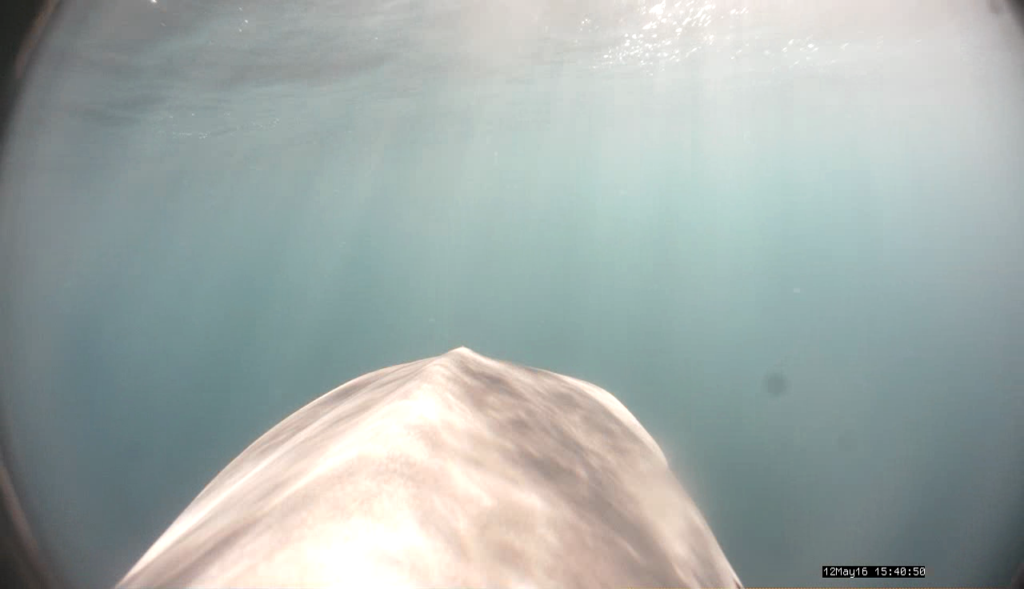
Tiger sharks are the top predators at Ningaloo Reef, which is a relatively pristine and remote reef system located in north-west Western Australia. It is vital that we understand their behaviours to better understand this system as a whole. We know where to reliably find them on the reef and how to catch and tag them with the minimum of disturbance to the animal. The difficult part for us is the cost of travelling to and working in this remote environment. Last month we travelled to Ningaloo for a week and tagged four tiger sharks, collecting some exciting footage and data in the process. From a preliminary scan of the video, we’ve already seen a number of interesting behaviours as well as interactions with turtles and other sharks. But to better understand tiger shark behaviour, we need more deployments. By supporting our project, you can help us get to Ningaloo for a month next year, which would allow us to tag up to 30 tiger sharks. For every $100+ contribution we will send you a copy of the highlights clip from the video tags, and for every $50 a print image from the field. For every contribution, no matter how small, you will also be able to access one of our coolest videos to date – a tiger shark re-swallowing its stomach after being tagged (don’t worry, this is a normal event and strategy following capture!).
To learn more about the project, see our video and help support our research, please click here.