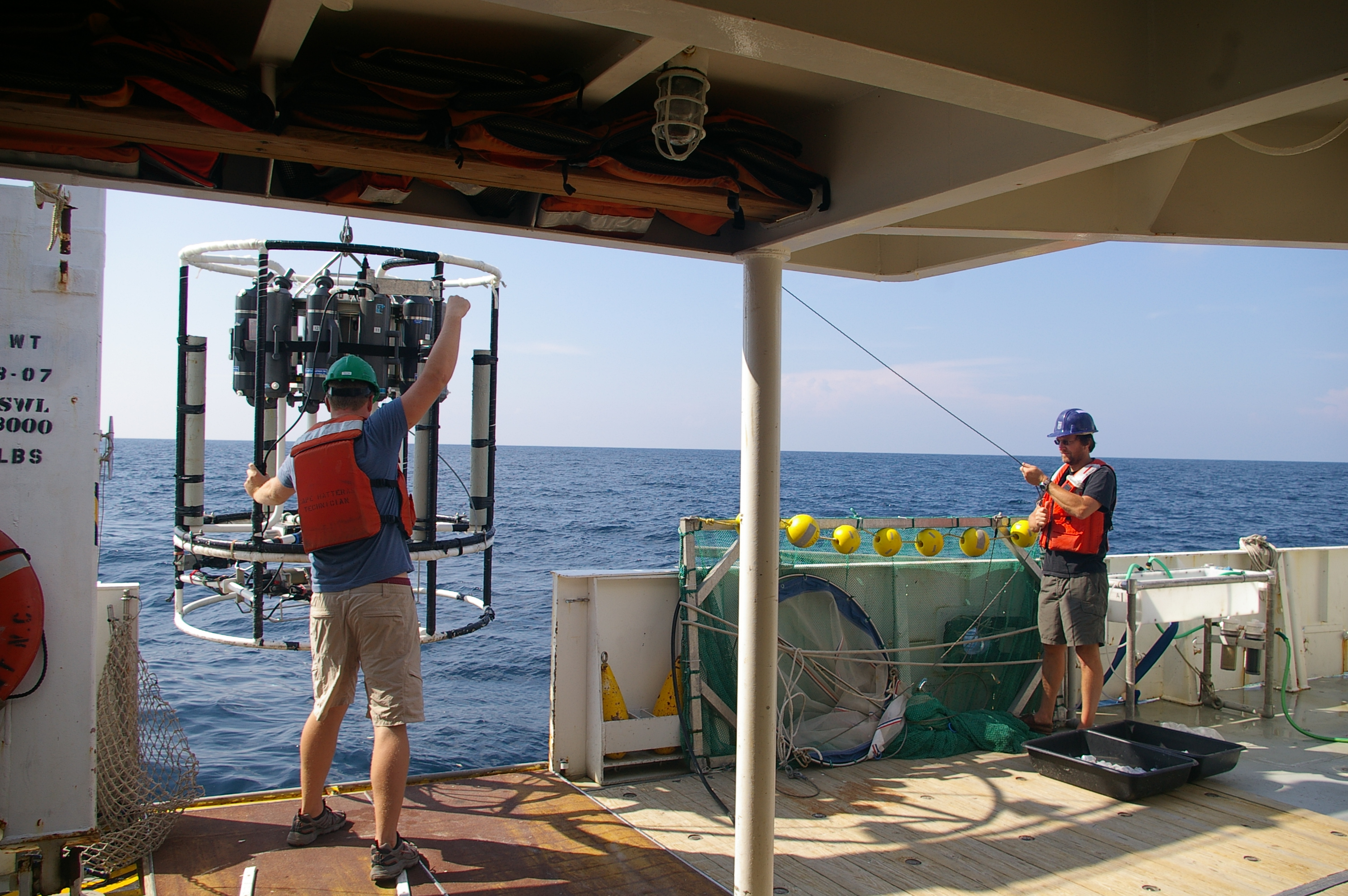
 A stormy beginning makes for a busy end. We spent the day prepping for a couple of experiments that will happen tomorrow while we’re all awake for the second round of the diel experiment. We sent a go-flow, typically used to collect data on trace minerals in the water, overboard to gracefully collect and filter seawater to be used for growth medium in an incubation experiment. It’s hard to think about treating seawater nicely, but apparently the go-flow apparatus is designed to not split any cells upon entry or exit. This ensures that the phytoplankton we’re trying to grow and measure will have the most realistic experience in their little containers as possible tomorrow.
The incubations will occur at two separate depths: 66 and 256 meters, each with two communities: whole seawater and one where the phytoplankton grazers have been filtered out by size. Afterwards, we’ll be able to get a picture of the degree of predation pressure the phytoplankton are under and how much of a control on their abundance those grazers serve.
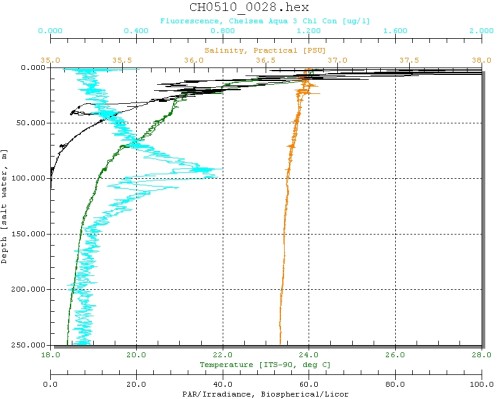
Also occurring tomorrow will be a dilution experiment, with differing concentrations of phytoplankton to get an idea if the energy created by the single-celled organisms is linearly related to their number or in any way density dependent. One might expect linearity, but density dependence could come in as simple a form as some phytoplankton blocking the sunlight of others by hanging out closer to the surface. More complicated density dependent mechanisms might occur if there’s some kind of chemical competition for space, like territorial phytoplankton. That’s a rare phenomenon in the terrestrial world, but it’s been documented among black walnut trees and certain types of grasses.
The amount of prep work required to get several experiments off the ground at once has left us busy with a long list of little tasks all day. Incidentally, that’s perfect timing for fun. Everyone’s awake and active and ready to start singing together and attempting to get annoying songs stuck in each other’s heads, for instance. Or taking pictures of awkwardly napping students taking 15 in the chair on deck while the go-flow goes to depth. Or making a mad dash for the last of the “Big Alaska” ice cream bars only to find that someone had locked the mess door.
My favorite, though, and perhaps a sign we’ve been at sea too long, is when we decided to perfect the style of sending the messenger down. The messenger is a small lead weight on a rope system that is sent from deck when the go-flow is at depth in order to close the lids and seal the water sample. Realistically, after it hits the water, gravity is the only force acting on the messenger, but the distance between the deck and the water surface is plenty of space for a style challenge in releasing the messengers. I’ll leave the rest of the imagining up to you.
~Bluegrass Blue Crab