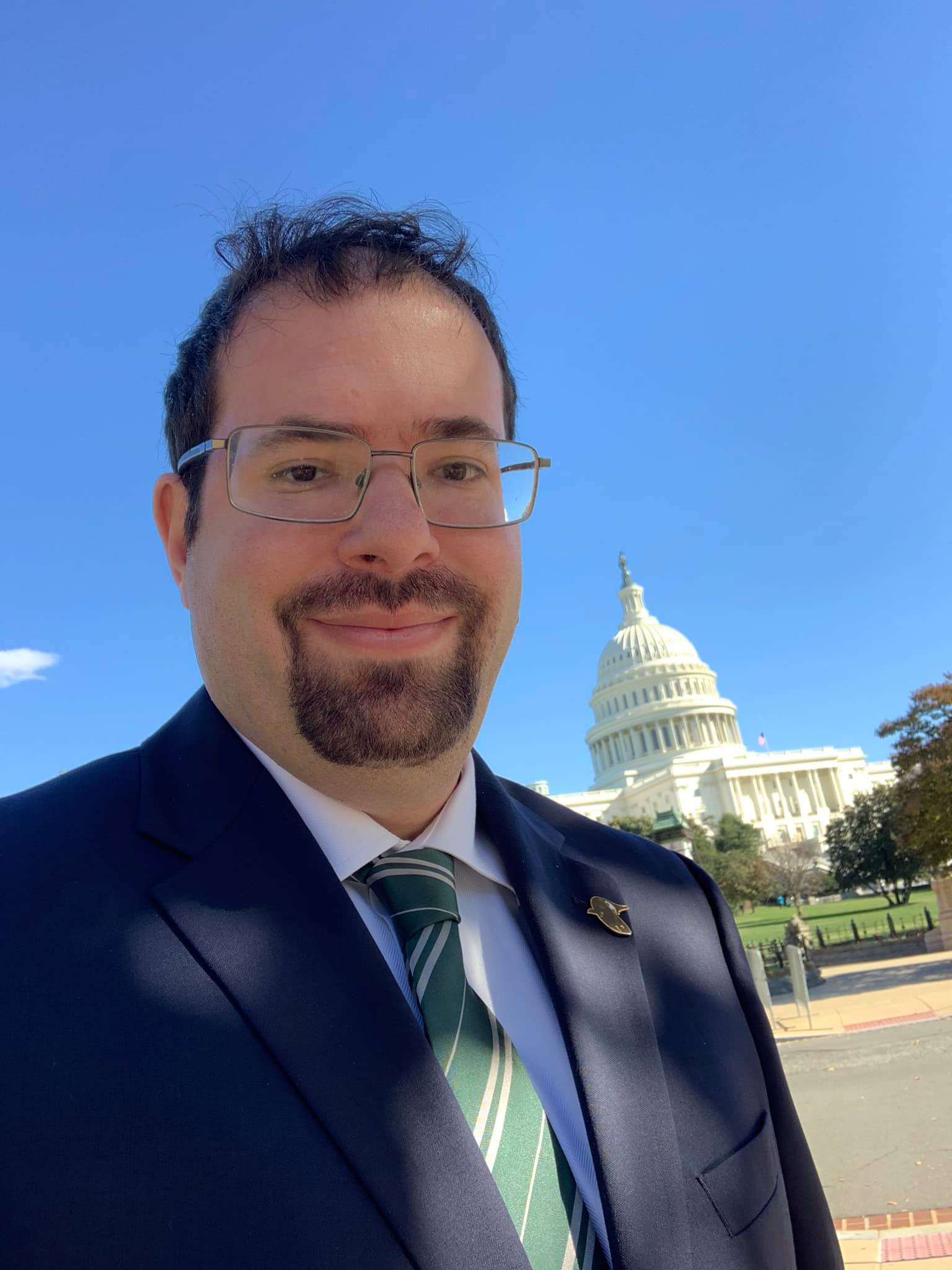
I defended my Ph.D. on April 1, 2016. Ten years later, I’m not where I thought I’d be, but I couldn’t be happier with how things turned out.
My original goals
If you had asked me on April 1, 2016 what career path I had planned after I finished graduate school, my answer would have been pretty similar to that of many graduate students. I was planning on pursuing a tenure-track faculty position at an R1 University, running my own lab and taking on graduate students of my own.
I thought I was well set-up for that career path. I had a dozen first-author peer-reviewed scientific journal articles and a dozen more coauthored publications. I had won several competitive grants and fellowships. I had served on the Board of Directors of two professional societies and had lots of other leadership and service, including helping to train and mentor dozens of field interns of the lab. I had teaching experience with stellar course evaluations. I had at least one recommendation letter from a Big Name In The Field that was glowing enough that it made my mom cry when she read it. Alas, it was not to be.
What really happened
First of all, let me recommend, as I do every year, that you not schedule a Ph.D. defense on April Fools Day. My committee had concerns about some parts of my defense and I incorrectly believed that they were joking. It was extremely unplesant. Ten years later I’m still not ready to publicly talk about all of it beyond offering this general scheduling advice to everyone.
Anyway, after grad school, I took a Postdoc position- the Liber Ero Postdoctoral Fellowship in Conservation Leadership- based in Vancouver. I loved this Postdoc and recommend it to anyone interested in conservation-relevant science and policy.
In total, over 3 years (including the last year of my Ph.D. and the two years of my Postdoc,) I applied for 57 tenure-track faculty positions, including R1’s and R3’s. I got three interviews, and one offer that I didn’t end up taking.
As the Postdoc winded down, I didn’t know where I was going next, but I knew that I needed to leave and go somewhere because my Canadian visa was tied to that time-restricted position. And while turning down the one faculty job offer I got was the toughest professional decision I’ve ever made, resulting in having to move across North America without a job offer in hand, I’m glad I made it. Simply put, that position wasn’t right for me and I would not have been happy or successful in it.
I moved to Washington, DC for two reasons. Firstly, I was a finalist for a non-academia job there that I ended up not getting, but in the process of investigating that job I realized how much I’d like living in DC. And secondly, due to shipping logistics quirks, moving all my belongings from Vancouver to Washington, DC was only slightly more expensivce than moving them just a few hours to Seattle.
After reaching out to several environmental science and policy consulting firms and environmental non-profits, I realized that my skillset was very much in demand in this space, But I also realized that I wouldn’t get to use all of it if I worked for someone else full-time. So I hung my own shingle and created David Shiffman Scientific and Environmental Consulting, INC. And I spent the six months before COVID hit and the world shut down setting up meetings with everyone in town to see what their needs were, and how I could help. I took a long series of part-time contract positions, developing my skillset and earning some desperately-needed income. And the rest is history.
Where I am now
David Shiffman Scientific and Environmental Consulting, Inc. is about to celebrate it’s seventh year of succesful operations, and I love what I do. Working a series of part-time contracts isn’t for everyone, but there are lots of perks! First and foremost, every day is a little different, which means I never, ever get bored or burned out. I get to meet amazing people all over the world, and I get to choose who I work with, and who I do not work with. And working on environmental policy issues means that sometimes the real world is measurably different at the end of a day as a result of something I did, something that is not often true working in academia.
I’ve gotten to help with state-level, national-level, and international-level ocean conservation and management isuses, and I still get to do the fun stuff including shark field research.
And, critically, I still get to teach, I still get to do research, and I still get to help train graduate students (just not as their primary advisor).
In fact, in 2025, I taught more classes than some of my colleagues who are full-time teachers, I published more research papers than some of my colleagues who are full-time researchers, and along the way I also wrote more freelance science and environment news stories than some of my colleagues who are full-time freelance journalists.
No offense to my many colleagues who have to teach the 500 student Monday-Wednesday-Friday 8 a.m. intro to bio course where hundreds of freshmen learn that they won’t be doctors after all, you’re doing important work, but I don’t enjoy teaching like that. The courses I teach now instead are upper-level electives, and I teach about topics where I’m an expert and get to choose exactly how I teach and manage the class. I love my classes, and based on course evals, the students do too.
I get to travel extensively, and that’s not just counting my now 80-city international book tour for “Why Sharks Matter.” There’s no way I could have done all of that with an R1 tenure track job, there’s not enough time or scheduling flexibility.
Amaingly, I am now finding that some of the very institutions that didn’t offer me a tenure-track job when I applied are now hiring me to train their students about non-academia career paths.
Finally, I really love the DC area. There are lots of smart, passionate, interesting people, and lots of fun stuff to do.
In short, I truly and sincerely love what I do, even though it’s not at all what I thought I’d be doing when I finished grad school.
What I learned
I’ve learned quite a few personal and professional lessons in the last decade.
First and foremost, not succeeding in your original goals does not make you a failed scientist or a failed teacher. The overwhelming majority of graduate students will not become tenure-track faculty, it’s just simple math. And many of those who don’t find a position are extremely qualified and would have done a good job. I’m very much still an educator and researcher, even as I do it through different channels than I thought I would.
Secondly, and relatedly, more schools need to do a better job teaching students about what career paths are out there and how to succeed in them. I now incorporate these lessons into every course I teach, and I’m writing a whole book about marine biology and conservation career advice. If this information had been more available to me, I would have had a lot fewer stressful days and nights.
Thirdly, don’t take a job where you’d be miserable just because it’s a job and you need one of those. There’s no shame in doing something for a while just to build out your skillset or earn some income, but if you’d be miserable doing something, do something else.
Finally, find your people. I would not have been able to make this pivot, or be successful in my alt-academic hybrid career path, if not for advice and support from friends, colleagues, and mentors. I’ll always be grateful and will always do my best to pay it forward.