
Skip to content

Southern Fried Science

Over 15 years of ocean science and conservation online

  • Home
  • About SFS
  • Authors
  • Support SFS

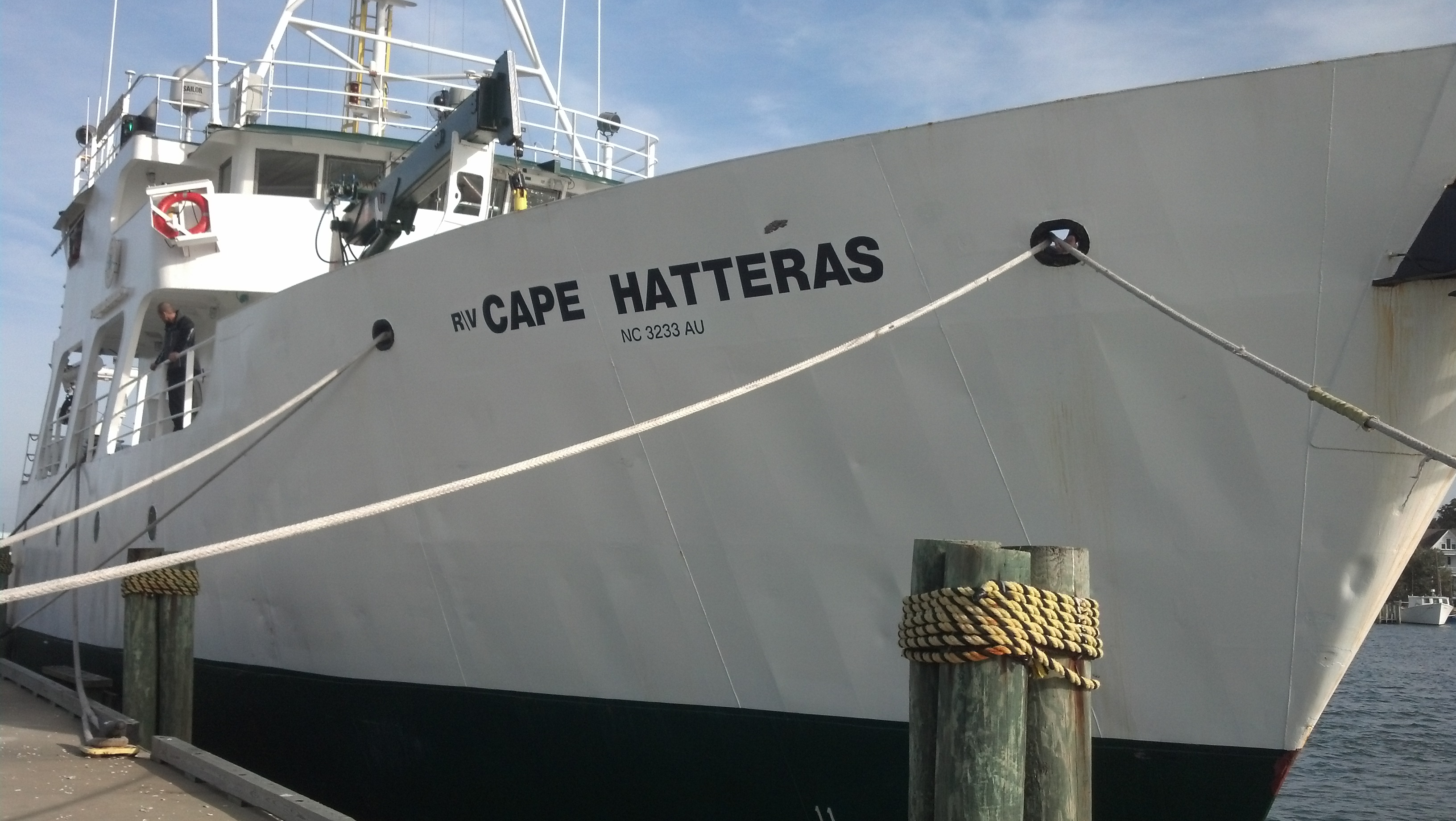
Saying goodbye to an old friend: The R/V Cape Hatteras returns home from her final voyage

Posted on January 30, 2013 By Andrew Thaler
Science
The R/V Cape Hatteras. Photo by Andrew David Thaler.

AndrewThumbAt 0930, January 30, 2013, the research vessel Cape Hatteras made her final voyage through the Beaufort Inlet to dock at Pivers Island. The Cape Hatteras served as the flagship of the Duke/University of North Carolina Oceanographic Consortium for 31 years. During that time she logged more than 5000 days at sea over the course of hundreds of research cruises.

In a period where science funding for oceanographic research is at an all time low, the decommissioning of the Cape Hatteras represents a significant loss to America’s research capacity. The Hatteras is the only regional class research vessel on the eastern seaboard south of Delaware. She served a region ranging from the mid-Atlantic to the Gulf of Mexico and as far east as Bermuda. She can handle equipment as simple as a box core or trawl or as sophisticated as the ROV Nereus.

In my time at Duke, I participated in two cruises aboard the Hatteras. One is described in my most personal blog post: The Importance of Failure in Graduate Student Training. My co-blogger, Amy, dedicated an entire series to her adventures aboard the Cape Hatteras in the Sargasso Sea.

The Hatteras is only one of several research vessels that have been decommissioned in recent years. She joins the R/V Seward-Johnson (and the Johnson Sea Links), the R/V Point Lobos, the R/V Zephyr, the Albatross IV, and numerous coastal and near-shore research vessels. While new, privately funded ships, like the R/V Falcor, have recently entered service, the loss of so many publicly funded vessels is a major blow to scientific research. The folks at Deep Sea News put out a call for an oceanic equivalent of NASA to meet the United States scientific needs.

The Hatteras was more than just another research vessel, she was a home to many and a symbol of pride for Carteret County. It is estimated that she contributed more than $4 million a year to North Carolina’s economy. Beyond that, she was a friend.

This morning, the Beaufort community came together to welcome the Hatteras back from her final voyage.

httpv://www.youtube.com/watch?v=YlV56jkkh0g

Share this:

  • Share on Bluesky (Opens in new window) Bluesky
  • Share on Facebook (Opens in new window) Facebook
  • Share on Reddit (Opens in new window) Reddit
  • Share on Threads (Opens in new window) Threads
  • Share on WhatsApp (Opens in new window) WhatsApp
  • Share on Mastodon (Opens in new window) Mastodon

Related

Tags: bagpipes Cape Hatteras farewell

Post navigation

❮ Previous Post: Know Your Fishermen as well as your Farmer
Next Post: Inaugural Post: Fishermen Are Not Evil ❯

You may also like

Uncategorized
Dipping a Toe in the Confluence
March 17, 2015

Popular Posts

What Ocean Ramsey does is not shark science or conservation: some brief thoughts on "the Shark Whisperer" documentaryWhat Ocean Ramsey does is not shark science or conservation: some brief thoughts on "the Shark Whisperer" documentaryJuly 2, 2025David Shiffman
Zombie ideas in conservation: trophy hunting and conservationZombie ideas in conservation: trophy hunting and conservationAugust 6, 2026Ali Gaster
What is a Sand Shark?What is a Sand Shark?November 12, 2017Chuck Bangley
Ten very bad, no good things the latest Trump Administration has done to the oceansTen very bad, no good things the latest Trump Administration has done to the oceansAugust 14, 2026Ali Gaster
Shark of Darkness: Wrath of Submarine is a fake documentaryShark of Darkness: Wrath of Submarine is a fake documentaryAugust 10, 2014Michelle Jewell
Is Academic Publishing is breaking conservation science?Is Academic Publishing is breaking conservation science?August 10, 2026Chris Parsons
How the Bluespotted Ribbontail Stingray got its SpotsHow the Bluespotted Ribbontail Stingray got its SpotsMarch 28, 2024David Shiffman
These are the 10 most-cited shark science papers of all timeThese are the 10 most-cited shark science papers of all timeApril 24, 2025David Shiffman
That's not a blobfish: Deep Sea Social Media is Flooded by AI SlopThat's not a blobfish: Deep Sea Social Media is Flooded by AI SlopDecember 19, 2025Andrew Thaler
Emergency room conservation: why waiting for the Endangered Species Act to save a species is a fiscal disasterEmergency room conservation: why waiting for the Endangered Species Act to save a species is a fiscal disasterAugust 11, 2026Ali Gaster
Subscribe to our RSS Feed for updates whenever new articles are published.

We recommend Feedly for RSS management. It's like Google Reader, except it still exists.

Southern Fried Science

  • Home
  • About SFS
  • Authors
  • Support SFS


If you enjoy Southern Fried Science, consider contributing to our Patreon campaign.

Copyright © 2026 Southern Fried Science.

Theme: Oceanly Premium by ScriptsTown