Skip to content

Southern Fried Science

Over 15 years of ocean science and conservation online

  • Home
  • About SFS
  • Authors
  • Support SFS

Scientists deploy satellite tags on rarely studied sawsharks for the first time

Posted on March 23, 2017March 23, 2017 By David Shiffman
Science

An Australian research expedition has successfully deployed three satellite telemetry tags on sawsharks for the first time! These rarely-seen sharks have a toothy rostrum similar to a sawfish, but are true sharks while sawfish are rays. Sawshark rostrums also have sensory barbels, unlike the rostrums of sawfish. “This is actually a good example of convergent evolution where two distantly related species have adaptations that have converged to be very similar in looks and (purportedly) function,”said professor Jane Williamson, the head of the Marine Ecology Group at Macquarie University and the leader of this expedition. “Sawsharks probably use their rostrum in a similar manner to sawfish: as a tool for sensing and capturing prey, and possibly for self-defense.”
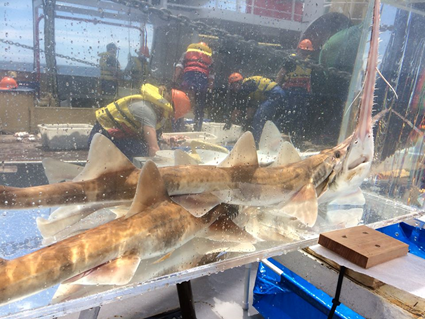
Temporarily-held sawsharks P. cirratus on the R/V Bluefin. Photo credit: Jane Williamson


Professor Williamson’s research focuses on two of Australia’s three endemic sawshark species: the common sawshark Pristophorus cirratus and the southern sawshark P. nudipinnis. “Sawsharks are very difficult to study as they occur in waters 500m+ depth,” she said. “We don’t have much idea how far these animals travel, and thus not much clarity as to whether there are particular pupping grounds, seasonal movement, or how animals utilize particular habitats.”

While satellite telemetry tags are an important and commonly-used tool in marine ecology, the biology and behavior of sawsharks makes their use challenging in this case. “These animals don’t ever come to the surface, so we are unable to glean regular pings of data as you would in other species of sharks,” Professor Williamson said. “The tags were also difficult to build as our sawsharks are slender and weigh, on average, only 2-3 kg.”
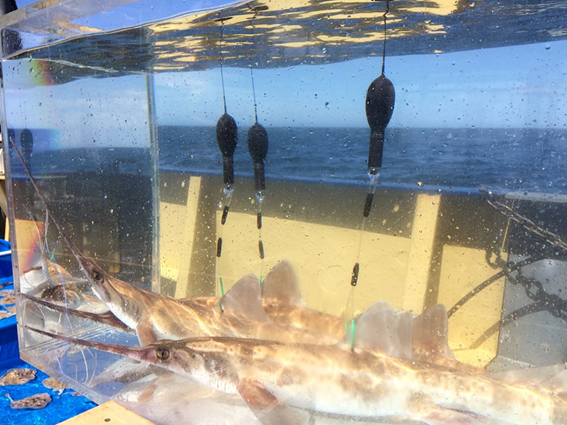
Satellite tags attached to the sawsharks. Photo credit: Jane Williamson

So far, the research team has received data from one of the three tagged sawsharks. It moved approximately 300 kilometers from its tagging location over the course of about a month. The popped-off satellite tag also contains lots of other data, which the team has not yet analyzed. If the results of this pilot study show that satellite tags can successfully be deployed on sawsharks, Professor Williamson hopes to expand it to a much larger scale. To our knowledge this is the first time that satellite tagging has been tried on any sawshark species, and information gained will be extremely valuable to the conservation and management of these species,” she said.
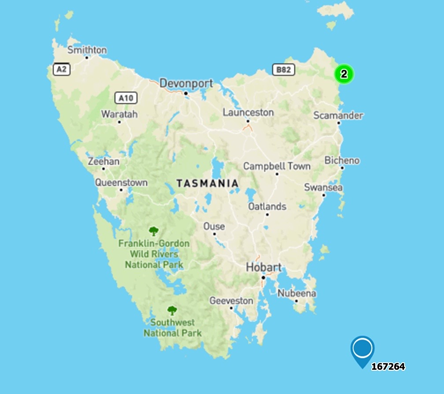
Tagging location (green) and detection location 33 days later (blue).

Other recent research published by this team includes a look at identifying sawshark species once fishermen remove their heads and a look at the trophic ecology of these species. Professor Williamson is looking for a Ph.D. student to help research these amazing animals, and invites candidates to contact her directly. You can follow Professor Williamson and her research on twitter here.


Share this:

  • Click to share on Bluesky (Opens in new window) Bluesky
  • Click to share on Facebook (Opens in new window) Facebook
  • Click to share on Reddit (Opens in new window) Reddit
  • Click to share on Threads (Opens in new window) Threads
  • Click to share on WhatsApp (Opens in new window) WhatsApp
  • Click to share on Mastodon (Opens in new window) Mastodon

Related

Tags: jane williamson satellite telemetry sawsharks

Post navigation

❮ Previous Post: “When we left the beach…” Monday Morning Salvage: March 20, 2017
Next Post: Thursday Afternoon Dredging: March 23, 2017 ❯

Popular Posts

Shark scientists want their research to help save threatened species, but don’t know how. Our new paper can help.Shark scientists want their research to help save threatened species, but don’t know how. Our new paper can help.December 1, 2025David Shiffman
Norway and Cook Islands put their deep-sea mining plans on pause.Norway and Cook Islands put their deep-sea mining plans on pause.December 3, 2025Andrew Thaler
What Ocean Ramsey does is not shark science or conservation: some brief thoughts on "the Shark Whisperer" documentaryWhat Ocean Ramsey does is not shark science or conservation: some brief thoughts on "the Shark Whisperer" documentaryJuly 2, 2025David Shiffman
The Trouble with Teacup PigsThe Trouble with Teacup PigsOctober 14, 2012Andrew Thaler
2025: My year in writing, public speaking, and media interviews2025: My year in writing, public speaking, and media interviewsDecember 3, 2025David Shiffman
What we know we don't know: impacts of deep-sea mining on whales, dolphins, sharks, turtles, and other migratory species.What we know we don't know: impacts of deep-sea mining on whales, dolphins, sharks, turtles, and other migratory species.November 20, 2025Andrew Thaler
Urea and Shark OsmoregulationUrea and Shark OsmoregulationNovember 15, 2010David Shiffman
Shark of Darkness: Wrath of Submarine is a fake documentaryShark of Darkness: Wrath of Submarine is a fake documentaryAugust 10, 2014Michelle Jewell
How tiny satellites are tracking marine wildlifeDecember 1, 2025Andrew Thaler
Build a dirt cheap, tough-as-nails field computer in a Pelican caseBuild a dirt cheap, tough-as-nails field computer in a Pelican caseJuly 21, 2015Andrew Thaler
Subscribe to our RSS Feed for updates whenever new articles are published.

We recommend Feedly for RSS management. It's like Google Reader, except it still exists.

Southern Fried Science

  • Home
  • About SFS
  • Authors
  • Support SFS


If you enjoy Southern Fried Science, consider contributing to our Patreon campaign.

Copyright © 2025 Southern Fried Science.

Theme: Oceanly Premium by ScriptsTown