Skip to content

Southern Fried Science

Over 15 years of ocean science and conservation online

  • Home
  • About SFS
  • Authors
  • Support SFS

Tag: Pamlico Sound

Is a Changing Environment Bringing Baby Bull Sharks to North Carolina?

Posted on April 16, 2018April 16, 2018 By Chuck Bangley 4 Comments on Is a Changing Environment Bringing Baby Bull Sharks to North Carolina?
Climate change

Marine environments are typically considered more open than those on land when it comes to animal movement. On land, the range of a species can be limited by geographic features like mountain ranges, canyons, rivers, and anything else that might get in the way. In the ocean, however, actively swimming animals like, say, large sharks have few physical barriers and may instead be restricted by their own environmental preferences. This is why in unusually warm summers you might see tropical fishes in southern New England. Because of this, one of the anticipated consequences of warming ocean temperatures is shifting distributions of mobile and highly migratory species. Basically, changes in temperature are likely to allow marine animals to move into places they haven’t before, and if those temperature changes become consistent, these species might make regular visits or even just start staying there.

This kind of change is already happening and has been documented across a variety of marine species. Now, findings from a new paper in Scientific Reports by me and co-authors from the North Carolina Division of Marine Fisheries, Simon Fraser University, and East Carolina University show an apex predator may be joining the northward shift.
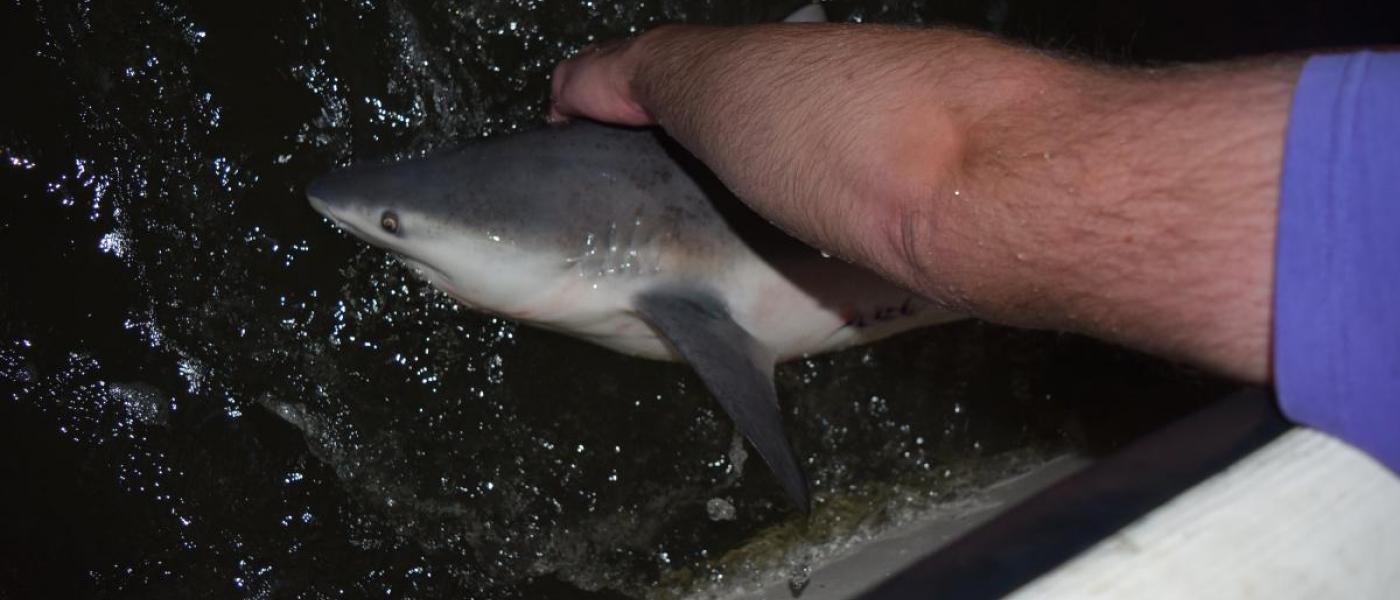
Juvenile Bull Shark captured in Pamlico Sound, North Carolina. Photo from the Smithsonian Environmental Research Center.

Read More “Is a Changing Environment Bringing Baby Bull Sharks to North Carolina?” »
America’s Second-Largest Estuary is a Lagoon Full of Sharks

Posted on April 12, 2018April 15, 2018 By Chuck Bangley 5 Comments on America’s Second-Largest Estuary is a Lagoon Full of Sharks
Uncategorized
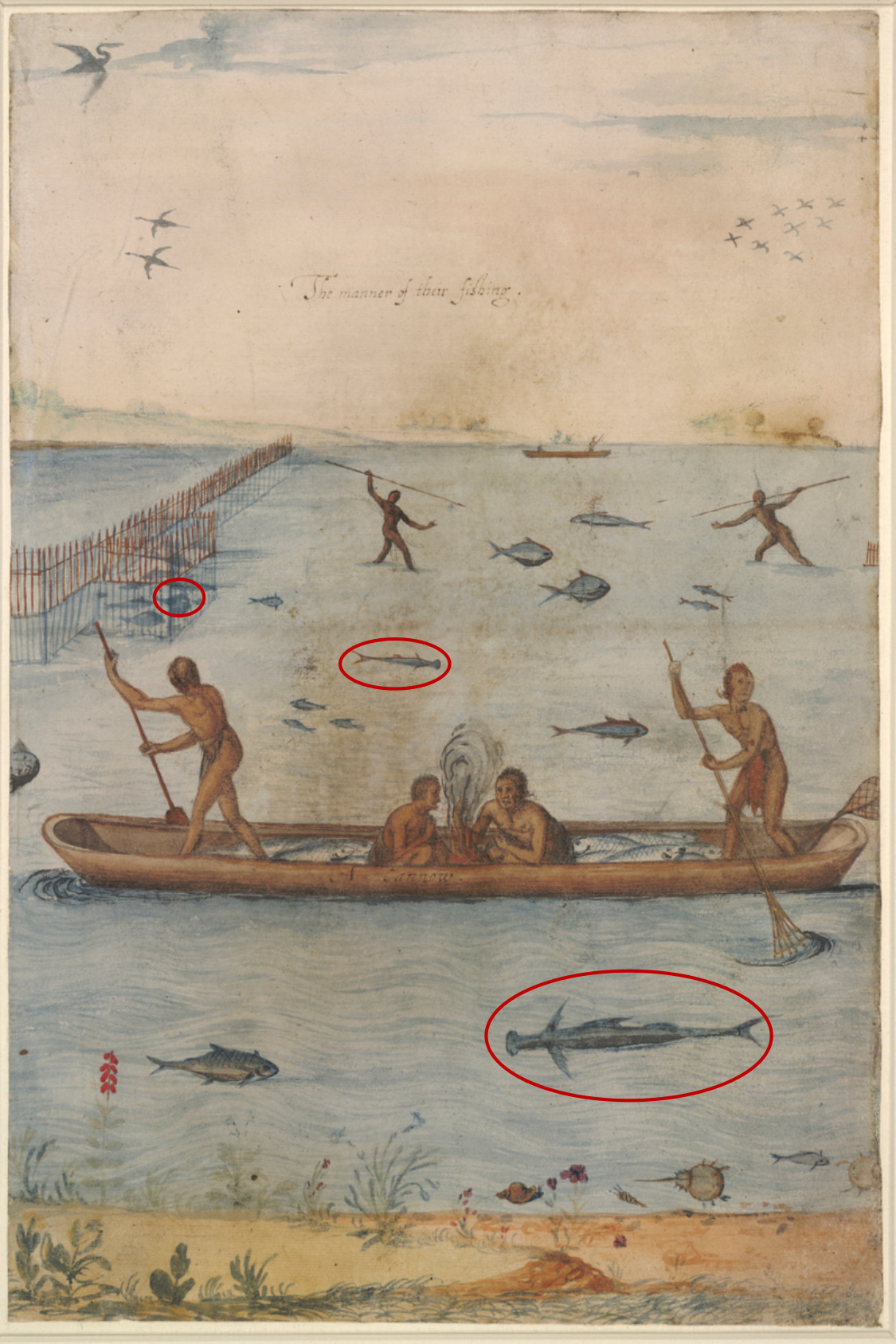
I’ve defaced this colonial-era image of Native American fishing methods from Roanoke Island, NC to show that sharks have been observed in North Carolina’s estuaries for quite some time. Original art: “The Manner of Their Fishing” by John White.

It’s a bit of a cliché to reference the movie Jaws when talking about sharks, but I’m going to do it anyway. There’s a pivotal scene where the giant White Shark is spotted moving into a salt pond, where it proceeds to terrorize the children of protagonist Chief Martin Brody. While no sharks are in the business of regularly eating humans, at least part of this scene is realistic: sharks do make use of inshore, estuarine environments like lagoons, bays, and the lower portions of rivers. Despite the fact that sharks are generally thought to stay out in the ocean, many species are not only comfortable entering estuaries, they actually depend on them. Some species make extensive use of estuaries as shelter from predators and/or a place to grab a bite themselves.

So it should come as no surprise that North Carolina’s Pamlico Sound, part of the Albemarle-Pamlico estuary (the second-largest in the continental U.S. after Chesapeake Bay) offers a lot of potential real estate for sharks. Unlike Chesapeake Bay, Pamlico Sound is a lagoon, which means it’s wide, shallow, mostly water, and connected to the ocean via fairly small inlets between barrier islands. It straddles the transition zone marked by Cape Hatteras between temperate and subtropical marine ecosystems, and the amount of seagrass growth there is second only to Florida in sheer area. This estuary is already well-known for its importance as habitat for such varied (as well as tasty and/or fun to catch) species as Blue Crab, Penaeid shrimps, Flounder, and Red Drum. However, the sharks of Pamlico Sound have mostly been known by scattered reports and sightings from fishermen. That is, until my co-authors and I were able to look through a nice data set to get an idea of which sharks are present in the sound and where in the estuary they might like to be. The results are now published in PLOS One, and here’s a quick summary of how we got them.

Read More “America’s Second-Largest Estuary is a Lagoon Full of Sharks” »

Popular Posts

Shark scientists want their research to help save threatened species, but don’t know how. Our new paper can help.Shark scientists want their research to help save threatened species, but don’t know how. Our new paper can help.December 1, 2025David Shiffman
Norway and Cook Islands put their deep-sea mining plans on pause.Norway and Cook Islands put their deep-sea mining plans on pause.December 3, 2025Andrew Thaler
What Ocean Ramsey does is not shark science or conservation: some brief thoughts on "the Shark Whisperer" documentaryWhat Ocean Ramsey does is not shark science or conservation: some brief thoughts on "the Shark Whisperer" documentaryJuly 2, 2025David Shiffman
What we know we don't know: impacts of deep-sea mining on whales, dolphins, sharks, turtles, and other migratory species.What we know we don't know: impacts of deep-sea mining on whales, dolphins, sharks, turtles, and other migratory species.November 20, 2025Andrew Thaler
2025: My year in writing, public speaking, and media interviews2025: My year in writing, public speaking, and media interviewsDecember 3, 2025David Shiffman
The Trouble with Teacup PigsThe Trouble with Teacup PigsOctober 14, 2012Andrew Thaler
Urea and Shark OsmoregulationUrea and Shark OsmoregulationNovember 15, 2010David Shiffman
How tiny satellites are tracking marine wildlifeDecember 1, 2025Andrew Thaler
Shark of Darkness: Wrath of Submarine is a fake documentaryShark of Darkness: Wrath of Submarine is a fake documentaryAugust 10, 2014Michelle Jewell
Quick Tips for Graduate Student Life - Write a Book ReviewJanuary 23, 2014Andrew Thaler
Subscribe to our RSS Feed for updates whenever new articles are published.

We recommend Feedly for RSS management. It's like Google Reader, except it still exists.

Southern Fried Science

  • Home
  • About SFS
  • Authors
  • Support SFS


If you enjoy Southern Fried Science, consider contributing to our Patreon campaign.

Copyright © 2025 Southern Fried Science.

Theme: Oceanly Premium by ScriptsTown