Skip to content

Southern Fried Science

Over 15 years of ocean science and conservation online

  • Home
  • About SFS
  • Authors
  • Support SFS

Tag: shark conservation

37 things I learned about shark ecology and conservation for my dissertation

Posted on December 12, 2016August 24, 2017 By David Shiffman 5 Comments on 37 things I learned about shark ecology and conservation for my dissertation
Conservation, Science
The fam attending my dissertation defense

After a little more than 5 years of hard work, I’ve officially completed my Ph.D.! You can read my dissertation (“An Integrative and Interdisciplinary Approach to Shark Conservation: Policy Solutions, Ecosystem Role, and Stakeholder Attitudes”) online here in its entirety.

In case there are some among you who don’t really want to read a 281 page dissertation but are curious about what I found, I’ve prepared this blog post to summarize my key conclusions. (Note: this does not include every conclusion. Some are aggregated together, and some more technical conclusions are omitted for this summary).

Read More “37 things I learned about shark ecology and conservation for my dissertation” »
Fun Science FRIEDay – Shark Daycare

Posted on September 2, 2016September 2, 2016 By Kersey Sturdivant 3 Comments on Fun Science FRIEDay – Shark Daycare
Conservation, Uncategorized

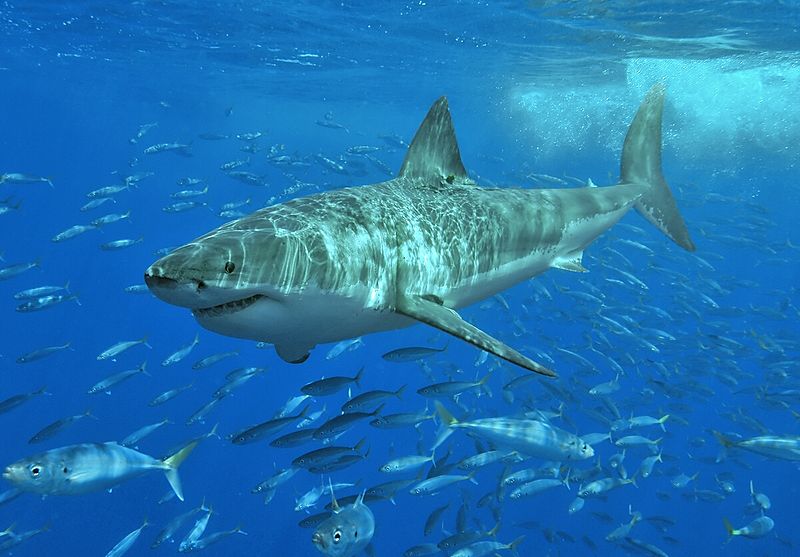
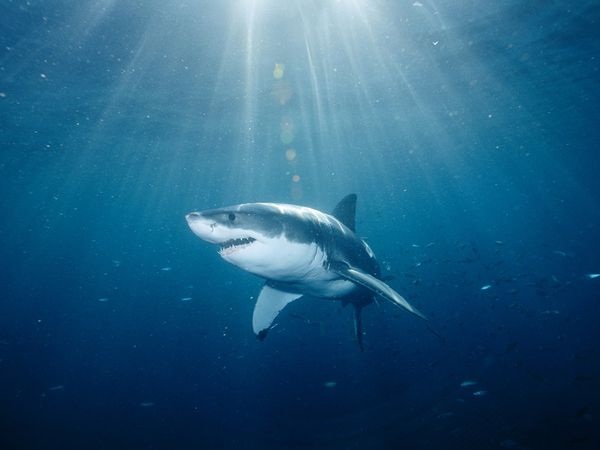
A great white shark nursery in the North Atlantic that was discovered in 1985 south of Cape Cod in the waters off Montauk, New York  has received renewed attention due to the increased activity of white sharks off cape cod in recent years. The nursery was first documented in 1985 by Casey and Pratt who deduced the presence of a nursery based on the number of juvenile sightings and landings in the area. This work was followed up recently  by OCEARCH (an organization dedicated to generating scientific data related to tracking/telemetry and biological studies of keystone marine species such as great white sharks), which tagged and tracked nine infant great whites to the nursery, located a few miles off Montauk.

Great White Shark. Image courtesy animals.NationalGeographic.com
Photo of a great white shark in Mexico by Terry Goss, WikiMedia Commons. http://commons.wikimedia.org/wiki/File:White_shark.jpg


Read More “Fun Science FRIEDay – Shark Daycare” »

What can be done to protect the incredibly long-lived Greenland shark?

Posted on August 16, 2016August 17, 2016 By Guest Writer 1 Comment on What can be done to protect the incredibly long-lived Greenland shark?
Science
Sonja Fordham President, Shark Advocates International
Sonja Fordham
President, Shark Advocates International

Sonja Fordham founded Shark Advocates International as a project of The Ocean Foundation in 2010 based on her two decades of shark conservation experience at  Ocean Conservancy.  She is Deputy Chair of the IUCN Shark Specialist Group and Conservation Committee Chair for the American Elasmobranch Society, has co-authored numerous publications on shark fisheries management, and serves on most of the U.S. federal and state government advisory panels relevant to sharks and rays.  Her awards include the U.S. Department of Commerce Environmental Hero Award, the Peter Benchley Shark Conservation Award, and the IUCN Harry Messel Award for Conservation Leadership.

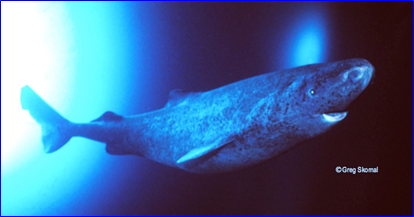
1A new study confirming the mysterious deepsea Greenland Shark as the world’s longest lived vertebrate has made huge news in the last few days – from Science News and BBC to People magazine and the Wall Street Journal. While some scientists are questioning whether these sharks live quite as long as estimated (392 years ± 120), most agree they could well live for a century or two and – as a result —  are particularly vulnerable to overfishing. Experts also warn that risks to Greenland sharks may be increasing as melting sea ice changes Arctic ecosystems and makes fishing in the region more feasible. Study authors are among those urging a precautionary approach to the species’ conservation. In other words, an incomplete picture of status and threats should not be used as an excuse for inaction. So what might be threatening Greenland sharks today, and which upcoming policy opportunities might warrant consideration, given worldwide interest in these jaw-dropping findings?  To come up with some ideas, I first took a look back.

Read More “What can be done to protect the incredibly long-lived Greenland shark?” »

Does Shark Week portrayal of sharks matter?

Posted on June 29, 2015July 3, 2015 By David Shiffman 6 Comments on Does Shark Week portrayal of sharks matter?
Blogging, Popular Culture, Science

sharkI’ve been critical of factual inaccuracy and fearmongering on Shark Week documentaries for years. But how big of a problem is this, and how do we know? I asked some of the authors of three recent scientific studies*  to summarize the evidence.

Many species of sharks are in desperate need of conservation. Twenty-four percent of all known species of sharks, skates and rays are considered Threatened with extinction by the IUCN Red List. Using a variety of different methods, scientists have documented rapid and severe population declines in many species of sharks all over the world.

Conservation requires public support. In a participatory democracy, new policies and regulations require some public support to pass. It’s easy to get public support to conserve cute and cuddly animals, but ugly animals need protection too. So do animals that scare people, like sharks.

Read More “Does Shark Week portrayal of sharks matter?” »

Bigger than just conservation: The WWF Pacific Shark Heritage Program

Posted on September 17, 2014 By Guest Writer 2 Comments on Bigger than just conservation: The WWF Pacific Shark Heritage Program
Conservation, Science

IanIan Campbell has spent his entire career employed across the spectrum of fisheries science and policy, working as a marine surveyor, a fisheries observer and writing fisheries policy for the UK & European governments. He even spent several years as a commercial diver working on oil rigs and for the film industry. Ian is currently leading WWF’s global shark management work. You can follow him on twitter @IanFisheries , and follow the WWF campaign @WWF_sharks.

On September 2, in a back room on the campus of the Secretariat of the Pacific Regional Environment Programme (SPREP), on the small island of Samoa, we at the environment conservation non-government organisation, World Wide Fund for Nature WWF quietly launched our Pacific Shark Heritage Programme. This launch was incorporated into the bigger, much flashier United Nations meeting on Small Island Developing States (SIDS), where the United Nations Secretary General Ban Ki Moon spoke of partnerships, conservation of the oceans’ resources and responsible stewardship. There were meetings of Heads of State & UN officials, the World Bank and Ambassadors, with lots of “high-level statements” and “roadmaps for the future of the oceans” announced at champagne & canapé receptions. Yet, we believe, it was our unheralded meeting in the SPREP’s training centre (tea & coffee were provided), that could have the biggest impact on sharks (and rays, rays need love too) and Pacific Island culture.

There are two major components to WWF’s work in the Pacific. The first is to highlight how intrinsically linked sharks and rays are to the many diverse cultures of the Pacific Island nations. We have documented apocryphal tales, fable and legends that have been passed down from generation to generation over hundreds, if not thousands of years. Tales that have been told in villages and communities ever since people have inhabited these islands. And contained in these stories are some truly remarkable accounts of love, war, marriage advice and even a bit of shark taxonomy. Did you know, for example, that in the Cook Islands, a kindly shark gave Ina, the Fairy Voyager a lift across the ocean to be with her fiancé Tinarau, the God of the Ocean? Ina took with her coconuts to ensure she didn’t die of thirst, but no way of opening them (you always forget something, right?). Ina tried to break the coconut on the shark’s head, which resulted in the hammerhead getting its’ distinctive shape. So there’s a taxonomic question answered. It may be a fable, but it’s still as accurate as some recent Shark Week documentaries. On the beautiful island of Taveuni in Fiji, villagers and school children still speak of Dakuwaqa, the shark god, a ferocious warrior who actually protects the islanders. At the SIDS conference there are carvings and murals of Samoan shark legends everywhere, some selling for up to $40,000 (US). In Pacific Island countries, sharks are everywhere and everyone knows about sharks. At WWF, we know we need to keep this history alive.

Read More “Bigger than just conservation: The WWF Pacific Shark Heritage Program” »

5 simple things you can do to improve U.S. shark and ray management

Posted on August 16, 2014 By Guest Writer
Science
Sonja Fordham President, Shark Advocates International
Sonja Fordham
President, Shark Advocates International

Sonja Fordham founded Shark Advocates International as a project of The Ocean Foundation in 2010 based on her two decades of shark conservation experience at  Ocean Conservancy.  She is Deputy Chair of the IUCN Shark Specialist Group and Conservation Committee Chair for the American Elasmobranch Society, has co-authored numerous publications on shark fisheries management, and serves on most of the U.S. federal and state government advisory panels relevant to sharks and rays.  Her awards include the U.S. Department of Commerce Environmental Hero Award, the Peter Benchley Shark Conservation Award, and the IUCN Harry Messel Award for Conservation Leadership.

Most Americans by now must know it’s Shark Week, but did you know that the Discovery Channel headquarters are mere steps from the headquarters of the National Marine Fisheries Service (NMFS), and that right now — and rather often — fishery managers in that NMFS building are soliciting comments on US shark fishing rules?

Photo by Sonja Fordham

Shark Week is winding down just as several key opportunities to help US sharks are being announced. Aside from controversy over some programming, other shows, the associated press coverage, and the veritable social media frenzy have sparked a lot of concern for sharks, and sent many Americans on a hunt for things that they can do to help. I welcome that interest and am taking the opportunity to make a plea for some unique, hand-crafted comments and personalized testimony about timely policies for several particularly deserving Atlantic shark and ray species.

Taking these actions won’t be quite as easy as pushing a button on an automatic petition, but I believe – because of the relatively low profile of these species and the increased influence of original comments – that they can truly make a difference. If heeded, your advice can lead not only to better conservation of US shark and ray species, but also to better examples for other countries to follow. Here goes (see the hyperlinks for more information and contact details):

Read More “5 simple things you can do to improve U.S. shark and ray management” »

First systematic threat analysis reveals that 1/4 of sharks, rays, and chimaeras are threatened with extinction

Posted on January 21, 2014 By David Shiffman
Conservation, Science

It took a team of over 300 scientists nearly two decades, but the first systematic analysis of the conservation status of chondrichthyans (sharks, rays and chimaeras) has been completed. The results, published today (open access) in a paper titled “Extinction risk and conservation of the world’s sharks and rays,” are chilling.

“Our unprecedented analysis shows that sharks and their relatives – which make up one of the earth’s oldest and most ecologically diverse groups of animals  —  are facing an alarmingly elevated risk of extinction,” said Dr. Nick Dulvy, IUCN SSG Co-Chair and Professor at Simon Fraser University in British Columbia.

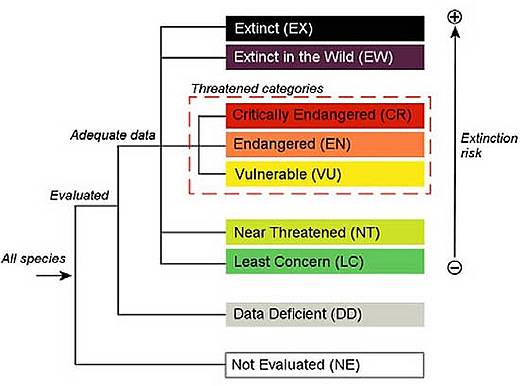
As of the writing of this paper, the IUCN Shark Specialist Group recognized 1,041 species of chondrichthyans. However,  a new species is described, on average, every two or three weeks! Out of these 1,041 species of chondrichthyans, approximately one in four are considered “Threatened” by IUCN Red List criteria;  113 species are Vulnerable, 43 are Endangered, and 25 species are Critically Endangered. 487 species are considered Data Deficient, but the IUCN Shark Specialist Group estimates that 68 of them are likely to be Threatened as well! Most alarmingly, only 23% of known chondrichthyan species are considered Least Concern, the lowest percentage out of any group of vertebrates on land or sea!

A hierarchy of IUCN Red List categories. Note that "Threatened" includes Vulnerable, Endangered, and Critically Endangered
A hierarchy of IUCN Red List categories. Note that “Threatened” includes Vulnerable, Endangered, and Critically Endangered

One of the two main factors influencing Threatened status is the size of the animal. Larger bodied species are sensitive to overfishing because they typically have a life history with slow growth, late age at maturity, and relatively few offspring. Additionally, living in coastal habitats (in other words, close to humans) makes a species more likely to be Threatened.

Read More “First systematic threat analysis reveals that 1/4 of sharks, rays, and chimaeras are threatened with extinction” »

3 sharks that were on twitter before being a shark on twitter was cool

Posted on January 3, 2014January 15, 2014 By David Shiffman 3 Comments on 3 sharks that were on twitter before being a shark on twitter was cool
Science

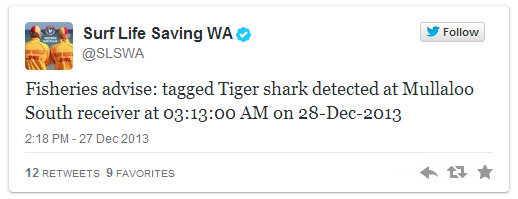
Recent plans in Western Australia to place acoustic tags in sharks and have them tweet their location when they approach a beach have resulted in a sharknado of media coverage. The plan has been covered by internet technology news giant Mashable, Fox News, NPR news, Popular Science, and NBC news (which, with “sharks with frickin’ tweets,” has what I believe to be the best headline. That one also interviews me.) When a tagged shark approaches the beach, a tweet like this results:

tweet


I can understand why a project involving both sharks and twitter caught the media’s eye… and why about a billion of you e-mailed or tweeted the news to me. However, these aren’t the first sharks to be on twitter!

Read More “3 sharks that were on twitter before being a shark on twitter was cool” »

13 amazing things scientists discovered about sharks in 2013

Posted on December 28, 2013December 30, 2013 By David Shiffman 5 Comments on 13 amazing things scientists discovered about sharks in 2013
Conservation, Science

Other than a certain week in August whose name we shall not speak here, 2013 was a great year for both shark science and the communication of that shark science. There were many important and fascinating discoveries, and many of the world’s top media outlets covered them. Presented here is a list of 13 amazing scientific discoveries made in 2013, in no particular ranking order. To make the list, research must have been published in a peer-reviewed scientific journal in 2013, and someone else other than me must have also thought it was awesome (i.e. it received mainstream media or blog coverage). In the interest of objectivity, I did not include any papers that I or my lab were directly involved with. Whenever possible, I’ve linked to an accessible version of the paper.


1) A two-headed bull shark!

From Wagner et al. 2013


Citation: Wagner, CM, Rice, PH, and Pease, AP 2013. First record of dicephalia in a bull shark Carcharhinus leucas foetus from the Gulf of Mexico. Journal of Fish Biology 82: 1419-1422.

Brief description: Researchers presented the first case of a bull shark embryo with 2 heads (the mother was caught by a Florida fishermen). In response to the most common question I received about this study, no, this animal would not have survived to adulthood.  While this is a cool discovery, the broader significance is somewhat minimal. As I told science writer Douglas Main in an interview about a similar study, “There have been a number of reports of deformed shark and ray embryos in recent years— two heads, one eye, etc. There’s no evidence to suggest these defects represent a new phenomenon or that they are harmful to shark populations as a whole.”

Media coverage highlights: A figure from this study was named one of the coolest science photos of the year by the International Science Times. It was also covered by National Geographic, the Guardian, and TIME magazine.

Read More “13 amazing things scientists discovered about sharks in 2013” »

A Shark Week 2013 retrospective…with memes!

Posted on August 12, 2013August 14, 2013 By David Shiffman 7 Comments on A Shark Week 2013 retrospective…with memes!
Conservation, Popular Culture, Science

davesquare

As Shark Week 2013 comes to a close, I wanted to take a look back at which part of my outreach strategy worked (and didn’t work), as well as what I liked and disliked about Shark Week as a whole. Ever since my “15 important shark conservation and management terms explained with memes” post, I’ve been looking for an opportunity to incorporate more internet humor into a blog post, so here goes…

While this Shark Week allowed scientists  like myself to reach the public on a large scale, most of the content was...troubling.
While this Shark Week allowed scientists like myself to reach the public on a large scale, most of the content was…troubling.

Read More “A Shark Week 2013 retrospective…with memes!” »

Posts pagination

Previous 1 2 3 4 Next

Popular Posts

What Ocean Ramsey does is not shark science or conservation: some brief thoughts on "the Shark Whisperer" documentaryWhat Ocean Ramsey does is not shark science or conservation: some brief thoughts on "the Shark Whisperer" documentaryJuly 2, 2025David Shiffman
I can serve on your graduate thesis committee. Here’s what you can expect of me, and what I expect in return.I can serve on your graduate thesis committee. Here’s what you can expect of me, and what I expect in return.October 16, 2025David Shiffman
Build a dirt cheap, tough-as-nails field computer in a Pelican caseBuild a dirt cheap, tough-as-nails field computer in a Pelican caseJuly 21, 2015Andrew Thaler
Shark of Darkness: Wrath of Submarine is a fake documentaryShark of Darkness: Wrath of Submarine is a fake documentaryAugust 10, 2014Michelle Jewell
I turned my woodshop into a personal solar farm.I turned my woodshop into a personal solar farm.June 21, 2021Andrew Thaler
Blackfish: the Science Behind the MovieBlackfish: the Science Behind the MovieSeptember 18, 2013Chris Parsons
What can the funniest shark memes on the internetz teach us about ocean science and conservation?What can the funniest shark memes on the internetz teach us about ocean science and conservation?November 8, 2013David Shiffman
I spent 50 days working out in Virtual Reality and everything went better than expected.I spent 50 days working out in Virtual Reality and everything went better than expected.May 16, 2019Andrew Thaler
Norway and Cook Islands put their deep-sea mining plans on pause.Norway and Cook Islands put their deep-sea mining plans on pause.December 3, 2025Andrew Thaler
"Twitter sucks now and all the cool kids are moving to Bluesky:" Our new survey shows that scientists no longer find Twitter professionally useful or pleasant"Twitter sucks now and all the cool kids are moving to Bluesky:" Our new survey shows that scientists no longer find Twitter professionally useful or pleasantAugust 19, 2025David Shiffman
Subscribe to our RSS Feed for updates whenever new articles are published.

We recommend Feedly for RSS management. It's like Google Reader, except it still exists.

Southern Fried Science

  • Home
  • About SFS
  • Authors
  • Support SFS


If you enjoy Southern Fried Science, consider contributing to our Patreon campaign.

Copyright © 2025 Southern Fried Science.

Theme: Oceanly Premium by ScriptsTown