Skip to content

Southern Fried Science

Over 15 years of ocean science and conservation online

  • Home
  • About SFS
  • Authors
  • Support SFS

Tag: stable isotope analysis

37 things I learned about shark ecology and conservation for my dissertation

Posted on December 12, 2016August 24, 2017 By David Shiffman 5 Comments on 37 things I learned about shark ecology and conservation for my dissertation
Conservation, Science
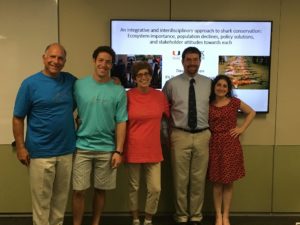
The fam attending my dissertation defense

After a little more than 5 years of hard work, I’ve officially completed my Ph.D.! You can read my dissertation (“An Integrative and Interdisciplinary Approach to Shark Conservation: Policy Solutions, Ecosystem Role, and Stakeholder Attitudes”) online here in its entirety.

In case there are some among you who don’t really want to read a 281 page dissertation but are curious about what I found, I’ve prepared this blog post to summarize my key conclusions. (Note: this does not include every conclusion. Some are aggregated together, and some more technical conclusions are omitted for this summary).

Read More “37 things I learned about shark ecology and conservation for my dissertation” »

Watch the Sharks International 2014 Keynote Presentations!

Posted on September 23, 2014 By David Shiffman 2 Comments on Watch the Sharks International 2014 Keynote Presentations!
Science

logoIn June of 2014, almost 400 of the world’s top shark researchers gathered in Durban, South Africa for the 2nd Sharks International conference.  The four keynote presentations have just been put online.

Beyond Jaws: Rediscovering the “lost sharks” of South Africa

Dave Ebert, Moss Landing Marine Laboratory

daveBiography:Dave Ebert earned his Masters Degree at Moss Landing Marine Labs and his Ph.D. at Rhodes University, Grahamstown, South Africa.  He is currently the Program Director for the Pacific Shark Research Center, a research faculty member at Moss Landing Marine Laboratories, and an honorary research associate for the South African Institute for Aquatic Biodiversity and the California Academy of Sciences Department of Ichthyology.  He has been researching chondrichthyans around the world for nearly three decades, focusing his research on the biology, ecology and systematics of this enigmatic fish group.  He has authored 13 books, including a popular field guide to the sharks of the world and most recently he revised the Food and Agriculture Organization’s Catalogue of Sharks of the World.  He has published over 300 scientific papers and book chapters, and contributed approximately 100 IUCN Shark Specialist Group Red List species assessments.  Dave is regional co-Chair of the IUCN Northeast Pacific Regional Shark Specialist Group, Vice Chair for taxonomy, and a member of the American Elasmobranch Society and Oceania Chondrichthyan Society.  He has supervised more than 30 graduate students, and enjoys mentoring and helping develop aspiring marine biologists.


Read More “Watch the Sharks International 2014 Keynote Presentations!” »

Thanks for your support of my SciFund crowdfunded shark research!

Posted on March 8, 2014 By David Shiffman
Blogging

The SciFund Challenge came to a close last night. In total, more than 15 projects, including mine, were fully funded! More than $45,000 was raised for scientific research! My minimum funding goal for this project was $3,000, an amount which would have allowed me to use stable isotope analysis to study the feeding ecology of … Read More “Thanks for your support of my SciFund crowdfunded shark research!” »

SciFund challenge background: 6 questions you can answer about shark feeding ecology with stable isotope analysis

Posted on January 14, 2014August 24, 2017 By David Shiffman
Science

scifundAs many of you have heard, I have a project in the 4th SciFund Challenge, a scientific research crowdfunding organization.  My project, entitled “You are what you eat: non-lethal feeding ecology to help conserve threatened sharks,” is part of my Ph.D. dissertation research. You’ll be hearing a lot more about it over the new few weeks here, on twitter, and on my Facebook page once the challenge officially starts on February 1st. I’d really appreciate your support of my research!

I’ll be using a research technique called stable isotope analysis to study the diet and food web interactions of shark species in Florida. My project (and the research technique) will be briefly explained on my SciFund site, but I wanted to go into more detail about the type of research questions that stable isotope analysis can answer, as well as why this kind of data is significant.

Feeding ecology is important to the conservation and management of sharks.

An emerging trend in marine conservation is “ecosystem based fisheries management”, which means that managers would consider the diet and food web interactions of species of interest. An effective ecosystem-based fisheries management plan would require, among other things, detailed diet and food web interaction data. We can better conserve and protect threatened marine life such as sharks if we better understand their biology and ecology, including what they eat. Over 100 priority research questions for shark conservation were identified in a 2011 research paper (available open access here), and several of these are related to feeding ecology and ecosystem role.

The traditional method for studying the diet of sharks is called stomach content analysis, which typically involves cutting open the stomach of a shark to examine what is inside. Southern Fried Science writer Chuck used a non-lethal alternative that involved pumping the sharks’ stomachs, but that is far less commonly performed. While direct and effective, this kind of lethal sampling research may not be appropriate for certain threatened species of sharks. Stable isotope analysis, which requires only a small tissue sample, can be performed non-lethally.

Stable isotope analysis background information

Read More “SciFund challenge background: 6 questions you can answer about shark feeding ecology with stable isotope analysis” »

Popular Posts

Shark scientists want their research to help save threatened species, but don’t know how. Our new paper can help.Shark scientists want their research to help save threatened species, but don’t know how. Our new paper can help.December 1, 2025David Shiffman
Norway and Cook Islands put their deep-sea mining plans on pause.Norway and Cook Islands put their deep-sea mining plans on pause.December 3, 2025Andrew Thaler
What Ocean Ramsey does is not shark science or conservation: some brief thoughts on "the Shark Whisperer" documentaryWhat Ocean Ramsey does is not shark science or conservation: some brief thoughts on "the Shark Whisperer" documentaryJuly 2, 2025David Shiffman
What we know we don't know: impacts of deep-sea mining on whales, dolphins, sharks, turtles, and other migratory species.What we know we don't know: impacts of deep-sea mining on whales, dolphins, sharks, turtles, and other migratory species.November 20, 2025Andrew Thaler
2025: My year in writing, public speaking, and media interviews2025: My year in writing, public speaking, and media interviewsDecember 3, 2025David Shiffman
The Trouble with Teacup PigsThe Trouble with Teacup PigsOctober 14, 2012Andrew Thaler
Urea and Shark OsmoregulationUrea and Shark OsmoregulationNovember 15, 2010David Shiffman
How tiny satellites are tracking marine wildlifeDecember 1, 2025Andrew Thaler
Shark of Darkness: Wrath of Submarine is a fake documentaryShark of Darkness: Wrath of Submarine is a fake documentaryAugust 10, 2014Michelle Jewell
Quick Tips for Graduate Student Life - Write a Book ReviewJanuary 23, 2014Andrew Thaler
Subscribe to our RSS Feed for updates whenever new articles are published.

We recommend Feedly for RSS management. It's like Google Reader, except it still exists.

Southern Fried Science

  • Home
  • About SFS
  • Authors
  • Support SFS


If you enjoy Southern Fried Science, consider contributing to our Patreon campaign.

Copyright © 2025 Southern Fried Science.

Theme: Oceanly Premium by ScriptsTown