Why well-intentioned but uninformed guessing cannot and will not solve conservation problems, and what we should do instead.

Picture this scene: you’re walking down the street, and you see your neighbor pacing back and forth nervously near the door to his house. He’s locked himself out of his house, accidentally leaving his keys inside. A locksmith is there trying to help, a tension wrench in his hand. You think you know a little something about locks, and decide to help. You shout to them from the sidewalk “I had a locker in high school, and the second number in my combination was 11! Now that I’ve helped, you should be able to get into your house!” You continue on your way, a big smile on your face, knowing that you’ve done a good deed today.
No one would do this, right? Doing something like this obviously cannot do anything to help open your neighbor’s locked door. The locksmith, a trained professional with experience and tools that you don’t have access to, is clearly using a tool for a totally different type of lock than the lock you have any experience with. And even if the lock that the locksmith was trying to open was the exact same type of combination lock that you used to use, knowing one of three numbers from a totally different combination lock would obviously not help to open the door. No one would shout “my old locker combination included an 11” and think they were being helpful in opening a locked door.
And yet, people do exactly this for complex environmental problems every day. People see trained, experienced conservation professionals working on complex issues, and without bothering to consider the complexity of those issues, they shout the first thought that pops into their head at us as if it’s a brilliant solution. And then they get annoyed (or worse) if we either ignore them or politely explain why that’s not how we solve complex problems.
We see this happen all the time, in many different branches of conservation science, from bees to sharks, from birds to plastic pollution cleanup.Well-intentioned people understand a little bit about the problem and want to help, but don’t understand enough of the problem to know that they’re essentially saying nonsense.
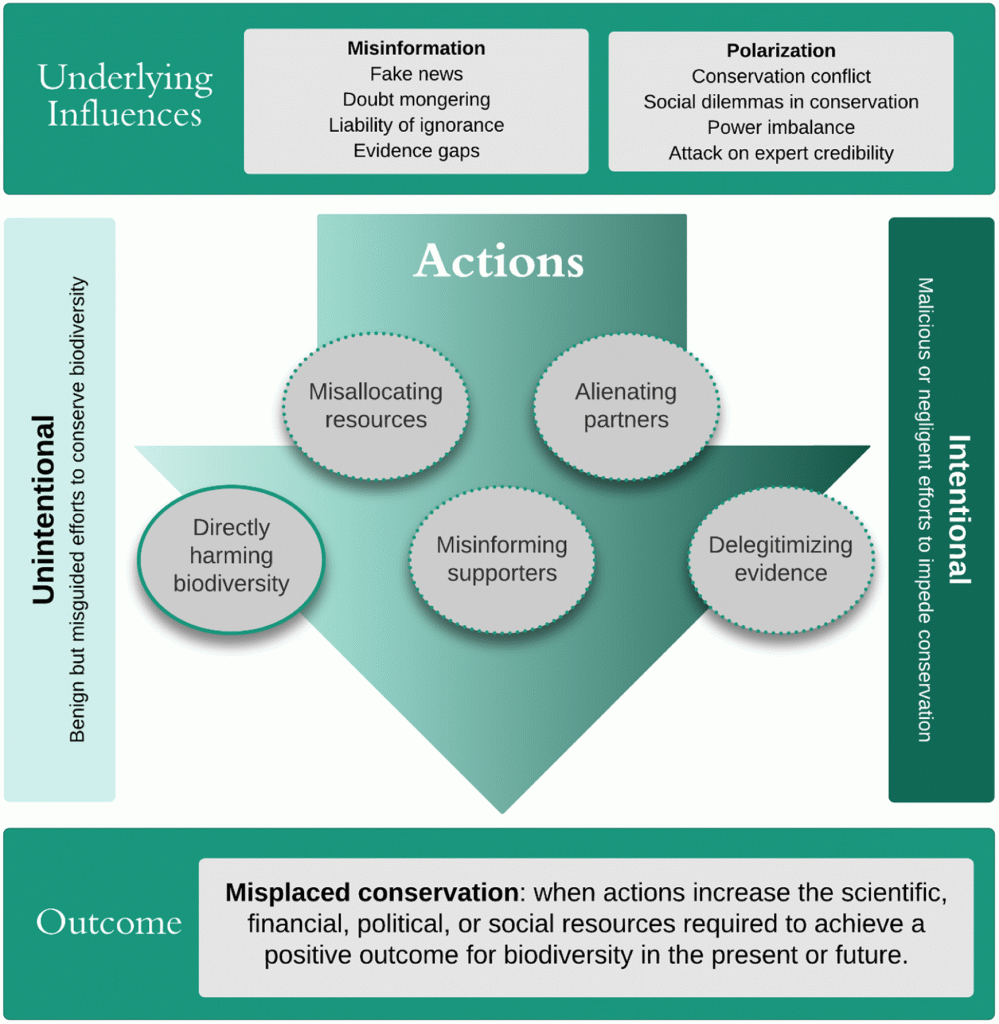
Figure 1 from Ford et al. 2021.
Psychologists refer to this phenomenon as the Dunning-Kruger effect, but I prefer cartoonist Zach Weinersmith’s visualization of the Dunning-Kruger curve as “mount stupid.”
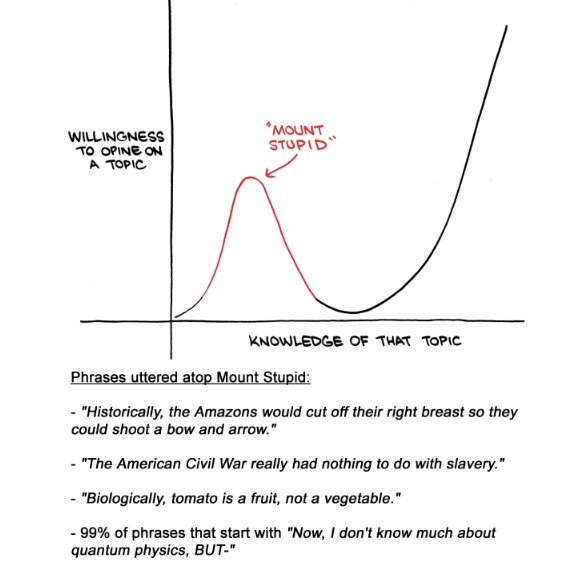
“Mount Stupid” from the webcomic Saturday Morning Breakfast Cereal.
It’s great that so many people want to help, and it’s great that so many people are trying to help. But wanting to help is not the same thing as actually helping. (And yes, as conservation professionals, trained in the science and law of solving complex problems and evaluating the effectiveness of conflicting conservation solutions, “is this helping” and “can this possibly help” are questions that we can answer.)
Unfortunately, flooding information channels with well-intentioned but uninformed nonsense is not harmless. It results in people devoting their limited time and energy to solutions that cannot possibly help, and may even make the problem worse.
If you don’t understand the complexities of the problem, you don’t understand what available solutions exist, and you don’t understand how to interpret evidence showing which solutions are more or less likely to solve the problem, you are unlikely to be able to think of an effective solution!
Let me be totally clear here: our environment faces many very serious threats, and the conservation community needs your help to help solve these problems. However, we do not need you to guess what to do to help. We need you to listen to the experts who have dedicated their lives to solving these problems (and learning how to solve them), and we need you to help us rather than make it harder for us to do our important work.
Want to help us? That’s wonderful, we need all hands on deck. But just as you shouldn’t believe that shouting “my old locker combination had the number 11 in it” would get your neighbor into their locked house, you shouldn’t believe that the first thought that pops into your head is going to solve a complex and nuanced global problem that lots of people have dedicated their lives to solving.