Skip to content

Southern Fried Science

Over 15 years of ocean science and conservation online

  • Home
  • About SFS
  • Authors
  • Support SFS

The next generation open-source, 3D-printable Niskin bottle has arrived!

Posted on February 12, 2019February 12, 2019 By Andrew Thaler
Oceanography for Everyone, Science

The Niskin bottle, a seemingly simple device designed to take water samples at discrete depths, is one of the most important tools of oceanography. These precision instruments allow us to bring ocean water back to the surface to study its chemical composition, quality, and biologic constituency. If you want to know how much plastic is circulating in the deep sea, you need a Niskin bottle. If you need to measure chemical-rich plumes in minute detail, you need a Niskin bottle. If you want to use environmental DNA analyses to identify the organisms living in a region of the big blue sea, you need a Niskin bottle.

View this post on Instagram

It's ready! The next-generation open-source, 3D-printable Niskin bottle is here! What do you want to sample? #ocean #oceanography #opensource #3dprinting #ecology #conservation

A post shared by Andrew David Thaler (@drandrewthaler) on Feb 12, 2019 at 2:52pm PST

Niskin bottles are neither cheap nor particularly easy to use. A commercial rosette requires a winch to launch and recover, necessitating both a vessel and a crew to deploy. For informal, unaffiliated, or unfunded researchers, as well as citizen scientists or any researcher working on a tight budget, getting high-quality, discrete water samples is an ongoing challenge.

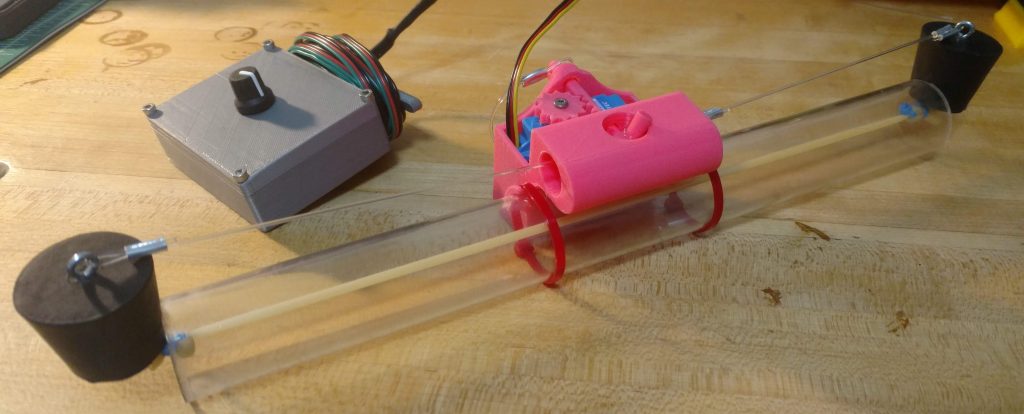
The Niskin3D lowers the cost of discrete-depth water sampling and makes this common tool of oceanographic research available to anyone. Several years ago, we released the first Niskin3D. Since then it’s been tested in lakes, rivers, and oceans, deployed on small ROVs and big submersibles, and met every challenge.

Today, I’m happy to unveil that the next generation of open-source Niskin bottle, developed through Oceanography for Everyone. We’ve made significant improvement to the trigger mechanism, replacing the pull-tab-style trigger with a more stable an reliable gear-driven linear trigger and removed a few non-essential components. The Niskin3D can be printed on a small 3D printer (in fact, the Monoprice Mini Delta, for which we’re just finishing up the review is more than capable of printing the entire assembly and, at $160, buying a 3D printer and all commercial components of the Niskin3D still costs less than a single conventional Niskin bottle).

Head on over the the Oceanography for Everyone GitHub Repository, where you can find shape files, bill of materials, and complete instructions, and build you own!


If you enjoy Southern Fried Science or want to support our ongoing development of open-source ocean tools, consider contributing to our Patreon campaign.

Share this:

  • Click to share on Bluesky (Opens in new window) Bluesky
  • Click to share on Facebook (Opens in new window) Facebook
  • Click to share on Reddit (Opens in new window) Reddit
  • Click to share on Threads (Opens in new window) Threads
  • Click to share on WhatsApp (Opens in new window) WhatsApp
  • Click to share on Mastodon (Opens in new window) Mastodon

Related

Tags: 3D printing Niskin bottle Niskin3D

Post navigation

❮ Previous Post: Remembering Walter Munk, a photo on a flash drive in a pile of poo from a seal at the bottom of the sea, lucky vikings, and more! Monday Morning Salvage: February 11, 2019
Next Post: The search for an inexpensive, field-ready 3D printer: Monoprice Mini Delta (review) ❯

You may also like

Weekly Salvage
Building the future with open hardware. Monday Morning Salvage: March 27, 2017
March 26, 2017
Science
This month’s 3D printed reward is a horn shark and horn shark egg case!
April 18, 2018
Uncategorized
Finding the best dirt-cheap, field-tough 3D printer for science and conservation work: six months later.
November 15, 2019
Science
Announcing new Patreon rewards: 3D printed shark and ray models!
March 9, 2018

Recent Popular Posts

What Ocean Ramsey does is not shark science or conservation: some brief thoughts on "the Shark Whisperer" documentaryWhat Ocean Ramsey does is not shark science or conservation: some brief thoughts on "the Shark Whisperer" documentaryJuly 2, 2025David Shiffman
At least 74 practicing shark researchers: How a silly thing I said online raised thousands for conservationAt least 74 practicing shark researchers: How a silly thing I said online raised thousands for conservationFebruary 26, 2025David Shiffman
I can serve on your graduate thesis committee. Here’s what you can expect of me, and what I expect in return.I can serve on your graduate thesis committee. Here’s what you can expect of me, and what I expect in return.October 16, 2025David Shiffman
Shark of Darkness: Wrath of Submarine is a fake documentaryShark of Darkness: Wrath of Submarine is a fake documentaryAugust 10, 2014Michelle Jewell
A quick and dirty guide to making custom feeds on BlueskyA quick and dirty guide to making custom feeds on BlueskyFebruary 7, 2024Andrew Thaler
What is a Sand Shark?What is a Sand Shark?November 12, 2017Chuck Bangley
What can the funniest shark memes on the internetz teach us about ocean science and conservation?What can the funniest shark memes on the internetz teach us about ocean science and conservation?November 8, 2013David Shiffman
Alberta, Canada is the proud owner of the largest man-made pyramid on the planetAlberta, Canada is the proud owner of the largest man-made pyramid on the planetOctober 16, 2012Andrew Thaler
"Twitter sucks now and all the cool kids are moving to Bluesky:" Our new survey shows that scientists no longer find Twitter professionally useful or pleasant"Twitter sucks now and all the cool kids are moving to Bluesky:" Our new survey shows that scientists no longer find Twitter professionally useful or pleasantAugust 19, 2025David Shiffman
Did monster hunters find a 120 meter long giant squid on google maps?Did monster hunters find a 120 meter long giant squid on google maps?June 17, 2016Andrew Thaler
Subscribe to our RSS Feed for updates whenever new articles are published.

We recommend Feedly for RSS management. It's like Google Reader, except it still exists.

Southern Fried Science

  • Home
  • About SFS
  • Authors
  • Support SFS


If you enjoy Southern Fried Science, consider contributing to our Patreon campaign.

Copyright © 2025 Southern Fried Science.

Theme: Oceanly Premium by ScriptsTown