
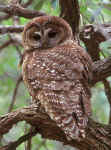
This month’s Frontiers in Ecology and the Environment has a brief article about a new proposed conservation strategy that seems perfect for a Southern Fried Science ethical debate. Northern spotted owls (Strix occidentalis caurina) are one of the most famous endangered species in the United States. While solutions to the destruction of their habitat by logging have been debated for years, a new threat has been recently identified- encroachment on their limited habitat by another species of owl (the barred owl, Strix varia). Some conservationists now believe that we need to kill barred owls to protect spotted owls.
Bob Sallinger, the Conservation Director of Portland’s Audubon Society, explains why this is such a tricky issue:
“Shooting hundreds, perhaps thousands of barred owls, in perpetuity, is a horrible thing to contemplate – but the [possible] extinction of the spotted owl is also profoundly difficult to accept”, he said.
Barred owls are not endangered. It is likely that without habitat restoration and removal of barred owls, the Northern spotted owl will go extinct.
According to the article, the US Fish and Wildlife Service expects to make a decision on whether or not to attempt small-scale barred owl removal experiments within a few months. They have also hired an ethicist to help sort out this problem.
Do you think it is acceptable to kill large numbers of a non-endangered species in order to prevent the extinction of an endangered similar species?
Do you think it is acceptable to allow an endangered species to go extinct by choosing to not kill a similar non-endangered species?
Do you think it should be within the authority of endangered species management bodies to kill animals that threaten those endangered species, or does killing animals go against the point of conservation?
Is this a dangerous precedent or an innovative new conservation idea?
The article does note that without a workable plan for restoring the old-growth forest habitat, even removing all the barred owls from the spotted owl habitat won’t help. Let’s assume for the sake of this discussion that there is a plan in place to restore old-growth forest habitat for the spotted owls, and only focus on the killing of barred owls.
~WhySharksMatter

Quick Q: are the barred owls invasive in the spotted owls’ habitat?
I wasn’t able to find anything that specifically answered that question. The map of their range from owlpages.com included the spotted owl habitat, so they may have always been there but are only a problem now that the spotted owl habitat is so much smaller.
I don’t honestly know enough about the issue to make an enormously informed decision.
Based on what you wrote, though, I have a few comments.
This kind of mirrors the basic heirarchy of life (cells -> tissues -> organs -> organism etc.) in that the dilemma is whether or not to sacrifice organisms in favor of a species. This logic, of course, leads to killing the barred owls to save the species.
This could also be an interesting experiment in island biogeography, though.
Also, if the “culling of the herd” takes place, what guarantees that those shooting the barred owls won’t shoot the northern spotted owls? Both species are similar in appearance and in size. Granted, it’s less likely because of the smaller population size of the Strix occidentalis caurina, but it’s still possible that they’ll get switched a few times.
This method has been tried before. The Atlantic Sea Lampreys in the Great Lakes were so overpowering fish populations in the ’70s that a “lampricide” to kill the larvae was used. In this case, which is admittedly less direct than hunting, obviously didn’t work.
Why is one Owl’s life more important than the other?
Could the barred Owl possibly be relocated? I guess that may not be possible,huh?It’s a sad thought,but maybe we should let nature take it’s course. I hope that something is figured out to save both.
Unfortunately, it sounds as if from the comments made, that the real problem is US. As always. So until we address the real problem, deforestation by us for our selfish purposes, then all of this “band-aid” work is pointless. We could go ahead and at least try to get the Barred Owl population under control for the time being. But it would have to be done by very environmentally dedicated hunters that can tell the difference between the two easily, thinking before they shoot. And yes, I can hear all of the bad jokes there on that line, but they DO actually exist. They’re rare, but they do exist. But you will still run into mistaken identities as already mentioned. But how long can we do this and at what cost? Until the logging COMPLETELY stops and reforestation is truly allowed to take place to allow these 2 owls to coexist? When will we as a species start to control our own population and excesses? I know, preaching to the choir. But unfortunately this is the same old story on every front of conservation and extinction discussion and issue. So when will we address the real problem? Because otherwise this is a circular conversation that will be happening again in 2 months or more time on some other species. Which one was it before this?
“Why is one Owl’s life more important than the other?”
I’m not sure if I agree that one is more important than the other, but spotted owls are critically endangered and barred owls are not.
How does the barred owl affect the population of the spotted owl? What are the competing for? Perhaps we could find a solution in trying to get both to coexist.
According to the comment left by Sam, history has shown that the removal of one species for the other may not work, thus, maybe we could think of introducing a third party to the ecosystem that could save the situation.. this is an idealistic thought, but i don’t know enough about the problem to give a practical one.
Why not? We’ve driven species to extinction for less worthy goals, haven’t we? Seriously though: we’ve culled predators to protect our domestic herds and the herds of wild herbivores we like to hunt, caused extinction of island species because we wanted to bring sheep and pigs on sailing ships. We’ve pulled up thousands of purple loose strife plants to protect the wetland plants we were worried they’d replace. Culling may be contentious, but its part of the toolbox that wildlife managers use, and if we consider protection of spotted owls a goal as worthy as protecting those wetland plants, or having a certain quota of white tailed deer to hunt, I encourage USFWS to pursue the experimental removals and gather some data on how effective this might be.
The expansion of Barred Owls into Spotted Owl territory is a recent (1900s) though not necessarily entirely natural process (http://sei.org/owl/finalreport/Chapter7Barred%20Owl.pdf). This means we have to get into the recurring debate, “are natural range expansions invasions?”
Finally, although habitat destruction is a major issue for these owls, as always, it will be difficult to weigh the impacts that either conservation effort will have relative to the other, and so I wouldn’t necessarily write off barred owl culling because there’s a larger threat out there, nor would I suggest that a barred owl culling program would release us from the need to conserve old growth forest.
All Owls,as do all animals,matter.So the life of one owl species is the same as the life of another species,whether it competes foe food,habitat or mating space.But i agrre there should be a way to manage both species in a sustainable way,without kiling one species
I agree with Heather’s first comment. As per usual it is the actions of humans which is causing the problem. To go out and kill another species, as so often happens in conservation, simply provides a scape goat. If we want to trully conserve species and biodiversity, we need to start treating all nature, which includes every single animal regardless of whether or not their species is endangered or not, with respect. We need to change our actions, not persecute nonhuman animals who are simply doing what they need to do to survive.
I think they do not have the right to kill any native species to save another even if they are endangered.Perhaps more funding for captive breeding of this species might help instead of killing a population of another species. I think this conservation technique is a quick and temporary fix to the problem. Also by killing off the local population of barred owls might cause a ripple effect in the natural balance of that area. Are they planning on replacing all those predators to keep a balance of predator/prey while the spotted owl recovers? Next thing you know they will be killing off some other species that the population has exploded as a result because they are now overpopulated and a nuisance. Its a vicious cycle. i believe killing any species for another is not a conservation technique…its just a quick fix. I believe more research and captive breeding is the key.
This looks like what happened in Australia, centuries ago when MAN brought the rabbit and the population exploded…or the case of the american type squirrels in London, killing the British type…
I have a more “human” (or should we say “animal” ) solution…Years ago, in Paris the population of pidgeons represented a big dancer for health and hygene of the tow… the prefecture wanted to kill a big part of the population, the “fondation Brigitte Bardot” had a better idea: instead of giving poisonous food to the pigeons…why not give them “contraception”? A special bird food was then created and “euthanasia” was not necessary. The same can be done with the owls.
Why not? We’ve driven species to extinction for less noble goals. Just think of all of the island bird species that no longer exist because we wanted to bring sheep and pigs on sailing ships, or all of the predators that were extirpated so that we could hunt their prey (white tailed deer, etc.), or all of the purple loosestrife we have pulled out of wetland because it chokes out native plants.
Seriously though, species removal is just another technique in the toolbox of environmental managers, and if the goal of saving spotted owls is judged to be worthy, why not let them use all of the tools at their disposal? I encourage the USFWS to undergo the appropriate experiments and gather some data on how effective it might be.
Yes, habitat destruction is also a threat (and possibly a bigger threat) but that doesn’t mean we should ignore all of the other threats the species faces.
I couldn’t find a good report on the history of the barred owls’ range expansion but here scientists suggest that it is a natural range expansion that humans may have facilitated or sped up. (http://sei.org/owl/finalreport/Chapter7Barred%20Owl.pdf) So if you consider barred owls invasive (the result of human meddling) I don’t see why you wouldn’t support this as much as you support pulling up purple loosestrife to save native plants and animals. If you don’t consider them native then it gets a little trickier. Species-based management plans often lead to these sorts of contradictions: a whole-ecosystem approach would be better.
@CathytheCat developing wildlife contraception techniques is time and resource intensive, that’s the reason it’s only pursued in heavily populated places like Paris where either for safety or public opinion reasons the much more effective (and cost effective) removal technique is not a viable option. This will never happen in old growth forests.
@Julie captive breeding is another feel-good measure that often ends poorly for the wildlife, we generally breed endangered species in hopes that an increase in their numbers will make them immune to whatever pushed them to the brink of extinction in the first place. This is rarely the case: management that addresses the cause of endangerment directly is much more effective.
Contraception has been used with the Atlantic Sea Lampreys in the Great Lakes. Captured lampreys were, instead of being killed, neutered or spayed. Didn’t work.
Did the contraception with pigeons in Paris work?
I think if a species is endangered then you must adopt it and change it surrounding knowing that in its current condition cannot survive. what does it say to save a species and kill another that we are pleying favorites with lives? I think you should reconsider this whole thing and that this beyond saving or studying a species its about learning about ourselves.
“there should be a way to manage both species in a sustainable way,without kiling one species”
No one has found one so far, and the spotted owls are dying. Should we continue to search for a perfect solution, or should we act to save a critically endangered species?
“we need to start treating all nature, which includes every single animal regardless of whether or not their species is endangered or not, with respect. We need to change our actions, not persecute nonhuman animals who are simply doing what they need to do to survive.”
How exactly will respecting barred owls stop them from encroaching on spotted owl habitat? I agree with some of your sentiment, but lofty goals don’t help on this level of planning.
“this beyond saving or studying a species its about learning about ourselves.”
Friend, what are you talking about? Learning about how humans view animals’ place in the world won’t save the spotted owl.
Hm. Well, that makes it tougher.
I was going to say that if they’re invasive (esp if we stupidly brought them there), then slaughter the problem owls. Call me heartless or cruel, but I’ve got no problem with culling invasive species to save endangered native ones. In Hawaii, a small little bird from Japan is devastating the endemic bird species, and I would gladly sign up to eradicate the pests from the islands, no matter how cute they are. It’s a matter of life or death, and the other birds were not only here first, but in danger of extinction – the choice is easy for me.
It gets a little fuzzier if species are native to an area – it seems a little less acceptable to just kill them by the tons.
Of course, either way it comes down to how you weigh the importance of two species. Does one deserve to live more than another, especially if it means that other ceases to exist? How important is it to save one species? I’m not really sure I know the answer to those questions.
I’m totally cool with extirpating invasives, though I see the argument against it; one could argue that it’s not fair. After all, the animals did nothing wrong. They just did what they’re supposed to – survived and reproduced. But that’s just how I draw the line – and as animals are pushed to the brink of extinction, we have to draw the lines somewhere. Some things have to end up mattering more than others – risk of extinction, native v. invasive, etc. Some criteria have to be weighed, and from them conservation decisions have to be made.
In this case, I think that as long as the barred owls are not in danger and the spotted ones are in danger but can be saved, then cull away. Of course, there have to be other plans to rehabilitate the spotted owls alongside mass murder of barred owls – habitat restoration, breeding programs, etc, to make the effort worthwhile.
As a museum guy and ornithologist I run into all the perceived problems with killing wildlife. The truth is birds and other wildlife are being killed all the time, 24-7, for many reasons, none of which has to do with spotted owls. Your house, your car, your cat, your cell phone are all contributing to killing birds. The numbers of birds killed by outdoor cats and cell phone towers FAR outweighs any proposed culling of barred owls. Millions of mourning doves, waterfowl, upland game birds like snipe and grouse and even crows are legally killed by the millions for sport and none of those species are threatened with extinction.
Often people forget that conservation is about preserving populations, NOT individuals, as every individual dies regardless of even the best conservation efforts. The issue is how will any proposed action affect the population. As legal hunting has shown for decades most avian populations can withstand considerable take.
Barred owls are invasive in the West and are threatening spotted owls through introgression, breeding, basically moving barred owl genes into the spotted owl gene pool. Interbreeding can lead to extinction just as quick, if not quicker, than any habitat loss.
I think if as a society we have deemed it important to keep spotted owls around, and it seems based on the money thrown at them we have, then this is a no-brainer. I think the bigger issue is the fact that one would likely have to cull barred owls for a very long time as dispersal from eastern populations would continue meaning that this would likely be another enormous long-term expense in spotted owl management.
I agree that this competition problem lies in the extensive deforestation and habitat destruction. This problem must be dissolved by stopping the destruction of habitat. Although barred owls may have a more general range across the landscape, the culling of their numbers will have more negative reverberations than positive. One of these is a reduction in local genetic diversity that could spell trouble for barred owls in the future. Then what will we have to kill to reduce competition for the barred owls? Will there be anything left?
Reference Jane Goodall and her intervention with regards to infanticide by chimpanzees. Do you agree with her tactics in that case?
NO SPECIES, including humans, have a right to exist forever. In fact, the natural law is just the opposite. 1) If this is a natural process then we must let it unfold. 2) If the barred owls are invasive, then intervene.
Let’s preserve the randomness of evolution and not our own wishes and desires. Last time I checked evolution involved change.
Hi all:
I just saw this discussion and read a few of the responses above and thought that I would very briefly weigh in on it. I am very familiar with this situation, and to answer one of the earlier questions posed, no, the barred owl is not native to the Pacific NW. Human modification of the lands of the midwestern US has allowed them to move westward into spotted owl range. Regarding the proposed solution to the problem, clearly the culling of barred owls is an ethical one more than anything, but I would ask you to consider this – are the spotted owl and barred owl actually two distinct species? Currently, we recognize them as such, but that does not mean that they are in reality. These two “species” do in fact hybridize, and their offspring are in fact fertile, as I understand it. So, together, they meet the definition of the biological species concept. So, if you consider this, then it changes the discussion altogether. Just a few things to contemplate.
The answer to this question obviously depends on ones ethical framework, but we should make sure not to fool ourselves into mixing up our ethics. It seems like there’s an underlying ethical theme of “naturalism” amongst people who wish to save endangered species. The prevailing idea is that the reason endangered species exist is due to human interference, and that human interference is not a “natural” mode of operation; therefore it is a moral imperative to protect endangered species. Of course this mode of thinking is categorically false and misguided, even if the protection of endangered species can be justified in other ethical frameworks. It’s obvious that human beings are natural, and that extinctions can and do occur despite them. The problem is that the human species is such a prolific one that it’s virtually impossible to extricate it from responsibility for any significant changes in ecosystems; in other words, human beings are responsible for a whole host of ecological events, not solely extinctions, but population explosions, and the evolution of new species. If one is truly motivated by a “natural” ethical framework, then they should understand that the extinction of a species is not implicitly a bad thing. The method by which any owls have come to exist is through the extinction of some other species. There is nothing implicitly wrong, from a biological standpoint, with one species of owl dominating and subsequently wiping out an other species of owl.
Whether a species is invasive or non invasive is only relevant in that it may introduce drastic shifts in the ecology of the area, and this is only of concern if ones morals are motivated by ethical frameworks other than the “natural” one, since ecosystems have been making drastic changes since ecosystems have existed.
I would propose that the reason people should be concerned about the extinction of a species is two fold: the first is that the extinction of a species can bring about drastic changes in ecosystems, and that this can cause disruption in the way human beings live. This concern is motivated by the ethical framework of self interest. The second is that the extinction of a species may result in the loss of a valuable piece of history, information, and beauty. This can fall under a number of ethical frameworks, but I’ll put it under aesthetics and understanding. Self interest, aesthetics, and understanding, are all ethical frameworks which most people seem to agree upon, so given those reasons, perhaps it is best to protect the endangered species.
The problem with protecting an endangered species at the detriment to another species is that you are not allowing for the efficient evolution of new species. Why would we want new species to evolve? From a self interest standpoint it’s hard to say. On one hand it would seem that we don’t want new species to evolve, a new breed of super owl may come along and devour us. On the other hand a new breed of super delicious owl may emerge. From an aesthetic and understanding standpoint, new species provide us with a new mode of seeing and understanding the world.
Given that these spotted owls are already a dwindling population, I suspect that their loss will not result in a drastic change in the ecosystem, so self interest is off the table. I propose that the best solution is to store as much of their genetic material as possible, so that if need be we may resurrect the spotted owls, and then allow the barred owls to do their thang.
Regarding barred owl ecology
– The barred owl has spread across the USA from the east to the west coast in the last 200ish years, and is considered invasive by some (The Barred Owl(Strix varia) invasion in California, Auk, 1998, http://fwcb.cfans.umn.edu/research/owls/lit%20folder/1827_DARK1998.pdf)
– The cause of the spread is debated. I’ve heard climate change and altered successional patterns in the great plains (ie increased woodlands) as possible causes. The owl, however, was not artificially introduced, so its status as “invasive” is perhaps debatable.
-Barred owl compete with Spotted owls for nest sites and territories (Are barred owls displacing spotted owls? Condor 2003). Barred owls are considered to be more aggressive than spotted owls.
-The two species also hybridize (Hybridization between barred and spotted owls, Auk, 1994)
Besides the ethical issues, It needs to be considered how many owls need to be killed in order to make an impact on the population. This would require a population analysis of sorts (a population un-viability analysis in application). Managers of invasive species have been criticized in general for shooting from the hip and not considering the demography of the species they wish to control to inform its management.
For those who asked:
Others gave range detail, but in general Barred owls are a more generalist species than the old-growth specialist spotted owls. Presumably, the spotted owls can out-compete barreds in their preferred habitat; everywhere else (eg, younger forests, mixed edge-type stuff) the barreds succeed. Here in the Northeast, barreds seem to fall out when the landscape becomes more suburban (though they can stand some development and are seen in urban parks sometimes) and/or primarily hardwood forests.
I think the biggest error on the part of biologists/conservationists was to, years ago, frame the debate around spotted owls specifically rather than (old-growth) habitat conservation. Focusing on a single species leads to ideas such as this – “let’s exterminate a native species that is actually responding positively to habitat change.“
I study owls myself (albeit in a much different setting), and even I see little “big picture” difference between a forest dominated by spotteds vs. one dominated by barreds. The point is that the forest is there and the system remains intact. Whether barreds are labeled invasive or not is not really the issue…will the barred owl drastically alter the system if it pushes out the spotted? The 2 species are so similar I really don’t think so. There are probably more substantial ways to spend your conservation dollars than shooting barred owls.
I realize the infamous spotted owl struggle may have required the single-species focus in order to quickly enact ESA protections, and there was no time to address the inefficiencies in our legislation and conservation philosophy, so my opinion above has a large amount of 20/20 hindsight. 🙂
Nathan also makes a good point re: a thorough demographic analysis/shooting from the hip.
“I see little “big picture” difference between a forest dominated by spotteds vs. one dominated by barreds. The point is that the forest is there and the system remains intact.”
That’s an interesting point, Chris. All too often we focus on charismatic endangered species and not the ecosystem as a whole.
“a new breed of super owl may come along and devour us. ”
And now I am terrified.
“a new breed of super delicious owl may emerge. ”
And now I am terrified and hungry.
“new species provide us with a new mode of seeing and understanding the world. ”
And now I am terrified and hungry and inspired.
Interesting points all.
Thanks for the links, Nathan. I always appreciate it when folks provide references for claims they make in these discussions.
The biological species concept is a mess. That’s really interesting that they can hybridize, though. I hadn’t heard that.
“How exactly will respecting barred owls stop them from encroaching on spotted owl habitat?”
It won’t, and unfortunately that means that the population size of the spotted owl will decrease. What I am saying for is that we have absolutely no right to persecute and kill any animal in for the benefit of another, or some animals of one species to try and maintain the population of another. WE created the problem through logging! Before this, it seems that the two species were able to both exist perfectly well, so before we take the usual conservation route of killing the so-called problem animal species, we should look in the mirror, and see that we are causing virtually every single conservation problem on the planet, and start changing our actions instead of passing the blame to nonhuman animals who are simply doing what they need to do to survive in their even decreasing habitats which we are destroying more and more by each passing day.
I recently seen a list of the 100 worst invasive species on the planet. To my surprise humans were not on it. This reflects the arrogant and foolish view that seems so common in conservation, that humans are somehow above all other animals and the same terms cannot even be applied to us.
Rather than make a long-winded reply of my own, I am going to second this one. There is a lot to consider on this issue. We have some other bird species that are rapidly changing their ranges, and putting pressure on other species because of it (although not necessarily putting pressure on an endangered species). One is the white wing dove in Central Texas, which never used to occur here 20 years ago. It has moved north for the same reasons that barred owls are moving north, and is displacing other dove species.
I would wait for more good scientific information before coming down on one side or the other of this question. If keeping numbers of barred owls lower would improve the chaces of spotted owls, I might go for it, but it had better work, or there will be a lot of killing for no good reason.
In Texas, barred owls are only found in moist (usually riparian) habitats, never in upland, drier areas.
I do not believe any degree of violence can solve this.
Assuming they are not facing a greater threat from man caused habitat change/destruction, I would say remove the non-native owls species without killing them. Use enough people to safely capture without harming them and relocate. That is what I want to see money used up for.
Is it the barred owls fault that the spotted owls are going into extinction? Do they deserve to die for our mistakes? Yes, it is a dangerous precedence.
We usually don’t use words like “fault” to describe the behavior of animals, particularly the behavior of whole species instead of individuals.
Assuming that there is a plan in store for the restoration of the old-growth forest habitat, it is implied that the next biggest obstacle in restoring the Northern spotted owl population lies within the new encroaching barred owl population.
As one who sees myself as an advocate for all living things, I find myself facing a difficult dilemma. Is the life of one living thing more deserving, or more important than the life of another? My instinct is to say no. In this situation, however, I must ask myself to weigh the options in front of me.
It comes with the saying, “desperate times call for desperate measures.” I can fully understand the growing need for an answer on this topic, but the thought of killing large numbers of a non-endangered species in order to save an endangered one almost seems like a scapegoat. Is there no other alternative? The information presented above makes me seem to think that the answer is “no”. And so, I find myself wanting to save this endangered species. And so, if this extermination of part of the barred owl population were to occur, and the population of Northern spotted owls were to increase, what would happen next? Would the barred owls continue to be a threat to the Northern spotted owl population, or do they only cause a threat because of the variation in numbers?
I find it important to act on behalf of this endangered species in the most effective, yet humane way possible, and if this is the only plan left, then I find I must support it, regardless of who I think has the authority over these situations. I do believe, that if we as humans have the capacity and resources to help this species, then we should, only as long as the barred owl population does not become endangered as a result. I think THAT is my biggest worry in this situation, and that is why I still see this as a dangerous precedent, and what should be seen as a last resort, because in any other circumstance, I would see killing other animals as an effort against conservation as opposed to for it.
I believe that deforestation and habitat destruction mostly because of the ever expanding population has led to a lot of species becoming endangered. However, why do we need to kill one owl species in order to save another? Has there been any effort to increase the spotted owl population for example, capturing a few to put in a protective environment in order for the species to mate and grow? I am not that well informed about biology, but I don’t know how effective relocating either the spotted owl or the barred owl would help either population. One main problem that I see is if we do choose to relocate either species, we are changing their habitat, which would mean that the owl would have to adapt to this new habitat. This can either hinder or promote the owl growth depending on how well they adapt to the habitat. Another problem that might arise in killing some barred owls is that species would adapt to this and reproduce more. How is killing some barred owls going to stop their reproduction? I personally think that deciding to kill the barred owl is a preemptive decision and we need to look at other possibilities.
Do you think it is acceptable to kill large numbers of a non-endangered species in order to prevent the extinction of an endangered similar species?
This topic was brought up in Bio class and I’m glad I read this post because its given me a better understanding of the issue. I agree that allowing an endangered species to go extinct by choosing to not kill a similar non endangered species is acceptable. It is definitely unethical to kill one species at the expense of another species. I’m not knowledgeable of the importance or benefits of the Spotted owls but i think that it is safe to say that there is no real significance of saving the spotted owls (for example, they aren’t used for research to save lives) so there is no real need to go to the extreme and start killing off the barr owls. Killing animals definitely defies all the laws of conservation. I mean come on, killing and conserving are complete opposites. This definitely a dangerous precedent that need not go any further than just an idea. Like I said before, there is no way to conserve while killing!
I don’t agree with killing the barred owls just to try to increase the spotted owls population. Has anyone tried to increase the Spotted Owls population by having two mate? What if we tried to build up the Spotted Owls population a bit more before we go and kill another animal? I don’t believe that killing an animal just so another animal can live is ethical.
What is going to happen when we kill all the barred Owls and they are then endangered? Will we feel it’s ok to kill another animal just to save this one? As you can see, I believe that this will cause a snowball effect, it will keep building up and up.
I believe that we should try to produce more spotted owls and see how successful we are before we go and kill other animals.
If one truly steps back, the problem at hand is not the abundance of Barred Owls, rather the limited habitat from excessive logging. I believe finding a solution to the source of the problem should take precedence over the slaughtering of Barred Owls. Killing excessive amounts of owls is simply a temporary solution to a much greater problem.
Although the northern spotted owls are an endangered species, I do not think that it is ethical to kill barred owls. Even if barred owls are not in danger of becoming extinct, killing one species of owls for another does not seem like the right solution. I do not think that the endangered owls should be allowed to go extinct, but I also do not think that killing animals is acceptable. Endangered species management bodies should decide how to preserve any species facing possible extinction, but the purpose of these bodies should be to conserve all animal life. So, I do not think that they should have the authority to kill anything. I believe that killing owls to save owls contradicts the concept of conservation because, in the struggle to save a particular species, another species is dying; therefore, this idea is a dangerous precedent, not an innovative conservation idea.
I agree with bioloquest. Killing one species for another will not resolve the real problem at hand, excessive logging. By reducing the numbers of the Barred Owls, we are punishing them for our mistakes. It’s not fair to either species. We should be more focused on cutting down on the amount of logging or coming up with a plan that replenishes the trees in a way that they are always plentiful, rather than putting yet another species at risk.
According to the Santa Clara University Ethics department, only an astounding 10% of northern spotted owl habitat remains in today’s environment. I believe that the real question here is how are we as Americans responsible for causing such a catastrophe to occur, and what can we do to replenish and rehabilitate the mass destruction? Sadly, it does not seem as that the answer will come in a timely fashion, which in turn will ultimately lead to the extinction of the northern spotted owl if drastic measures are not taken…and quickly. For hundreds of years this beautiful species has called “home” the old-growth forests of the Pacific Northwest. They have been able to fed, survive, and reproduce off of the vegetation and invertebrate life, which is created by the timber. The timber in question is the hemlock, spruces and cedars, to mention a few, which have aided in a multi-billion dollar logging industry that threatens to destroy many species habitat, not just the northern spotted owls. The debate about the precedence of the owls, over the major economic impact of the logging industry, sounds like the real problem. Of course, it is vitally important to save the northern spotted owl, as well as the barred owl, but to what extent are Americans willing to go? Relocation of the barred owl might not work in the long term, and rebuilding the habitat of the northern spotted owl may not be in time. I think that this particular instance of endangerment of a species is a great example of what could happen to our world if we continue to over-use and diminish all of our natural resources at such a horrific rate. These owls, both species, are an important addition to the ecosystem, and therefore I cant say that I agree that one life should be valued over the other, but I am not willing to see a endangered species die off while we sit around and wait for it to happen.
I agree with the previous post by dani. Since when is it right to kill one species over another, endangered or not? You are eliminating one species to conserve another. I am sure that there is another way to manage both species, possibly by relocating, changing their habitat (planting more trees),etc. It is not right for endangered species management bodies to kill animals that threaten endangered species because it does go against the point of conservation. There can be other resolutions besides killing. That’s like taking the easy way out. The entire idea is a dangerous precedent, not an innovative new conservation idea. There is nothing innovative, conservative, or new about it.
Although it is terrible that the northern spotted owls are going extinct I do not believe that the best way to solve this problem is by killing another species of owl just for the sake of saving and endangered species. This simple does not seem human to me. There has to be another way to go about this. Would it be possible to try relocating the northern spotted owls? Or perhaps moving a great deal of them to captivity? (I know that sounds hard but maybe in a zoo or somewhere these owls could be taken care of…)
The non-endangered owls should not be killed to save the endangered species because there are other possible solutions to the problem. They could capture the endangered species and breed them into some facility or zoo till there population get large enough to release them back into their habitat. I do not believe killing the owls is the best way to go about the problem.
“Do you think it is acceptable to kill large numbers of a non-endangered species in order to prevent the extinction of an endangered similar species?”
This is a very tricky ethical problem. Depending on your perspective it can go either way. In a utilitarian sense, the life of the endangered species has more value then the more populated one. But from a more individualist mindset, what makes the killing of one living thing more just then another? I am under the opinion that the endangered life has more value and that if eliminating a less valuable life for the sake of saving multiple endangered ones is justified.
“Do you think it should be within the authority of endangered species management bodies to kill animals that threaten those endangered species, or does killing animals go against the point of conservation?”
Yes killing animals does go against conventional conservation there is no arguing that point. But this is such a tricky question I don’t think it can be solved with conventional methodology. While its still a sticky problem, this solution should not be discarded without proper deliberation; even if it does go against convention.
“Is this a dangerous precedent or an innovative new conservation idea?”
It certainly has the potential to be a dangerous precedent. But I feel that it is more-so an innovative new conservation idea (although based on other’s posts it seems its not all that new). As stated above, the answer to this question depends solely on the ethical framework its approached with. I happen to think eliminating some of the more populous species is justified
Lacking thought in my
Opinions, I, instead, blame
Mexico. More tea?
Comment edited as per rule 5a.
This problem has many solutions with different consequences. I feel like killing the owls would be a bad choice as it results in a structure problem for not only the owls, but other species near them. Changing the habitat to suit everyone would be the best possible way for everyone’s survival here.
I agree with both sides of this argument. I do see killing many Barred Owls as a cruel punishment to that species seeing as they, I’m sure, didn’t plan to move in on the Spotted Owl’s habitat and take over. It’s the common idea of survival of the fittest. I feel that people are always trying to save and rescue what sometimes is out of our control. It is not up to us to save another species. However i understand their are many people who do spend their lives trying to rebuild and maintain species from going extinct. For this there are plenty of wildlife reserves that could take in the endangered Spotted Owls, rebuild their habitats, repopulate their species behind closed doors and allow them to slowly crawl out of extinction. However it is wrong to decrease a strong species like the Barred owl simply because the Spotted owl has perhaps lost their ability to adapt with the changes in their environment and survive.
I am truly stuck between both sides of this argument, but I’m leaning more towards this…
Part of me finds it unacceptable to kill large numbers of non-endangered species to prevent the extinction of an endangered similar species. One reason I feel this way is because…
“The extinction of at least 500 species of animals has been caused by man, most of them in this century. Today there are about 5,000 endangered animals and at least one species dies out every year. There are probably many more which become extinct without anyone knowing.”
(http://www.ypte.org.uk/environmental/endangered-animals-of-the-world/24)
At least one species dies out every year and probably many more we don’t even know about? Plus, 500 species have been caused by man, so who is to say that we could not easily make that mistake again by false identification of the wrong owl? Being similar in shape and size could make it hard to eliminate only the non-endangered one.
Also, I find it hard to convince myself that taking the life of an owl that is non-endangered, abundant, and could possibly be as valuable as the Northern Spotted Owl one day, is simply just acceptable.
Endangered species have been dying off for years, it’s all a process. We’ve all heard of natural selection, the organism best adapted to the environment will survive.
Who is to guarantee that killing large amounts of this non-endangered owl will do any good in the long run? Sooner or later, the Northern Spotted Owl is going to be extinct. By killing large amounts of the barred owl, were only adding another animal to the list of close extinction.
I say, let nature take its course. If the Spotted owl is meant to survive, it will. If not, why not sit back and see what the barred owl has to offer?
I don’t believe it is right for the barred owls to die. I think the better choice would be to try and relocate the barred owls. I thought the job for the endangered species management was to save animals from becoming extinct. I understand by killing off some of the barred owls that would save the spotted owls but the killing of the barred owls might go too far and instead of saving one species the endangered species management would have two species to save.
I believe that killing animals is barbaric regardless of whether or not the species is endangered. I don’t know much about how to increase the population of endangered species, or what specifically causes many species to become endangered. It seems as if we could increase the spotted owl population by figuring out a way to increase the amount of mating and procreating among them. Or maybe place them in a controlled area where there population can increase on its own. Killing the barred owl will only create a larger problem in the long run. There will be less barred owls and then their population will possibly become endangered also. There must be some other resolution to this. But opting to kill the barred owl, in my opinion, is not an option.
I believe that in order to ensure the survival of the Northern Spotted Owls we should at least experiment with decreasing the population of the Barred Owls. This may mean opening up hunting grounds for Barred Owls to be hunted during the appropriate season (with some stipulations to ensure no that neither species becomes extinct). Animals will always be hunted; at this current time, we must try to protect the Northern Spotted Owl. Conservation calls for a different action dependent upon each situation. In this case, the Barred Owl is invading the habitat of the Northern Spotted Owl, and, since the Barred Owl has a broader variety of habitats it may choose to inhabit, we need to focus on decreasing their population in the old-growth forest habitats, which is the Northern Spotted Owl’s primary habitat.
I agree with many of the previous commenters, it is not acceptable to kill the barred owl at the expense of the spotted owl. It should not matter whether one is endangered and one is not, they are both living creatures. What makes the spotted owl more important then the barred owl? Just because the spotted owl is on the verge of extinction does not mean we should kill a whole population of barred owls. All throughout the wilderness the birth and death of animals is all involved in the circle of life; its natural. It makes no sense to me to intentionally kill a certain species of owl just to save another. According to Charles Darwin, it is “survival of the fittest”. There are other ways to go about this issue. One would be to move the barred owl or the spotted owl to a new location. It seems to me that killing a whole population of the owl would create an even bigger problem. I understand that the barred owl is invading the spotted owls natural and primary habitat, but how do we know that the owls will not adapt to their new inhabitants? It is only fair to let nature take its own course. We are born, and then we die, it is a part of life, whether you are a human or an animal.
I think mass killing of the barred owl would be totally unethical. How can it be justified when it is the fault of humans(by deforestation) that the spotted owls are going extinct to begin with- now we want to kill MORE owls to put it right? Doesn’t make much sense to me. If possible we should do what we have done with other species that are going extinct and round some up and put them in conservations and hope they reproduce.
I found it really interesting that the barred and spotted owls can produce fertile offspring because this means that they are not really different species (if we are going by biological rules). This makes the mass killing of barred owls even more unethical because how do we know that they are not hybrid owls we are killing?
This sounds more like a conservation problem instead of a “favorite owl” problem. Although they are not on the same scope (as the barred owls are not considered “invasive” species) there is the similar issue of feral cats vs. birds. There is much argument as to whether or not that is a “cat person vs. people person” debate or strictly a conservation issue. Obviously the spotted owl is in danger of going extinct so I’m looking at this as a conservation issue. I would much rather see the killing of barred owls to save the population of the spotted owl. Who knows how long it will take to find the best solution, and no matter what we do we’re going to offend someone in the short term. However, in the long term there will still be both species of owls. For the most part, I see conservation as the restoration from loss, damage or neglect. These spotted owls have certainly suffered a loss and will obviously continue to suffer the loss even to the point of extinction. The loss of the spotted owl could result in other areas of lost in the ecosystem. In the long run, I see the killing of barred owls as the better solution to this conservation issue and within five, ten, twenty, etc years hopefully we will see in increase in the population. Yes, I do see benefits in some sort of relocation, a trap, change ,and release movement to possibly manage the barred owl population, but right now I prefer the former.
Human’s habits are to blame for putting the Northern spotted owl on the endangered species list to begin with, so why not kill off another owl species, the barred owl? That is ridiculous. Let nature run its course. It does not make sense to kill off one species just because another is endangered. If the barred owl is not an invasive species it should be allowed to live. We, as humans, try to control too much of our world’s habitats. With humans being the reason species go extinct it seems that we are trying to over compensate for our mistakes. As someone posted before, who is to say one species has the right to live over another?
As soon as you start killing the species that is harming another species then they might become extinct as well. If the non-endangered species are killing other species it follows suit with Darwin’s theory of “survival of the fittest,” basically saying, “survival of the good enough.” If that species of owls isn’t good enough to stay alive then maybe it shouldn’t be. A little harsh, I know. But, there will always be problems with this kind of stuff and we as humans can’t always save the world. Nature is going to take its course.
The complete eradication of the Barred owls is entirely too much human interference. As tragic as it would be to see an end to the Spotted owls, if this is what nature has in store for them, then humans have to authority to have an alternate course of action.
There are a lot of questions that arise after reading this article. For instance, what are the two species of owls competing for? Are both species native to the area? Does there exist any other way of protecting the Northern spotted owl? However based on the information provided, I feel that it would be a huge mistake to follow through with killing such a significant number of barred owls. To be honest, I am surprised that ‘shooting hundreds, perhaps thousands’ of any species would even be a debate among conservationists. Maybe I am naïve about the objectives of proclaimed ‘conservationists,’ but it appears to me that this mass killing goes against everything they claim to stand for. It would be best to let nature run its course. There is no way of knowing what the exact repercussions of such an act would be or if it would even be enough to save the Northern spotted owls from extinction. Furthermore, this would without a doubt set a dangerous precedent. Such a severe undertaking would, in a sense, ‘open the flood gates’ for similar acts to follow. I do not feel that this proposition should even be within the authority of endangered species bodies.
In most cases it is not acceptable to kill large numbers of a non-endangered species in order to prevent the extinction of an endangered similar species. Usually is it the circle of life and survival of the fittest. If the barred owl is the more dominant species, then they will survive and the Northern spotted owl will not. However if the barred owl has been forced into the Northern spotted owl territory and did not come there naturally, then it is not fair to the Northern spotted owl, and I would justify controlling the barred owl population for the sake of the spotted ones.
I think if one wanted to act as a traditionalist, and not tamper with the forces of nature, then they would allow the barred owl to take over and ruin the population of the Northern spotted owl. However, it is due to human activity that both species are forced into this situation. Therefore if humans caused the problem, humans should be there to fix with the solution.
It is within the authority of endangered species management bodies to kill animals that threaten endangered species. Killing animals does not go against the point of conservation. With some animals, such as deer, if some are not killed, the species will overpopulate, and will slowly die from malnourishment and competition.
I believe it is a dangerous precedent and I would not encourage it at all. I can only hope that people realize in advance what they are doing to the local ecosystem before it gets to this point so they can prevent it from ever getting that close.
I would have to agree with Christy’s post. You gotta do what you gotta do. If the competitor is an invasive species… nuke’em. A) They’re animals, not Jews. B) What do they taste like all battered up and fried?
This situation reminds me of the experiment done in my lab once. It was an debate as to whether introducing an new species could help restore the endangered species at hand or should it be caught for consumption and sporting. In this case it does go against the ideal conservation. Just as the issue of the extinction of the bald eagle, I believe this situation as well should play its course out. The killing/shooting or shall I say murdering these barred owls manipulate the conservation process. It should be left alone and there isn’t proof that killing them off is a solid conclusion to the extinction that is being taken place with the spotted owl. That is my biggest problem, everything is being quickly done off pure impulse instead of strategically thinking the situation through.
“Human’s habits are to blame for putting the Northern spotted owl…Let nature run its course.”
You do realize that you just said completely opposite things, right?
“A) They’re animals, not Jews. B) What do they taste like all battered up and fried?”
What on Earth are you talking about? I’m not sure whether this offends me most as a Jew, as a conservationist, as a lover of fried food, or as a speaker of the English language.
“A) They’re animals, not Jews. B) What do they taste like all battered up and fried?”
“What on Earth are you talking about? I’m not sure whether this offends me most as a Jew, as a conservationist, as a lover of fried food, or as a speaker of the English language.”
Sir, as a big Jew fan (Curb Your Enthusiasm box-set owner/lover) I certainly did not intend to offend anyone. I was employing humor to make the point that these aren’t human beings, and that Jews AREN’T animals. Get it now? Because we’re entertaining the systematic destruction of one animal for the sake of another (and given the controversy surrounding the suggestion), I felt (however thoughtlessly) that I was illustrating an interesting parallel. If, after clarifying my comments, I continue to offend anyone then I apologize.
How can we find it appropriate to end the lives of a group of non-endangered species in order to justify the lives of an endangered similar species? As Bob Sallinger clearly stated about the situation, this puts us all between a rock and a hard place, and frankly it turns out into a lose-lose situation. With that being clarified then NO, it is not acceptable by any means to go ahead and kill off the barred animals just to save the spotted owls. The situation overall is unfortunate but I am confident that the Animal Conservation bodies can conclude a much better alternative, besides, who is to say that this plan can turn out to be efficient?
I agree with Figtree. There has got to be another alternative.
I have a proposal to make. The whole gist of what I’m about to discuss has been brought up by Bjaded earlier and no one commented on it. I’m curious as to why this isn’t being seriously contemplated…
We should, instead of killing, take enough of the barred owls out of the environment to where it would let the Northern Spotted owl population grow. The number of barred owls captive would be equal to barred owls hunting quota (if they were to be hunted).
While I know people will ask,” How can you decide to captivate one bird and let the other go free?” ok, I understand.
However, my point is not looking at animals as individuals but as a species. Once a species is doing fine, care about the individual, but when an entire species is dyeing do what you can to revive it. But I think killing, at this state and amount of justification, is over the line.
However, if the owls have a certain purpose like deer being killed then perhaps it is justified. But I have not heard of any resources that would be attained and equally positive to humans (like deer hunting). But if there is no food source that would come from the killing of the barred owls, then instead of just killing them in vain, we could instead raise awareness with them.
Make some type of school owl program… I don’t know. Anything! I’m in school to be a high school teacher so anything to educate would be wonderful!
I know there will be questions of money, resources, etc.
Is that the reason this proposal is not seriously contemplated? Or is there some other obvious point I’m missing…
Basically, all I’m wondering is whether there is any other purpose that can be furthered before the killing. I think there is something that could be done.
Also, of the topic of my post, I think I don’t think the survival of the fittest applies to this debate considering we are the ones destroying their environment. In an ideal non-human effected environment, yes, survival of the fitted makes since but not when, as one commenter stated; only 10% of their environment is here. Nature can take its course when we haven’t tampered with it. But we have so let’s at least try to make up for what we’ve done without making things worse.
I agree with many of the above posted comments. If killing the barred owls is the only way to save the spotted owls, then it doesn’t look like we have much choice. Saving an endangered species should certainly be top priority over the safety of the other non-endangered, dominating species.
Population control of other animals are in place all over the US. White tailed deer were a major problem in Hilton Head, SC a few years ago, so to get their populations down to a manageable size, hunting them was allowed. I feel that this would be similar to the situation with the barred owls and should be allowed, especially if it will save an endangered species.
Also, are there places that have spotted owls in captivity? Not that this a solution to the problem, but if we were able to at least save some of them, then we could continue to have them reproduce so that they won’t completely go extinct.
As I understand the issue, which is taking place I feel strongly that humans should “ let nature take its course” – according to the comment left by “ Linda.” the endangerment of an animal yes, is something humans can help control however, is it something that should really be done? In my opinion it is not. The information provided above shows there has been a significant amount of research done, however is there room for more? Have all of the possible alternatives been carefully thought out? Is there a possibility of trying something other than killing off one species to protect another? What about attempting to reproduce more spotted owls? With the way the environment is going and the trend in high numbered endangered animals is it really worth the time and energy to take the time to kill off these owls? I think not.