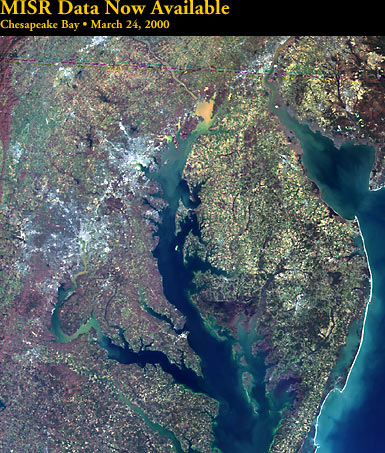
Rocks erode, travel down rivers and eventually in the form of small particles, settle in river deltas and estuaries. Even smaller pieces can be carried hundreds of miles into the ocean. It’s all part of the natural process of sedimentation, but like many other natural cycles, this one has been hijacked by human activities. Development, agriculture, channelization of streams, damming and many other practices change the natural course of sediment in the coastal oceans more than the ecosystem can handle.
These changes can either be a drastic increase in sediment runoff from upstream sources or a complete deprivation of naturally occurring deltas. In addition, many pollutants cling to these sediment particles so that changing the location of the sediment also shifts the location of pollution.
Increasing sedimentation
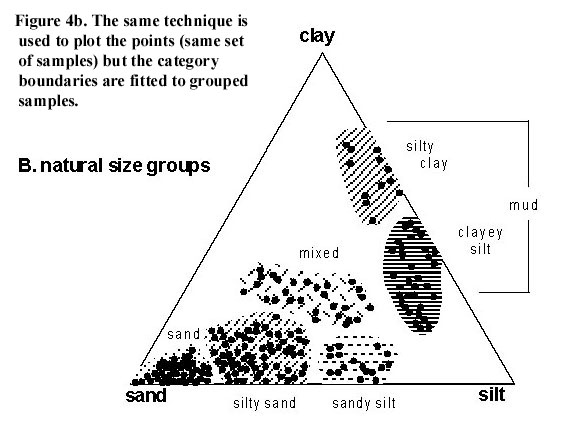
Sediment runoff from land comes in many forms. The largest particles settle out as soon as they hit estuarine water with a different mixing regime than the river they originated in. Lighter, small particles (silt) will continue traveling out to sea and some will slowly settle out. As sediment increases, the turbidity of the water increases. The largest concern with increasing turbidity is the consequent decrease in light that is able to penetrate the water. For seagrasses anchored to the sea floor, sediment pollution can mean a death sentence by starvation (Short and Wyllie-Echeverria 2009).
In addition, the sediment that settles out in the estuaries and close to shore can cover up benthic organisms. This has been observed directly in dredging operations by the Army Corps of Engineers. Once covered up, animals like oysters, clams, and scallops, cannot dig their way back out. Instead, they will likely suffocate and perish. This same process happens at a slower scale from terrestrial erosion, but the benthic organisms face the same problem of not being able to escape. Others have shown that larvae have a much less successful recruitment, occasionally also being trapped, in areas of high sedimentation.
Decreasing sedimentation
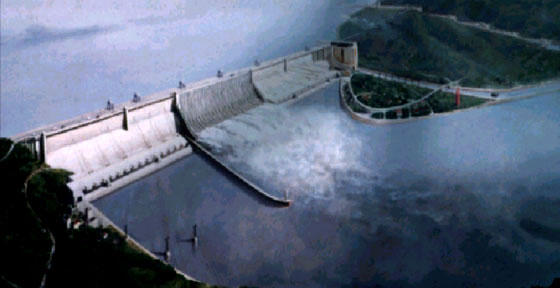
Dams play the opposite role in terms of human intervention in the sediment cycle – they collect the sediment that should be running offshore to create beaches, spits, and other coastal habitats. This has been recognized as such a problem in salmon runs that it was a reason in the decision to take down the Elwha dams in Washington State. The decrease in sediment has actually completely converted the sandy delta of the Elwha, one of few sandy shores on the West Coast, to a rocky shoreline with a completely different community of organisms. In another example, a calculation for the Yellow River in China determined that of a 86% decrease in sediment delivery, 30% was due to a decrease in rainfall (related to climate change), 70% terrestrial human activities (40% due to agricultural practices, 20% sediment retention in dams, 10% changed hydrology due to dams). This has huge implications for the type of coastal ecosystem that can exist in the area (Wang et al 2007).
Ties to pollution
Although this series profiles each of the other kinds of pollutants in marine systems separately, sediments often provide the transport for these pollutants to move throughout a system and enter the food chain. Sediments are often caught and stripped of their biofouling community as food for benthic organisms such as fiddler crabs, corals, and opportunistic zooplankton. Settled sediment provides habitat for countless organisms such as crabs, sea stars, flounder, oysters, clams, scallops, etc. There are countless studies documenting the toxicity of sediments downstream of urban areas, near dredging operations, and downstream of industrial operations (try a quick Google search for a river or estuary near you). It’s just yet another impact to think about if pollution is tied to the changing sediment structure we humans are creating.
~Bluegrass Blue Crab
Literature Cited:
Short, F., & Wyllie-Echeverria, S. (2009). Natural and human-induced disturbance of seagrasses Environmental Conservation, 23 (01) DOI: 10.1017/S0376892900038212
Toshihiro Onitsukaa, Tomohiko Kawamura, Satoshi Ohashic, Shunsuke Iwanaga, Toyomitsu Horiia and Yoshiro Watanabe (2008). Effects of sediments on larval settlement of abalone Haliotis diversicolor JEMBE, 365 (1) : doi:10.1016/j.jembe.2008.07.042
Houjie Wang, Zuosheng Yang, Yoshiki Saitoc, J. Paul Liud, Xiaoxia Suna, and Yan Wanga (2007). Stepwise decreases of the Huanghe (Yellow River) sediment load (1950–2005): Impacts of climate change and human activities Global and Planetary Change, 57 (3-4) : doi:10.1016/j.gloplacha.2007.01.003