 I write a lot about shark conservation issues, but I rarely focus on their fellow elasmobranchs. Rays and skates have similar life history strategies as sharks, and many species are similarly overfished. A friend just sent me a cool paper about the conservation of skates, which provides an excellent opportunity to remedy this oversight.
A major issue standing between well-managed elasmobranch fisheries and the mess we find ourselves in today is species identification. Many species look very similar (in some cases, DNA tests are required to tell them apart), which makes recording catch statistics extremely difficult. In fact, United States fishery management policy sometimes focuses on species complexes (i.e. “Large Coastal Sharks”) of sharks rather than individual species. Species identification is a major issue for skates as well.
The common skate (Dipturus batis) is heavily exploited by the European seafood industry. While this species was once common, it is locally extinct throughout large parts of its historic territory. Many consider common skates to be the first example of modern industrial fishing technology bringing a fish to the brink of extinction. However, the story isn’t as clear as some textbooks would have us believe.
Some evidence (extremely variable morphological measurements, differences in time to reach reproductive maturity, etc) suggests that D. batis is actually two different species, prompting the authors to do a re-evaluation of the taxonomy. They present pretty convincing genetic and morphological evidence that D. batis is, in fact, two different species. This has major consequences for the management of skates. As the paper’s authors say:
“This taxonomic confusion puts into question all previously accumulated data based on D. batis. Its endangered status highlights the need for an extensive reassessment of population collapses with accurately identified species.”
Since these animals have been extensively fished for nearly a century and have some of the most detailed fishery data around, having “all previously accumulated data” put into question is a big deal. To make matters worse, the authors found that European fishing markets often incorrectly label skate meat- apparently, one of the newly-identified species formerly known as D. batis looks very similar to yet another species of skate.
This research has enormous implications for one of the world’s largest elasmobranch fisheries (and possibly for numerous similar fisheries worldwide ), and I’m very curious to see how regulations change as a result of it. In the meantime, in case you ever find yourself near one of these animals, here is a diagram of “the most significant morphological differences” between them. It’s no wonder that fishermen call them both the same animal.
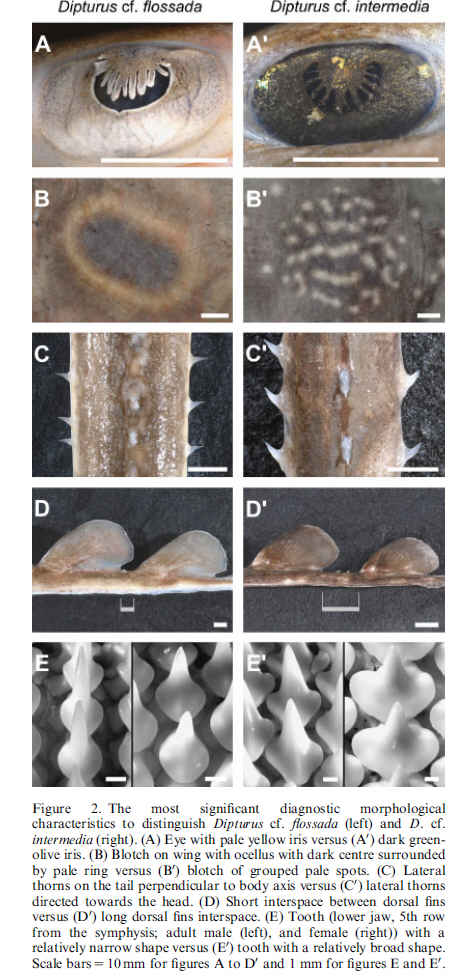

Iglésias, S., Toulhoat, L., & Sellos, D. (2010). Taxonomic confusion and market mislabelling of threatened skates: important consequences for their conservation status Aquatic Conservation: Marine and Freshwater Ecosystems, 20 (3), 319-333 DOI: 10.1002/aqc.1083
Please sign the petition to prevent shark-finning from becoming a threat to Bahamian shark populations. http://www.thepetitionsite.com/takeaction/549/487/335/
Also, there is a beautiful video from the petition’s author here: http://www.youtube.com/watch?v=WK2LpUoqX6A
Thank you, and enjoy!
The typesetters eye
context independent, fails
elasmobranchii
comments editted as per Rule 5a
Sharks and skates are closely related groups facing similar threats. I don’t understand your objection.