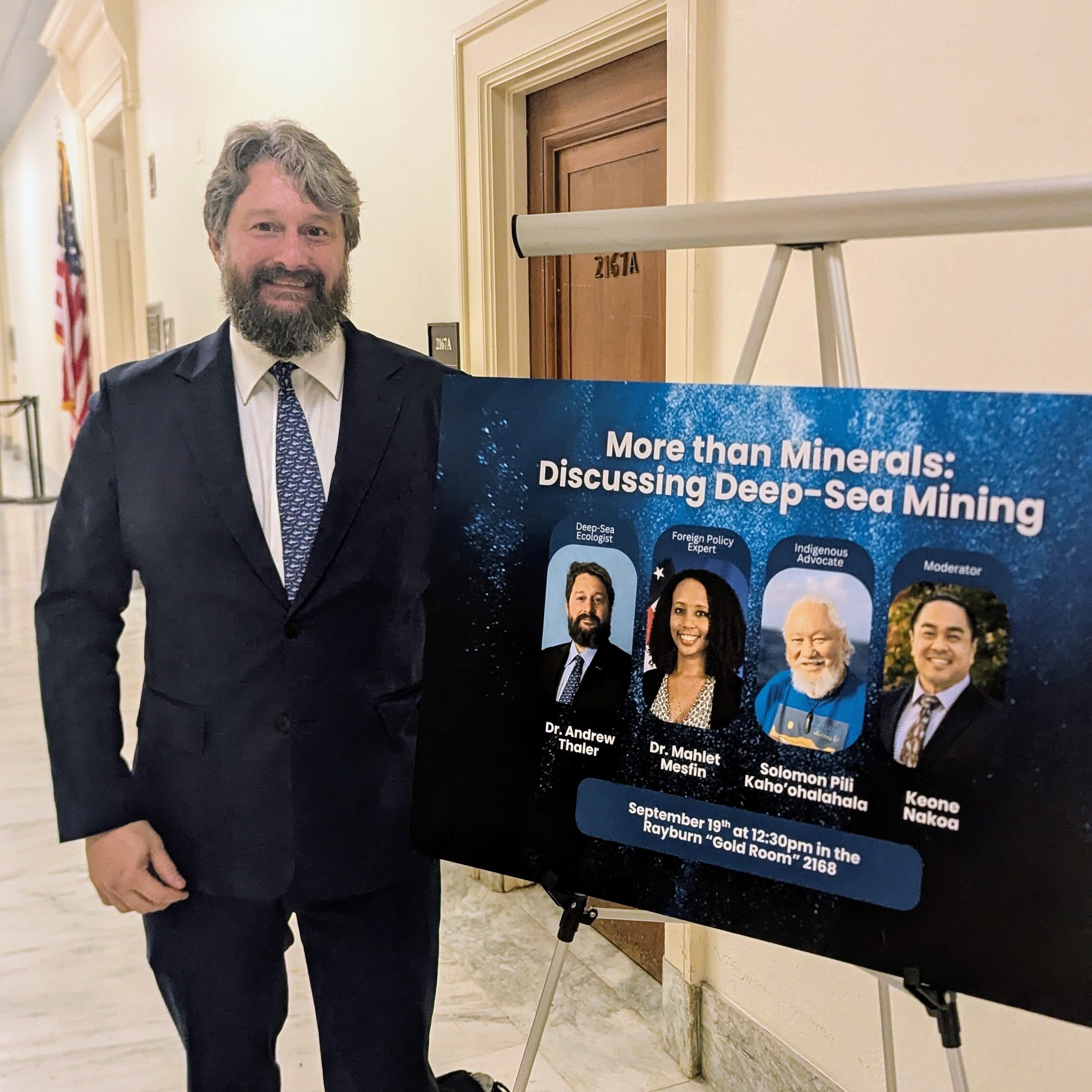
Last Friday, I was invited by Congressman Case to brief congressional staffers on the environmental impacts of deep-sea mining alongside former Deputy Assistant Secretary for Ocean, Fisheries and Polar Affairs, Dr. Mahlet Mesfin, and native Hawaiian Elder, Solomon Pili Kahoʻohalahala. It was a complex and wide ranging discussion across a range of scientific, policy, and cultural questions. Below is my attempt to summarize my answers on the ecology of the seafloor and the potential impacts of deep-sea mining. This is by no means a comprehensive look at the current state of deep-sea mining, but rather an attempt to distill and capture my contributions to an hour of discussion on the topic.
1. How much life is there, really, on the deep abyssal plain?
There is a myth being perpetuated that the deep-sea, and especially the nodule fields where deep-sea mining is proposed to occur, are relatively devoid of life. This is, by any scientific measure, incorrect. While it is true that the deep sea, which is generally nutrient limited, has relatively low abundance compared to surface and terrestrial ecosystems, the biodiversity of the deep sea not only rivals that of other charismatic ecosystems, but, thanks to the speciating power of isolation-by-distance, is likely more biodiverse than all other ecosystems, combined. The biodiversity of the deep sea is simply staggering.
This combination of exception biodiversity and low abundance makes species much more vulnerable to environmental harm.
2. What is the ecosystem like in a nodule field?
I could talk for hours about the ecology of the deep sea, especially at nodule fields, and did not have nearly the time to dive into the minutiae of nematode ecodiversity (I’m sure the audience was thankful for that). These fields are rich in microbial and macrobial diversity, hosting worms, glass sponges, coral, limpets, and large mobile scavengers. To provide one weird example, on of the first organisms we see return after a mining site is disturbed is something called a Xenophyophore. Xenophyophores are multinucleate single celled animals related to foraminifers. They are single cells. They are the largest single-celled organism that we know of, growing, in some cases, as large as a football. We know very little about them.
3. What is the national security value of the deep sea?
In terms of defense and national security, where we’re really losing ground is in discovery. Scientific discovery. For the last 50 years, every major discovery in the deep-sea has happened aboard an American ship or with the major contribution of US researchers. And these are real, economically tangible discoveries. Discovering hydrothermal vents fundamentally changed how we think about biology and revolutionized the medical industry to the tune of trillions of dollars. And we keep discovering new and totally novel ecosystems in the deep sea about once a decade. We are ceding that scientific legacy by prioritizing exploitation over exploration. This year, a Chinese research team discovered the deepest know complex ecosystem at 10,000 meters. This is a phenomenal discovery that pushes forward our understanding of the limitations, and lack of limitations, for life to survive and thrive in the harshest places on the planet. By pulling back on research in favor of mineral extraction, we are ceding American research dominance, and that can have real, long-lasting impacts that vastly exceed any economic benefits from mining the deep.
4. What kinds of impacts can we expect from deep-sea mining?
The nodule is the ecosystem, provide hard substrate for organisms to attach, as well as altering the topology of the seafloor and the current regime. Removal of nodules is removal of ecosystems. While there are some interesting proposals to mitigate the harm caused by deep-sea mining, I don’t think there’s anyway to avoid the direct impact to the immediate mine site – the best we can do, if mining proceeds, is to define acceptable loss and establish set asides and areas of particular environmental concern to be left alone.
Deep-sea mining produces sediment plumes at the seafloor, midwater, and, potentially, the surface, which has a range of impacts to benthic and pelagic species. There are numerous indirect impacts in the form of light and noise production. Nodule fields developed over millions of years, so it is likely that full recovery following disturbance will occur over eras, not years.
5. What lessons can we learn from previous seabed mining attempts?
The Blake Plateau provides a case study in just how vast and unknown the deep sea really is. In the 1970s, a company call DeepSea Ventures conducted an experimental nodule mining operation on the Blake Plateau. This first deep-sea mining serves as the longest running impact study for the industry. But the Blake Plateau is not just a nodule field. Stretching along three states, the Blake Plateau also contains the largest deep-sea coral reef in the world, a coral reef comparable to Australia’s Great Barrier Reef. And in the 1970s, DeepSea Ventures came with a few dozen kilometers of trawling it. This coral reef is likely the largest contiguous ecosystem in the United States of America, and we didn’t even know it existed until half a century after it was almost mined.
The deep sea is so vast and the potential for new discovery is functionally infinite.
6. What alternatives exists to deep-sea mining?
Our critical mineral gap is not in production, but in refining. We do, in fact, mine enough of these critical minerals in the US to meet our current and projected needs, but we fail to recover them from mining waste. Ninety percent recovery of by-products from existing domestic metal mining operations could meet nearly all US critical mineral needs.
The real alternative, at least for the major driver of excitement around deep-sea mining–electric vehicle batteries and energy storage–is to invest in new battery chemistries, like solid state batteries, which have very low metal requirements. China is way ahead of us on those fronts, to the point where we may rush to mine the sea to supply metals to a market which doesn’t really exist by the time commercial deep-sea mining reaches full production.
7. What evidence is there that deep-sea mining is cost effective?
It’s hard to predict. Operating at sea is a tremendously expensive and difficult endeavor and I expect that deep-sea mining companies are likely still a decade away from seeing full-scale commercial production. We’re really only talking about 3 metals, cobalt, nickel, and manganese, which make up the vast bulk of a nodule field’s value. Of those, the US is only 100% import dependent on manganese, and our primary supplier is South Africa. But deep-sea mining produces a lot of manganese, so much so that a modest mining prospect could nearly double annual manganese production. Deep-sea mining could very easily crash the manganese market, resulting in a similar surplus to what nickel and cobalt are currently enjoying. The values of all these metals are well below their historic highs.
8. Isn’t deep-sea mining less harmful than terrestrial mining?
There is a compelling argument to be made that deep-sea mining is less harmful than the worst forms of terrestrial mining, but that’s a bit of a cop out. Even the most optimistic projections for a commercial deep-sea mining operation accounts for only about 3% of the global supply chain for cobalt, nickel, and manganese in the next few decades. There’s no realistic possibility that deep-sea mining is going to lead to phase out of terrestrial mining. These are two different industries that need to be evaluated on their own merits, not in comparison.
9. Should we mine the deep sea?
It’s important to note that deep-sea mining is really three different industries which impact the environment in 3 very different ways. While we’re largely talking about polymetallic nodule mining at this moment, the President’s Executive Order and the Mining Code currently being discussed at the ISA leaves open the potential for hydrothermal vent and seamount mining as well. I think the case is pretty strong right now that there is no way to responsibly mine a hydrothermal vent, either active or inactive, nor is there a path forward for mining seamounts. I do still believe that a case could ultimately be made for polymetallic nodule mining, but we are still far from a comprehensive understanding of the ecosystem or cultural consensus. And I think deep-sea mining is racing against other technologies that will make the industry irrelevant. For me, the greatest tragedy would be for us to rush through the development of an entirely new extractive industry for metals that, by the time production reaches scale, we don’t even need.
Southern Fried Science is free and ad-free. Southern Fried Science and the OpenCTD project are supported by funding from our Patreon Subscribers. If you value these resources, please consider contributing a few dollars to help keep the servers running and the coffee flowing. We have stickers.