This post was originally published on September 8, 2010 as a part of our first Week of Ocean Pseudoscience. Enjoy!
 In 1954 and 1957 Gordon and Schaefer respectively described the idea of maximum sustainable yield (MSY) – that is, the amount of fish that could be taken by commercial fishing operations to maximize reproduction by the system year after year. Since then, it has been heralded as the mathematical panacea to fisheries management.
Gordon and Schaefer also described the maximum economic yield which threw price relations into the mix. It describes the point at which the fishers will make the most money, accounting for revenue and their expenses. Note in the graph below the fold that the maximum economic yield (MEY) is below the MSY in terms of effort. Gordon and Schaefer imagined a private manager or government overseer that could calculate the MEY and regulate fisher behavior in order to meet it. The idea was meant to be win-win for the fishers and the fish.
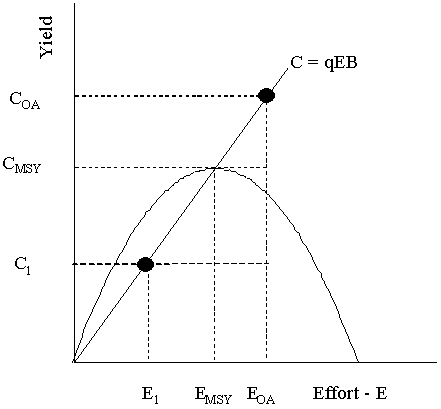
The graph above is usually how MSY is described. The upside down U curve describes revenue based on the catch yield. MSY harvests at the highest rate of growth, just before the removal of too many fish will cause a decrease in reproduction. The straight line describes cost to the fisher (gas, boat expenses, crew salaries). MEY (here E1) is the point at which the fishermen will gain maximum profit per fish they catch. Open access conditions (here Eoa) is when fishermen will be economically forced to stop because the profits they make equal the expenses toward fishing effort.
Granted, either MEY or MSY is better than open access, right? The situation prior to MSY thinking was described as “the race to fish” where every boat was out for their own best interest in the short-term. Since no one else was looking out for the future of the resource, it was safe to assume that the resource is non-renewable and therefore it makes the most rational economic sense to join in the same race. This assumes both perfect rational behavior on the part of the fisher and costs and revenues that follow a predictable pattern like those shown in the graph.
The MSY model also assumes that yield increases with effort until MSY is reached and that beyond that, replacement is slower due to a lower population size. Underlying that assumption is another in which fish population follow a classic sigma curve – slow growth at low and high populations, exponential growth in the middle. It also assumes that the cause-effect link is only one year long and that fishing behavior in one year will directly determine the next year’s stock. Gordon (1954) himself noted, however “large broods, however, do not appear to depend on large numbers of adult spawners, and this lends support to the belief that the fish population is entirely unaffected by man”. There are still small armies of graduate students out there attempting to characterize the population growth curve of major fishery species.
The assumptions continue, however. The model is single-species specific and doesn’t take into account any damage done to the ecosystem through fishing effort or outside factors that affect the fish stock related to the ecosystem at large. This is huge in an era of climate change and more widely recognized interacting factors. Furthermore, the model is a closed system, where there is no connectivity to other stocks, which in the case of cod (Kurlansky’s book), lobster (Wilson et al) and likely many other species, each stock is connected to others either farther inshore or offshore in terms of larval or juvenile transport.

Taking a big step up in scale, later work by Elinor Ostrom and more fisheries specific by Bonnie McKay and James Wilson question the assumption of tragedy of the commons. They documented real-life communities that despite incentives to participate in the race to fish, managed to self-organize to manage their commons in a sustainable manner for hundreds if not thousands of years. None of these systems used an MSY-like model and none had a central private or government decision-maker. In fact, there were several cases like those of the western Pacific (Conservation International) where disruption of the local management schemes actually led to fishery depletion and coral reef degradation, so there are recent efforts to restore traditional management techniques. These techniques rely upon social mechanisms and context-specific regulations. These concepts are worth a volume of books, but those have already been written and can be found sprouting out of the labs of Ostrom, McKay, and Wilson as well as their academic progeny.
For now, suffice it to say that MSY is simplistic and outdated. Marine management is on the edge of a shift towards a completely new management philosophy based more strongly in specific contexts and traditionally proven strategies.
~Bluegrass Blue Crab
Sources: Ostrom, E. 2002. Drama of the Commons. Washington, D.C.: National Academies Press.
Gordon, H. (1954). The Economic Theory of a Common-Property Resource: The Fishery Journal of Political Economy, 62 (2) DOI: 10.1086/257497