The mining of deep-sea hydrothermal vents for gold, copper, and other precious metals, is imminent. Over the last seven years I’ve worked with industry, academia, and international regulatory agencies to help craft guidelines for conducting environmental impact studies and assess the connectivity and resilience of deep-sea ecosystems. Deep-sea mining, particularly at hydrothermal vents, is a complicated endeavor. As an ecologist and environmentalist, I’d like to see all deep-sea ecosystems receive extraordinary levels of protection. As a pragmatist and someone who recognizes that access to technology is a human right, I realize that demand for essential resources like copper, cobalt, and rare earth elements is only going to increase.
Mining a deep-sea hydrothermal vent presents a conundrum. Across the world, vents vary in their longevity and proximity to each other. A fast spreading center like those found in western Pacific back-arc basins, can have numerous, densely packed vents that persist for tens of years. In contrast, ultra-slow spreading centers, like the central Indian Ridge, may have a few, sparsely distributed vents that remain active for centuries. The sustainability of deep-sea mining is completely dependent on the type of vents being mined. Vents in slow spreading centers may never recover from any anthropogenic impact, while those in fast spreading centers could be extremely resilient to the disturbance caused by mining.
Vents, especially vents in fast spreading centers, are extremely dynamic. The ecosystems that surround these hydrothermal vents have evolved to endure catastrophic disturbance on a decadal time scale. When I think about deep-sea mining, the question that matters most to me is: Is the disturbance caused by an extractive industry greater than the natural disturbance experienced by these system? One of the ways to work towards answering that question is: When we look at populations native to these systems, how isolated are they?
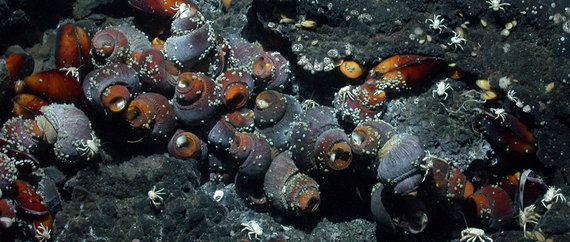
Through my research, I’ve attempted to answer that question with some of the dominant species from deep-sea vents in the western Pacific. For a broad swath of vent creatures, including barnacles, we see a surprising lack of population structure–that is, individuals from distant sites all appear to come from the same genetic stock; they are intermingling and interbreeding across vast spatial distances. In one particularly iconic species, Ifremeria nautilei–a fist-sized snail that lives right next to the hydrothermal vent plume–we looked at the entire known range of the species and only found evidence of genetic subdivision across thousands of kilometers. Within discrete back-arc basins, there was ever only a single well-connected population.
This sounds like a good thing for vents threatened by mining. If there is not population subdivision, than the population as a whole is more resilient to disturbance, critical genetic diversity is distributed throughout the population rather than concentrated in a few scattered and vulnerable groups. Recovery following extraction is more likely if there is a large, broadly distributed population that new recruits can be drawn from. And, if there is no recovery, if a post-mining vent site never returns to life, unique populations won’t be lost.
For my most recent paper, published last week in PLOS One, we looked beyond the vent plume to further our understanding of population structure at western Pacific hydrothermal vents. First, we examined Chorocaris sp. 2–a hydrothermal vent-dependent shrimp that, unlike all other species examined from these site to date, is highly mobile We complemented this with an investigation into Munidopsis lauensis–an opportunistic squat lobster that hangs out near vents, where food is abundant, but is also found elsewhere throughout the deep-sea. Squat lobsters like Munidopsis are part of the vent halo fauna, animals that aren’t directly dependent on vents to survive, but exploit these biomass rich regions. Halo fauna are often dismissed as being part of the general, homogeneous background.
Chorocaris behaved exactly like we expected, with one big population distributed throughout a single basin and genetic sub-division happening only over thousands of kilometers.
Munidopsis, however, was a shock. At the very outset of this research adventure, we hypothesized that the species most dependent on hydrothermal vents for survival would have the strongest signals of population structure–species that needed vents would become locally entrained–but that was not the case. In retrospect, it makes sense. If you need to find fresh vents to colonize, you have to be able to broadcast the next generation of a wide distance in the hopes that a few would find another vent and settle out. So we were working under the hypothesis that there would be very little local structure among any species. The vent-dependent species had to disperse broadly and the halo fauna didn’t have major drivers for local differentiation. If anything, isolation-by-distance would be the ultimate trend.
This was not the case. When we looked at Munidopsis, we found discrete populations separated by less than 2.5 kilometers and the signal for isolation was incredibly strong. Here was a background species, one that was supposed to be able to opportunistically move between vents, yet it apparently settled within a single vent field and remained there, generation after generation.
So what does this mean for deep-sea vent mining? In this specific case, it means that a loss of locally a differentiated population will result in the permanent loss of unique genetic diversity. How important that diversity is to the species is as-yet undetermined. More broadly, it means that we’ve been thinking about conservation at these hydrothermal vents backwards. The iconic, biomass dominant, vent-dependent species are likely resilient enough to survive a moderate degree of anthropogenic disturbance. It’s the background fauna, the animals that aren’t exposed to catastrophic disturbance as vents shut down on a decadal time scale, that may take the brunt of environmental insult.
So how should this kind of information inform deep-sea mining? Going back to the beginning, it’s not just whether or not disturbance occurs, but whether anthropogenic disturbance exceeds the natural disturbance of a system. Vent-dependent organisms clearly experience more disturbance than non-vent species that are opportunistic in their colonization of vent systems. Because relative frequency of disturbance matters, mitigation at mining sites is dependent on ongoing monitoring of at-risk species and rapid response to changes in community and population structure. Spreading out the insult so that a single population does not experience the entirety of the disturbance all at once is also paramount. And finally, acceptable set-asides that act as reservoirs for genetic diversity can provide a buffer against catastrophic loss.
These are not insurmountable challenges, and I continue to remain hopeful that science, conservation, and industry can work together to shape the practices of the nascent industry to minimize, monitor, and mitigate the environmental impacts of deep-sea mining.
Great article! One thing I would like to add is that most biological diversity is clustered around active vents, at least this is my understanding, therefore, the key to mining with minimal impact is to try to find extinct vents that no longer support such a large degree of ecological diversity. That way it would be possible to mine all the great sulphides that are deposited in a vent system without disturbing the ecology of active vents. Extinct vents far outnumber active ones but the catch is that finding extinct vents is very, very difficult since they don’t give off the nice geochemical signatures that active ones do.