Skip to content

Southern Fried Science

Over 15 years of ocean science and conservation online

  • Home
  • About SFS
  • Authors
  • Support SFS

Fun Science FRIEDay – I can SEE what you’re thinking!

Posted on February 13, 2015February 6, 2015 By Kersey Sturdivant
Uncategorized

Humans are edging closer and closer to telepathic communication where one human communicates with another purely from thinking. Wait… what’s that you say? We are already there?! Like something out of a sci-fi thriller neuroscientists in Europe and America demonstrated the viability of direct brain-to-brain communications in humans.
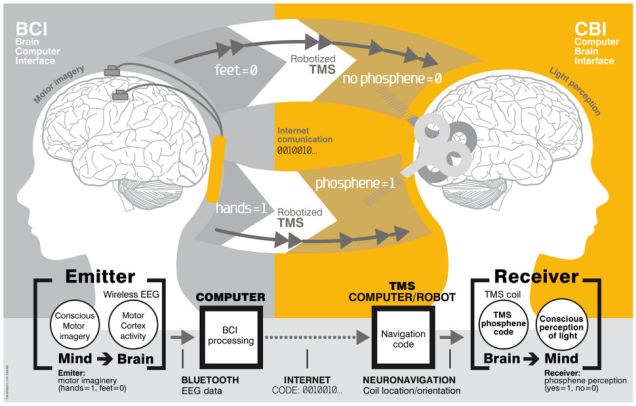
"Brain-to-brain (B2B) communication system overview. On the left, the BCI subsystem is shown schematically, including electrodes over the motor cortex and the EEG amplifier/transmitter wireless box in the cap. Motor imagery of the feet codes the bit value 0, of the hands codes bit value 1. On the right, the CBI system is illustrated, highlighting the role of coil orientation for encoding the two bit values. Communication between the BCI and CBI components is mediated by the internet." (Photo credit: Grau et al. 2014)
“Brain-to-brain (B2B) communication system overview.
On the left, the BCI subsystem is shown schematically, including electrodes over the motor cortex and the EEG amplifier/transmitter wireless box in the cap. Motor imagery of the feet codes the bit value 0, of the hands codes bit value 1. On the right, the CBI system is illustrated, highlighting the role of coil orientation for encoding the two bit values. Communication between the BCI and CBI components is mediated by the internet.” (Photo credit: Grau et al. 2014)

In the neuroscientific equivalence of telepathic instant messaging, Charles Grau from Starlab Barcelona, and others, had individuals from France communicate with individuals in India… telepathically. Yes you heard that right! With a human subject in France, and the other in India, they successfully transmitted the words “hola” and “ciao” in computer assisted brain-to-brain thought.

How it worked, the team fitted an individual with an electroencephalograms (EEG), which facilitates communication between a human brain and a computer, and another individual with a robot-assisted image-guided transcranial magnetic stimulation (TMS), which is useful for mapping the motor cortex. They used the electrodes attached to one person’s scalp to record the electrical currents in the brain and interpret those signals and translate them into an output which they sent to the other individual and transmitted the message into their brain. Individual A in France would think “hola”. That thought was mapped by the TMS and translated into a text output “hola”. This was then converted into binary and sent via the internet to individual B in India. Using the EEG, the researchers’ transmitted “hola” to the brain via noninvasive brain stimulation known as phosphenes — flashes of light in the peripheral vision.

Though a crude form of brain-to-brain communication, it offers us a framework for the way forward regarding telepathic communication, and is definitely a first in the realm of non-invasive direct communication between human minds.

You can see the full study in the journal PLoS ONE.

Share this:

  • Click to share on Bluesky (Opens in new window) Bluesky
  • Click to share on Facebook (Opens in new window) Facebook
  • Click to share on Reddit (Opens in new window) Reddit
  • Click to share on Threads (Opens in new window) Threads
  • Click to share on WhatsApp (Opens in new window) WhatsApp
  • Click to share on Mastodon (Opens in new window) Mastodon

Related

Tags: consciousness electroencephalography man-computer interface motor neurons scalp sensory cues telecommunications vision

Post navigation

❮ Previous Post: Bioshock Oceanographic: How deep is Rapture?
Next Post: To co-author or not to co-author? ❯

You may also like

Uncategorized
Fun Science FRIEDay – Life After Death
October 20, 2017
Weekly Salvage
Chasing Genius, aquatic brain blobs, hurricanes, bats, and more! Monday Morning Salvage: September 4, 2017
September 4, 2017

Popular Posts

Shark scientists want their research to help save threatened species, but don’t know how. Our new paper can help.Shark scientists want their research to help save threatened species, but don’t know how. Our new paper can help.December 1, 2025David Shiffman
Norway and Cook Islands put their deep-sea mining plans on pause.Norway and Cook Islands put their deep-sea mining plans on pause.December 3, 2025Andrew Thaler
What Ocean Ramsey does is not shark science or conservation: some brief thoughts on "the Shark Whisperer" documentaryWhat Ocean Ramsey does is not shark science or conservation: some brief thoughts on "the Shark Whisperer" documentaryJuly 2, 2025David Shiffman
What we know we don't know: impacts of deep-sea mining on whales, dolphins, sharks, turtles, and other migratory species.What we know we don't know: impacts of deep-sea mining on whales, dolphins, sharks, turtles, and other migratory species.November 20, 2025Andrew Thaler
2025: My year in writing, public speaking, and media interviews2025: My year in writing, public speaking, and media interviewsDecember 3, 2025David Shiffman
The Trouble with Teacup PigsThe Trouble with Teacup PigsOctober 14, 2012Andrew Thaler
Urea and Shark OsmoregulationUrea and Shark OsmoregulationNovember 15, 2010David Shiffman
How tiny satellites are tracking marine wildlifeDecember 1, 2025Andrew Thaler
Shark of Darkness: Wrath of Submarine is a fake documentaryShark of Darkness: Wrath of Submarine is a fake documentaryAugust 10, 2014Michelle Jewell
Quick Tips for Graduate Student Life - Write a Book ReviewJanuary 23, 2014Andrew Thaler
Subscribe to our RSS Feed for updates whenever new articles are published.

We recommend Feedly for RSS management. It's like Google Reader, except it still exists.

Southern Fried Science

  • Home
  • About SFS
  • Authors
  • Support SFS


If you enjoy Southern Fried Science, consider contributing to our Patreon campaign.

Copyright © 2025 Southern Fried Science.

Theme: Oceanly Premium by ScriptsTown