Skip to content

Southern Fried Science

Over 15 years of ocean science and conservation online

  • Home
  • About SFS
  • Authors
  • Support SFS

Fun Science FRIEDay – “A cold-water fish with a warm heart!”

Posted on May 15, 2015 By Kersey Sturdivant
Uncategorized

OPAH, OPAH, OPAH!

Recently scientists at NOAA’s South West Fisheries Science Center made a stunning discovery, the worlds first known warm-blooded fish, the moonfish, opah  (Lampris guttatus). Until this recent discovery all fish were considered cold-blooded ectotherms – allowing their body temperature to fluctuate with the change in ambient ocean temperature. However, opah’s are different, in that these largely solitary fish regulate their internal body temperature above the ambient temperature of their environment like mammals and birds (other warm-blooded animals).
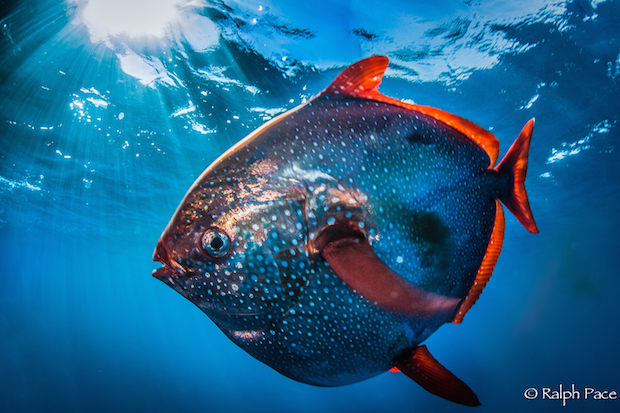
Opah off the coast of southern California. (Photo credit: Ralph Pace Photography)

Opah is a well-known fish, that given its body design and preference to dwell in cold deep-water habitats, was assumed to be lethargic-esque and slow-moving like other deep sea denizens. Scientists at NOAA stumbled onto the realization that this fish was warm-blooded when observing the gill tissue of opah. They found that blood vessels carrying warm blood into the fish’s gills wind around those carrying cold blood back to the body core. This design is known  as counter-current heat exchange, and is similar in function to a car’s radiator. This design allows warm blood leaving the body core to help heat up cold blood returning from the respiratory surface of the gills.  This natural heat conservation adaptation allows opahs to maintain an elevated body temperature despite the colder ambient sea temperature.  This is unlike anything ever observed in fish anatomy!

Realizing that opah’s are warm-blooded completely changes the way sceintist view life history strategies of this unique fish.  Once thought of as slow, ungainly predators, in reality opah’s are swift, actively chasing down and feasting on agile deep ocean prey like squid.

You can view more details this stunning study in the journal Science.


Happy FSF!!

Share this:

  • Click to share on Bluesky (Opens in new window) Bluesky
  • Click to share on Facebook (Opens in new window) Facebook
  • Click to share on Reddit (Opens in new window) Reddit
  • Click to share on Threads (Opens in new window) Threads
  • Click to share on WhatsApp (Opens in new window) WhatsApp
  • Click to share on Mastodon (Opens in new window) Mastodon

Related

Tags: Lampris guttatus moonfish opah warm blooded fish warm-blooded

Post navigation

❮ Previous Post: We built a beer-delivering underwater robot and sent it out to sea. You can probably guess what happened next.
Next Post: Dusky Sharks: Whale Killers ❯

Popular Posts

What Ocean Ramsey does is not shark science or conservation: some brief thoughts on "the Shark Whisperer" documentaryWhat Ocean Ramsey does is not shark science or conservation: some brief thoughts on "the Shark Whisperer" documentaryJuly 2, 2025David Shiffman
I can serve on your graduate thesis committee. Here’s what you can expect of me, and what I expect in return.I can serve on your graduate thesis committee. Here’s what you can expect of me, and what I expect in return.October 16, 2025David Shiffman
The story of the pride flag made from NASA imagery: Bluesky's most-liked imageThe story of the pride flag made from NASA imagery: Bluesky's most-liked imageSeptember 27, 2024David Shiffman
Shark of Darkness: Wrath of Submarine is a fake documentaryShark of Darkness: Wrath of Submarine is a fake documentaryAugust 10, 2014Michelle Jewell
What can the funniest shark memes on the internetz teach us about ocean science and conservation?What can the funniest shark memes on the internetz teach us about ocean science and conservation?November 8, 2013David Shiffman
The Trouble with Teacup PigsThe Trouble with Teacup PigsOctober 14, 2012Andrew Thaler
Nodules, Lost Mines, and Dark Oxygen: A new documentary on deep-sea mining asks important questions about the future of the industry.Nodules, Lost Mines, and Dark Oxygen: A new documentary on deep-sea mining asks important questions about the future of the industry.July 24, 2025Andrew Thaler
"Twitter sucks now and all the cool kids are moving to Bluesky:" Our new survey shows that scientists no longer find Twitter professionally useful or pleasant"Twitter sucks now and all the cool kids are moving to Bluesky:" Our new survey shows that scientists no longer find Twitter professionally useful or pleasantAugust 19, 2025David Shiffman
I turned my woodshop into a personal solar farm.I turned my woodshop into a personal solar farm.June 21, 2021Andrew Thaler
Build a dirt cheap, tough-as-nails field computer in a Pelican caseBuild a dirt cheap, tough-as-nails field computer in a Pelican caseJuly 21, 2015Andrew Thaler
Subscribe to our RSS Feed for updates whenever new articles are published.

We recommend Feedly for RSS management. It's like Google Reader, except it still exists.

Southern Fried Science

  • Home
  • About SFS
  • Authors
  • Support SFS


If you enjoy Southern Fried Science, consider contributing to our Patreon campaign.

Copyright © 2025 Southern Fried Science.

Theme: Oceanly Premium by ScriptsTown