 Erin Dillon is a PhD student at UC Santa Barbara studying how shark communities on coral reefs have changed over time. She graduated from Stanford University in 2014 with a B.S. in Biology and Honors in Marine Biology. Erin spent the following two years working with Dr. Aaron O’Dea as a fellow at the Smithsonian Tropical Research Institute in Panama, where she started exploring dermal denticles preserved in sediments as a paleoecological tool to reconstruct shark communities. She aims to develop this technique further as part of her dissertation to establish quantitative shark baselines and investigate spatial and temporal variation in shark assemblages on reefs. To do so, she has now set her sights on Curaçao, which is located in the southern Caribbean. There, she will work on validating the tool, explore differences in denticle assemblages between reef habitats, and provide estimates of relative shark abundance in data-limited parts of the island. Sharks are notoriously difficult to census, and it can be difficult to protect something that we rarely see. Therefore, the information provided by denticle assemblages extracted from reef sediments has critical implications for shark conservation, both in the Caribbean and worldwide. Erin is raising funds until September 22nd as part of Experiment’s Coral Reef Grant Challenge to unravel a pre-historical baseline of Caribbean sharks.
Sharks are important players on coral reefs. However, understanding the temporal and spatial dynamics of shark communities and how they are affected by human activities is challenging. Surveys and fisheries catch statistics reveal that shark populations worldwide have suffered significant declines over the past several decades due to overfishing and habitat degradation. But how many sharks should there be in a healthy coral reef ecosystem? The answer to this question is locked in the past. To address this issue, we turn to the recent fossil record to uncover clues about the sharks that used to roam the reefs of lore and paint a picture of how their communities have changed over time.
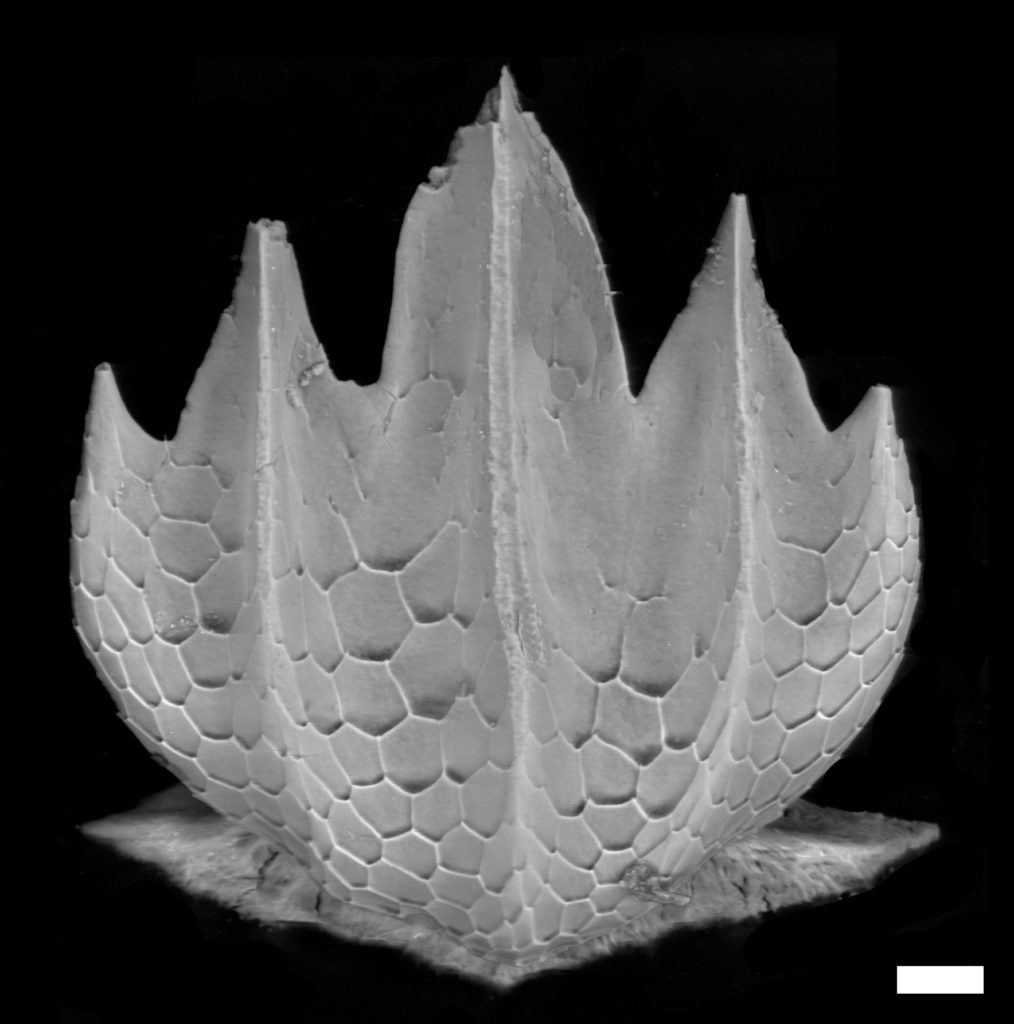
To do this, we examine dermal denticles, the tiny, tooth-like scales that line the skin of sharks. Denticles play several different roles, from reducing drag as the shark swims through the water to protecting the shark from mechanical abrasion or parasites that may try to settle on its skin. Consequently, denticles assume a variety of forms, which are often quite indicative of their function. Denticles are also continuously shed, and we’ve found them to be beautifully-preserved in both modern and fossil sediments on reefs. Denticles extracted from sediments not only tell us the relative abundance of sharks in an area over a long period of time but also the types of shark present. Specifically, these denticle assemblages can reveal whether the taxonomic or functional composition of the shark community has shifted over time and how it varies geographically.
Extracting and classifying denticles from sediments is not an easy task. It first involves collecting large amounts of sediment, particularly in areas where sharks are less numerous. The bits of shell and coral in the sand are eliminated using acetic acid, and the remaining residue is manually sorted under a microscope. In a way, the search for denticles resembles finding a needle in a haystack. The denticles, though, are abundant and diverse enough to identify and quantify the sharks from which they were shed.
Shark conservation is hampered by a lack of understanding of the baseline size of shark populations and the magnitude of decline. Denticles, however, show promise in providing some of this missing historical information, thereby informing more realistic management goals. After building a dermal denticle reference collection to facilitate identification and pioneering the technique with sediments collected from reefs in Panama and the Dominican Republic in 2015, we now aspire to further refine the insight supplied by denticle assemblages. Our proposed field work in Curaçao will help ground truth this novel approach to measuring shark abundance as well as standardize and broaden its applications.
Please check out our Experiment crowdfunding page to learn more about the project and support it. This field work won’t be possible without your help! Our campaign is in its final stage, and we must reach our funding goal by Thursday.