 Welcome to Dear Shark Man, an advice column inspired by a ridiculous e-mail I received. You can send your questions to me via twitter (@WhySharksMatter) or e-mail (WhySharksMatter at gmail).
Dear Shark Man,
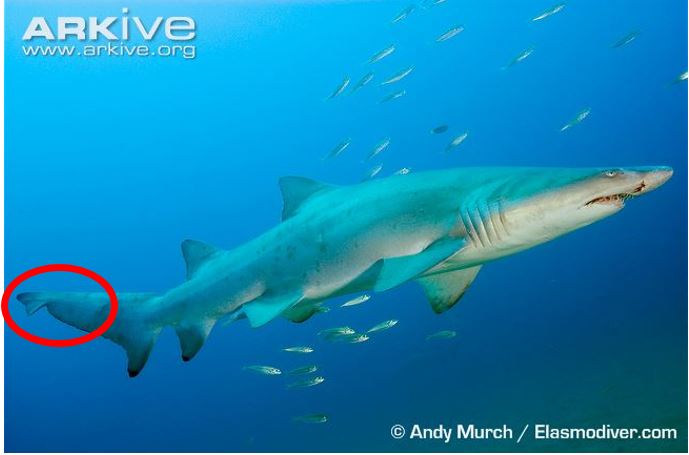
Why do sharks tend to have those little notches in their tail fin? Is it like an aerodynamic thing? If you were to fill it with more shark does something magic happen?
Sincerely,
Grateful in Georgia
Dear Grateful,
That’s a great question, and I didn’t know the answer! I reached out to an expert in the structure and function of shark fins, Dr. Brooke Flammang of the New Jersey Institute of Technology, to ask. Here’s what she told me.
“Sadly, there has not (yet) been a study focused on the fluid dynamics of the subterminal lobe (the flappy bit of tissue at the end of the tail, which moves freely because of the notch) of the shark tail. However, we can come up with a really good hypothesis about how it works!
Sharks that have the notch and the subterminal lobe are mostly in the order Carcharhiniformes (and also Squalus, which is the odd duck for everything). In Carcharhiniforms, as compared to, for example, Lamnids, the angle between the dorsal and ventral lobes is small, they have a low aspect ratio, and tails are more flexible. This suggests that Carchariniforms do not generate as much power with every tailbeat as Lamnids do.
Sharks with subterminal lobes tend to be slow-swimming, epibenthic/benthic/demersal dwellers. If you are swimming slowly in an undulatory fashion, you need to generate a considerable amount of force to maintain forward propulsion because you have less inertial benefit than when you are swimming quickly with a stiffer, more streamlined body. One way to increase force generation is to increase the momentum being added to the surrounding fluid – which is to say, you need to move more water away to push yourself forward.
The subterminal lobe adds surface area but is not stiff, lacking muscular control, and trails slightly behind the rest of the dorsal lobe during a fin beat. Because it trails behind, it extends the duration of time that fluid builds momentum before being shed from the tail (and thus generating thrust). Such passive thrust enhancement would likely only be effective at slow swimming speeds with more flexible tails, such as we see within the Carchariniformes. If you fill in the notch (and lose the flappiness of the subterminal lobe) you would decrease the efficacy of this enlarged area of flexible tissue in the tail considerably.”
Congratulations, Grateful, you’ve found a question that no one has explicitly studied, and given an expert an idea for a future project! We can only guess what would happen to shark’s swimming behavior if this notch were filled in, and Dr. Flammang’s guess is as good as anyone’s!
If you appreciate my shark research and conservation outreach, please consider supporting me on Patreon! Any amount is appreciated, and supporters get exclusive rewards!