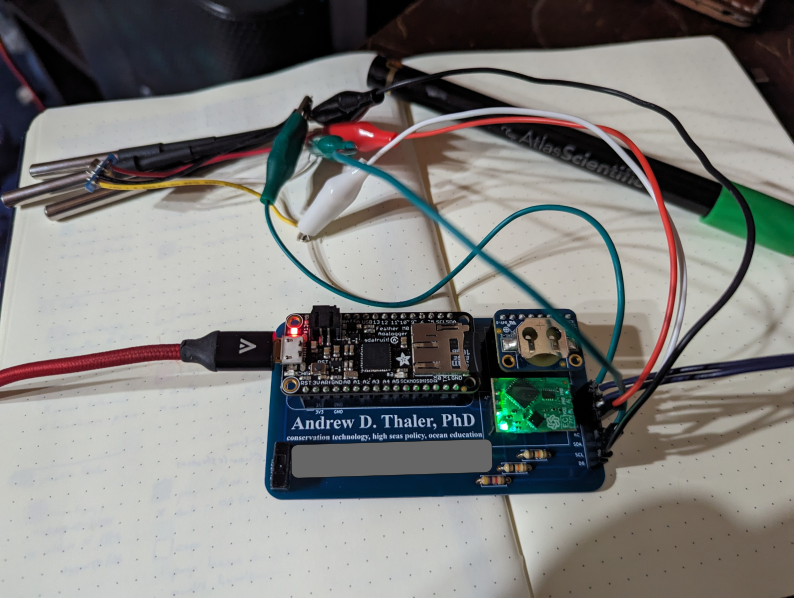
I spend a lot of time talking about the OpenCTD, my important, gigantic electronics project aimed at making the foundational tool of oceanography available to those most directly affected by our changing oceans. It’s been a minute since I’ve written about any of my weird little electronics projects.
I do lots of weird little electronics projects. I’ve written at length about why conservation technologists need to pursue those weird little electronics projects alongside their important, gigantic, world-saving electronics projects.
2023 was coming to an end. We finally published our first peer reviewed paper on the OpenCTD. The OpenCTD workshop program ramping up for the summer. I needed a memorable way to introduce ocean knowledge seekers to the OpenCTD.
Business cards are boring, largely superfluous in the era of the smartphone, and easy to lose. But a business card that doubles as a working oceanographic instrument, complete with an online guide, is not boring, superfluous, or easy to lose.
I made a calling card that was also an OpenCTD.
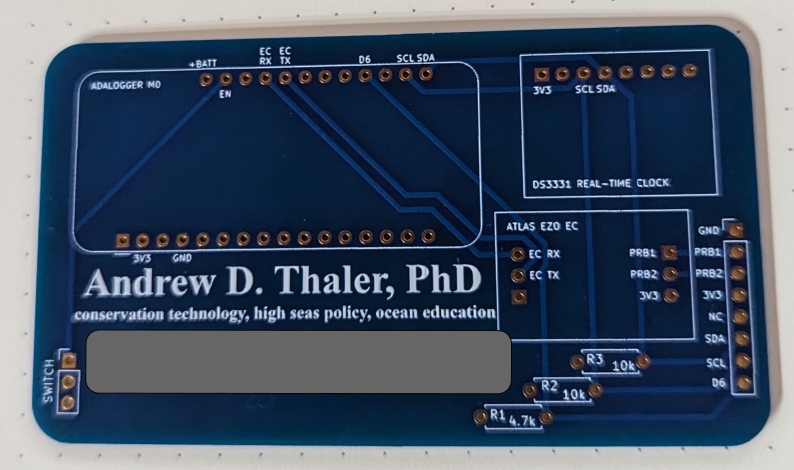
Like most of my weird little projects, it started as a goofy little novelty. At best a way to flex on my skills to a very, very niche peer group. When the first batch of prototypes rolled off the PCB mill, I realized that this very silly idea fulfilled an actual need during my OpenCTD workshops.
The OpenCTD is assembled over a two-day class and component testing doesn’t happen until late in the build, once both the control unit and the sensor package are finished, and just before everything is embedded in epoxy. Errors made early on compound, frustrating new and experienced users alike. The calling card, as it turns out, does triple duty:
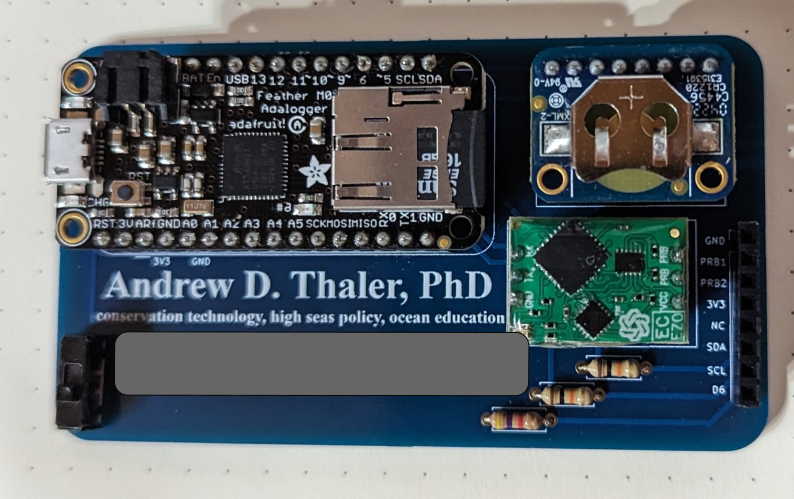
- Inexperienced students can use it to practice soldering. Students who have never soldered before are often nervous to lay down their first glob on a real component. This board let’s them practice as much as they want without risking any real components.
- Components can be tested earlier in the build. Once populated, this board can be used to test every component in the OpenCTD, from the control unit to the sensor package. This makes it much easier to identify and correct problems earlier in assembly.
- My contact information is close at hand. Just in case users need to get in touch with the core OpenCTD team or can’t remember the address to the GitHub repo, all of that information is stored right on the board.
I also added a non-dedicated pin to the breakout headers so advanced users can experiment with other sensors in the OpenCTD platform.
And yes, in a pinch, the bench board can also serve as a fully functional, if slightly awkwardly sized, control unit for an OpenCTD.
Here’s the punchline: a few months after I rolled out these boards/calling cards, Hackaday announced the 2024 Business Card Challenge. Of course I submitted this weird little electronics project.
The oceanographers calling card adds flexibility into the OpenCTD building process. A pre-made board which can test and verify each component of the OpenCTD before incorporation into the larger project, lets students evaluate and troubleshoot their builds before committing sensors to epoxy or soldering components into place. Having the bench test board helps participants build confidence in their skills and makes it easier to identify and correct potential issues during the build.
Southern Fried Science is free and ad-free. Southern Fried Science and the OpenCTD project are supported by funding from our Patreon Subscribers. If you value these resources, please consider contributing a few dollars to help keep the servers running and the coffee flowing. We have stickers.
