Skip to content

Southern Fried Science

Over 15 years of ocean science and conservation online

  • Home
  • About SFS
  • Authors
  • Support SFS

Author: Catherine Macdonald

Discovery of a Great Hammerhead Nursery

Posted on July 12, 2021January 9, 2022 By Catherine Macdonald
Conservation, Exploration, Uncategorized

Happy Shark Week (if you celebrate), and I’m so excited to share our newly published open access paper about our research on juvenile great hammerheads (Sphyrna mokarran) with you! (It’s been hard to keep this one to ourselves).

Great hammerheads are an iconic shark species which have undergone significant population declines globally. In 2019, they were assessed as Critically Endangered by the IUCN Red List, which reported overfishing as the greatest threat to their survival. Great hammerheads are known to make incredible long-range migrations and cross state and international boundaries, making them challenging to protect as adults. Little is known about where they are born or where they spend their early years of their life, although there have been scattered reports of juveniles from the Gulf of Mexico, the Florida Keys, and one report from Georgia.

Identifying habitats that are important to juvenile sharks matters because young sharks are often the most vulnerable individuals in a population, and their survival is vital to the future of their species. Many juvenile sharks spend time in “nursery areas”—places where they are less likely to be eaten by predators, or where food resources are abundant. They then expand their ranges as they age, covering more distance as they grow larger. Identifying nurseries has long been a conservation priority for managers and scientists. After several years of research, our team has collected the first scientific evidence of a nursery area for great hammerhead sharks on the Atlantic coast of the United States—within sight of the skyline of Miami, Florida.

There’s a three-part established test for an area to be identified as a shark nursery: 1) Juvenile sharks are more commonly encountered in that habitat than elsewhere; 2) they remain in the area for extended periods; and 3) The area is used repeatedly over years. Our results demonstrate that this area definitely meets two of these criteria, with preliminary evidence that it also meets the third. We’ve found the same habitat may be a nursery area for several other shark species too, including scalloped hammerheads, another Critically Endangered species!
Read More “Discovery of a Great Hammerhead Nursery” »

Sharks, Squalene, and a SARS-CoV-2 vaccine

Posted on October 16, 2020January 4, 2021 By Catherine Macdonald
Uncategorized
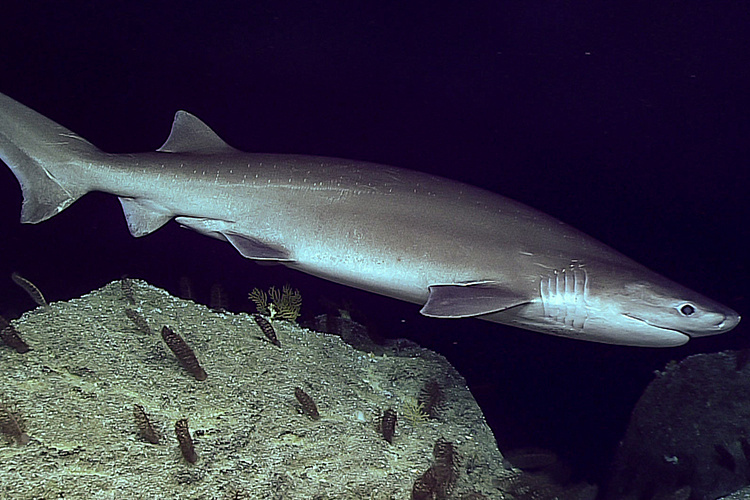
A bluntnose sixgill shark (Hexanchus griseus). Photo credit: NOAA Ship Okeanos Explorer.

Hi, friends at Southern Fried Science!

You’ve probably seen in the media lately that there’s been a lot of coverage about whether sharks are being killed for SARS-CoV-2 vaccines. With an awesome undergraduate co-author, I’ve tried to gather some facts about what is happening (or might happen) and what it means. You can read a preprint of that work here, or read on for a short FAQ in plain English.

Read More “Sharks, Squalene, and a SARS-CoV-2 vaccine” »

Creating Healthy Working Cultures in Marine Science Education

Posted on April 10, 2020April 10, 2020 By Catherine Macdonald
Academic life, Education

Below you’ll find a document I’ve been thinking about for more than a decade. I teach marine science field skills to undergraduates and graduate students at Field School and the University of Miami, and I’ve had a lot of opportunities to observe science and scientific learning in action. This is my best effort to distill the key principles I’ve learned about creating a healthy, supportive working environment. Starting the year, my students at Field School will all read and sign on to these principles before working with us.

It feels important to add that cultures are the product of choices and actions (or inaction). They don’t create themselves; they are created by the people within them. That means, sadly, that in every toxic organization there are people who choose, and benefit (or think they benefit) from that toxicity. The good news is that it also means we can choose something else. It’s not out of our hands.     

I’ve spent a lot of my time thinking about how to create welcoming, supportive learning environments for all of my students. And no: I don’t believe compassion and acceptance mean you have to sacrifice scientific rigor—in fact, I think students learn and grow more in these settings.

If you are also engaged in looking for solutions to the systemic problems in how we train future marine scientists, please feel free to join me by sharing this, implementing it in your own teaching, or reaching out with suggestions for how it can be improved based on your knowledge and practice. If you are a student who is struggling with these issues and you need advice or a friendly ear, please know that you are not alone, and my inbox is always open to you.

Read More “Creating Healthy Working Cultures in Marine Science Education” »

Meet the newest Southern Fried Science contributor, Dr. Catherine Macdonald

Posted on November 25, 2019November 27, 2019 By Catherine Macdonald
Conservation, Science

Hello, world of Southern Fried Science.

The Field School team restrains a blacktip shark for a quick work-up during a female-scientist-led trip with the amazing non-profit Terranaut Club.

I’m Catherine—if we’re being official about it, Dr. Catherine Macdonald—and I’m the newest contributing writer around here. Before we get into science, I thought it might be helpful to get better acquainted.  

Read More “Meet the newest Southern Fried Science contributor, Dr. Catherine Macdonald” »

Popular Posts

Shark scientists want their research to help save threatened species, but don’t know how. Our new paper can help.Shark scientists want their research to help save threatened species, but don’t know how. Our new paper can help.December 1, 2025David Shiffman
Norway and Cook Islands put their deep-sea mining plans on pause.Norway and Cook Islands put their deep-sea mining plans on pause.December 3, 2025Andrew Thaler
What Ocean Ramsey does is not shark science or conservation: some brief thoughts on "the Shark Whisperer" documentaryWhat Ocean Ramsey does is not shark science or conservation: some brief thoughts on "the Shark Whisperer" documentaryJuly 2, 2025David Shiffman
The Trouble with Teacup PigsThe Trouble with Teacup PigsOctober 14, 2012Andrew Thaler
What we know we don't know: impacts of deep-sea mining on whales, dolphins, sharks, turtles, and other migratory species.What we know we don't know: impacts of deep-sea mining on whales, dolphins, sharks, turtles, and other migratory species.November 20, 2025Andrew Thaler
2025: My year in writing, public speaking, and media interviews2025: My year in writing, public speaking, and media interviewsDecember 3, 2025David Shiffman
Urea and Shark OsmoregulationUrea and Shark OsmoregulationNovember 15, 2010David Shiffman
Shark of Darkness: Wrath of Submarine is a fake documentaryShark of Darkness: Wrath of Submarine is a fake documentaryAugust 10, 2014Michelle Jewell
How tiny satellites are tracking marine wildlifeDecember 1, 2025Andrew Thaler
Build a dirt cheap, tough-as-nails field computer in a Pelican caseBuild a dirt cheap, tough-as-nails field computer in a Pelican caseJuly 21, 2015Andrew Thaler
Subscribe to our RSS Feed for updates whenever new articles are published.

We recommend Feedly for RSS management. It's like Google Reader, except it still exists.

Southern Fried Science

  • Home
  • About SFS
  • Authors
  • Support SFS


If you enjoy Southern Fried Science, consider contributing to our Patreon campaign.

Copyright © 2025 Southern Fried Science.

Theme: Oceanly Premium by ScriptsTown