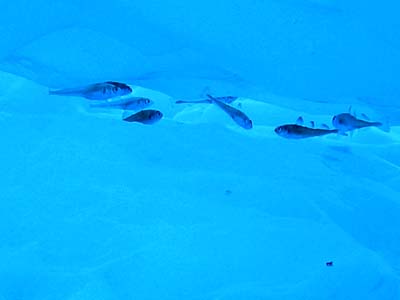
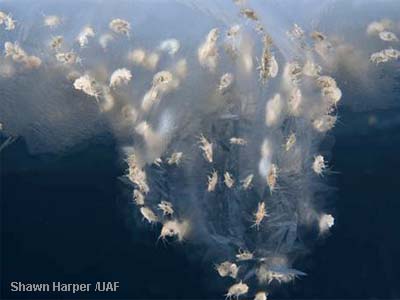
 A few years back I attended a mid-field season gathering of researchers working on International Polar Year projects. We were lucky enough to have collected the marine biologists, recently returned from a short cruise out of Barrow, AK with the mission to describe the biota living on the underside of the sea ice that is so critical to terrestrial Arctic ecology. It was absolutely stunning to me to realize that there is a whole ecosystem associated with the bottom of the ice, an ephemeral, threatened resource.
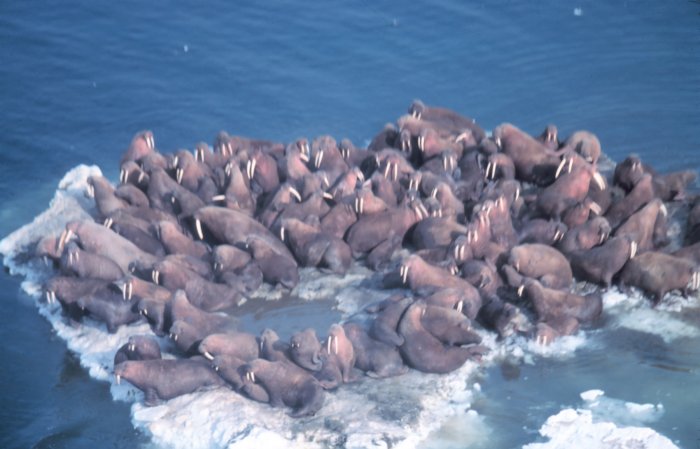
Depending on the time of year, sea ice covers 3-7% of the planet, making this relatively unexplored ecosystem fairly important to global biogeochemical processes. The algae trapped in and under sea ice, for example, accounts for 25% of the Arctic’s and 20% of the Antarctic’s primary productivity. This productivity trickles up the food web to the more well-known ice dwellers, such as polar bears and seals.Not all sea ice is created equal – some species prefer thin ice with lots of access to the ocean, while others prefer thick pack ice or fissured ice to make a safe nest. This leads to a stunning abundance of both microbes and macrofauna, especially for the cold arctic. Census of Marine Life has a great website about the critters that have been documented thus far, so I’ll leave covering individuals to them.
 The main threat to sea ice shouldn’t be surprising to anyone: climate change. We’ve all seen the pictures of sad polar bears swimming miles in search of a stable sea ice platform on which to rest. Or, from a human perspective, previously buried graves falling into the sea after the protection of the sea ice from winter storms is removed. EPA has a good summary of the physical and biological effects, complete with an animation of the shrinking habitat.
 A more often ignored threat is that of pollutants. In an area where human development consists of small indigenous villages, one might at first expect a pristine environment, but the poles constitute a global-scale environmental injustice. The pollutants spewed by industry in the tropics and temperate zones end up in the atmosphere, where they are transported by natural atmospheric movement to the colder poles, where snow is released from the cooling air, taking all the pollutants with it. Some of the highest rates of mercury, for example, have been found in the indigenous peoples of the Arctic, who sit at the top of the sea ice food chain with the bears and whales.
Sources: The Marine Biodiversity Wiki