 The ocean is full of metals and minerals that naturally occur such as zinc, copper, and cobalt and many marine organisms therefore depend upon access to those metals in small concentrations. However, inshore marine systems receive inputs from industrial, mining, and stormwater runoff that far exceed what these organisms can use. So what’s the effect? There was recently a good review article by Mayer-Pinto et al describings the effects of these metals at the assemblage level that basically did my job for me, research-wise, covering both marine and freshwater systems.
First, Mayer Pinto et al recognized that the majority of toxicological work is lab-based acute exposures in single organisms or very simple systems (micro or mesocosms). These results date largely back to the 1970’s and are great at determining which organisms are most susceptible to contamination and at what life stages. However, they don’t address the complex conditions to which these organisms are exposed in the wild and therefore don’t pick up any indirect effect a toxin might have.
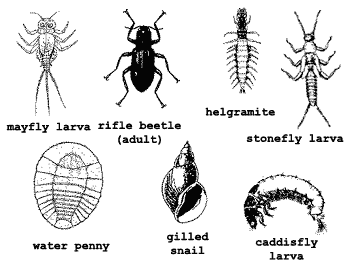
Aquatic assemblages are commonly used to determine the health of a stream or beach, as indicated by the presence of either mostly tolerant or mostly sensitive species. Careful quantitative analysis of these sites can lend some insight into these indirect or complex effects. However, as Mayer-Pinto et al warn, many of these studies are spatially confounded by only having one contaminant and one clean site. Also, because these sites are passive and often don’t have pre-contamination data, the most that can be concluded is correlation, not conclusion. However, these studies show that diversity, richness, and evenness of assemblages of macroinvertebrates (the ones seen by the naked eye) decrease with increasing copper concentrations.
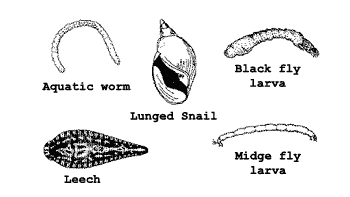
The few manipulated field studies they could find yielded much more mixed results, some showing no effects and some just as drastic (also mainly focused on copper). Effects varied across locations, taxa, season, and life stage as well as copper concentration. For instance, copper was found to have a delayed effect in winter but immediate in summer. Overal, though, some systems do have assemblage shifts when exposed to copper, zinc, and cadmium (the most commonly studied metals).
A few conclusions made by the authors – there need to be more direct field manipulations to establish a direct causal link between metal concentration and community assemblage shifts. In addition, more metals and combinations of metals need to be investigated to tease out some of the complex effects. I’m guessing some more nuanced and complex mathematical modeling might come in handy here, too, moving beyond the basic dose-response curve.
~Bluegrass Blue Crab
M. Mayer-Pinto, A.J. Underwood, T. Tolhurst, R.A. Coleman (2010). Effects of metals on aquatic assemblages: What do we really know? J. Exp. Mar. Biol. Ecol., 1-9