
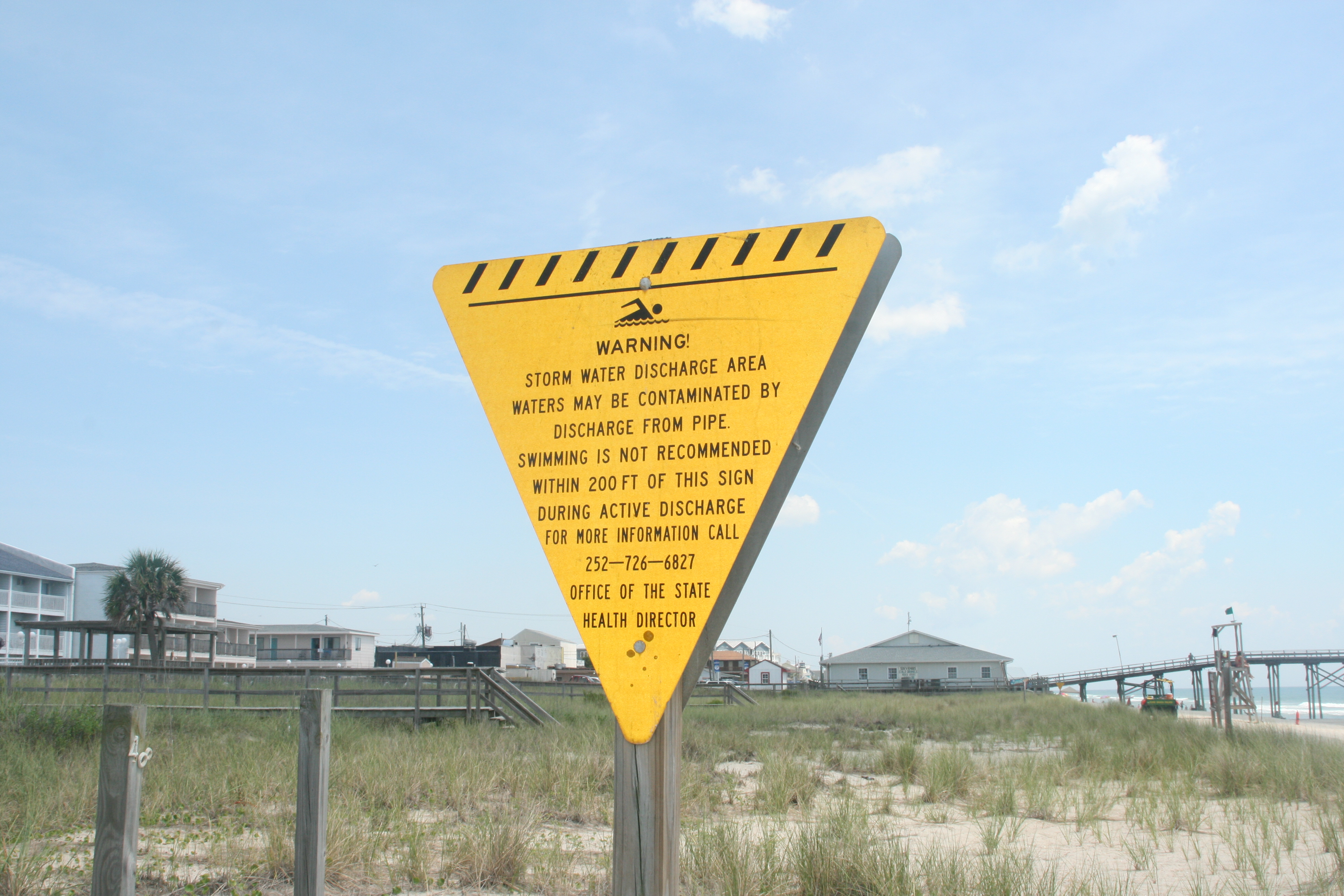
You live on a rural island. You poop. You flush. Does your island have a sewage treatment plant? Is your plant large enough to deal with the influx of tourists that increases the population of your island by an order of magnitude in the summer? Ever stop to look at the metal pipes on your island’s beach to see what was coming out? More than likely, there’s an ocean outfall involved in your island’s wastewater treatment plan. It may only be for overflow, but it’s an option.
What does “ocean outfall” really mean? Well, often it means raw sewage is dumped into the coastal environment that we all love to swim in.My own state, NC tests for fecal coliform bacteria, enterococcus, when deciding when to issue health advisories for swimming beaches or close shellfishing areas. Quite frankly, you’d be shocked how many signs are around town alerting me that the clams aren’t safe. And we don’t even have any ocean outfalls like Dare County and the Wilmington area.
But what are the impacts on the marine organisms? Depends on where you are and what’s in the sewage. At a minimum, the sewage contains extra nutrients and contributes to the eutrophication problems already described as part of this series. It also most likely contains pharmaceuticals, most notably estrogens and antidepressants.
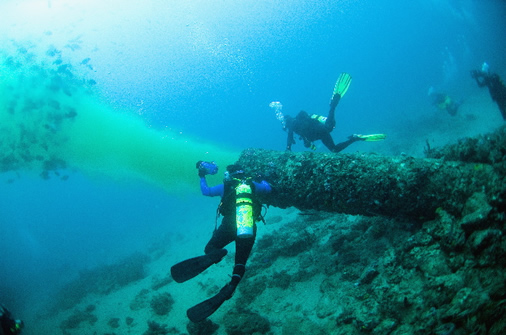
Outfalls in coral reefs are surprisingly common and is where the effects of raw sewage are often most visible. According to a study by James Bruno at UNC, the two most common coral diseases are much more potent in the presence of the extra nutrients found in sewage. One of these, a fungus called aspergillus, infected twice as much area of sea fan coral in the presence of nutrients from sewage. The other, yellow band disease, killed 50% hard corals in the presence of nutrients. And apparently, corals accumulate the bacteria in sewage – in a recent Florida study two-thirds of coral mucuses were found to contain enterococcus and 93% containted viruses commonly found in sewage. All this while the surrounding water tested clean.
In more temperate waters, the concerns are a bit different. In Halifax and St. John’s harbor, water and mussels around an untreated sewage outfall were found to have elevated levels of estrogens. The mussels fortunately were able to metabolize the extra estrogen quickly, but there’s some evidence from previous lab studies that these estrogens contribute to feminization of entire mussel colonies (Saravanabhavan et al 2009).
At a larger scale, the water around outfalls has been found to be characterized by higher turbidity, phosphate and ammonia in the water column, and organic matter, fecal coliforms and fecal Streptococci in sediments. In this same study, diversity of limpets was found to drop off as one neared the outfall and distribution of various limpet species was found to be determined by pollutant load, not competition with other limpets as described in more pristine systems. (Espinosa et al 2007). Why limpets? Because in this particular site in the Mediterranean, a number of these species are endangered and determining their biggest stresses is of immediate conservation priority.
The amazing part about sewage in the ocean is that it’s a relatively easy fix – the sources are distinct point sources and can be remedied by basic wastewater treatment – something that most people in a country like the US assume that they have. So next time you’re oceanside, think when you flush and ask the township you’re in what they’re doing to join the modern world.
~Bluegrass Blue Crab
Literature Cited:
Saravanabhavan G, Helleur R, & Hellou J (2009). GC-MS/MS measurement of natural and synthetic estrogens in receiving waters and mussels close to a raw sewage ocean outfall. Chemosphere, 76 (8), 1156-62 PMID: 19435639
Espinosa, F., Guerra-García, J., & García-Gómez, J. (2007). Sewage pollution and extinction risk: an endangered limpet as a bioindicator? Biodiversity and Conservation, 16 (2), 377-397 DOI: 10.1007/s10531-005-3014-3
Hello,
Our beach town (Rehoboth Beach Delaware) is getting ready to put in an ocean outfall. I wanted to do some research on this as far as safety. We were just voted one of the number one beaches in the nation for clean water. They have other options, such as land application, but are going with the outfall instead. Do you have any good sites that you would recommend for research?
Suzanne