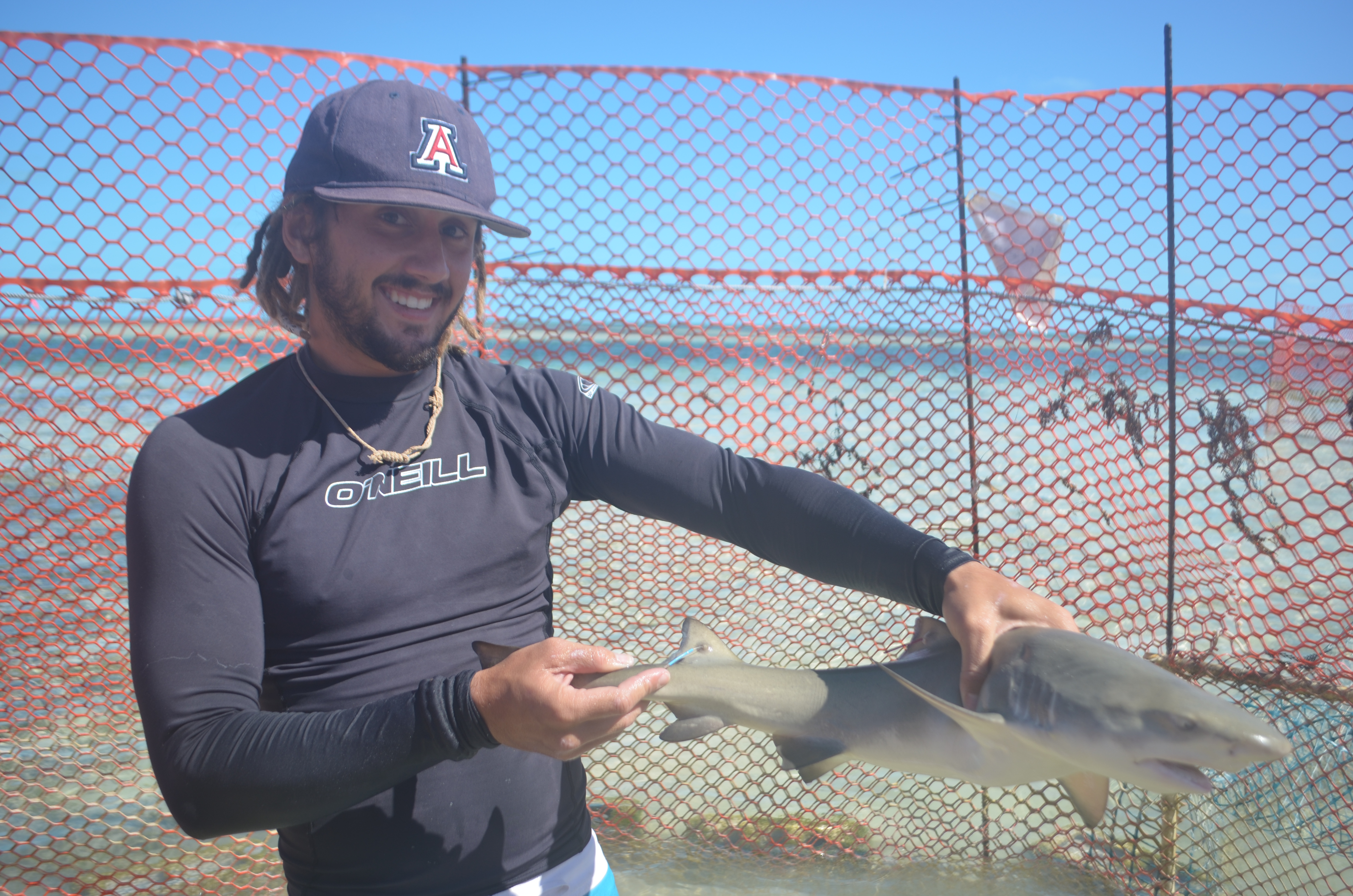
 Bryan Keller just graduated with his M.Sc. from Coastal Carolina University. For his thesis, he investigated the effect of familiarity on the social preferences of lemon sharks while researching at the Bimini Biological Field Station. Bryan and his team showed that lemon sharks do indeed prefer familiar individuals. Imagine this: You have two classes of kindergarten students that remained separated for one school year, and at the end of the year, the classes are mixed. More often than not, students would choose ‘friends’ based upon whom they are most familiar with, in this case that would be their classmates. Lemon sharks are the same way, they showed a preference for their ‘classmates’.
Offshore wind farms offer countless benefits, but will there be environmental costs? To help answer the looming question, we will tag a population of bonnethead sharks in South Carolina. The tags will communicate with acoustic receivers, and when the sharks swim close enough to the receiver, its presence will be documented. By using a series of receivers, we will be able to determine where a shark spends most of its time. After we know where the bonnetheads are spending their time, we will be able to conduct laboratory trials to determine if the introduction of offshore wind farms can displace the shark from this area. Recent work in SC showed that bonnetheads returned to the same estuary each year and from this, we know that the sharks aren’t randomly distributed throughout the environment. What if they can’t get back to the habitat they occupy every year? If offshore wind farms disrupt the marine ecosystem and prohibit sharks from returning, then there could be serious repercussions.
Generated power from offshore wind farms is sent back to shore with submarine cables, which emit an electromagnetic field. Sharks are very capable of detecting the signals that surround these cables. If sharks use magnetic-based navigation for migration, then the signals from the submarine cables could act as a roadblock to migration. Before federal land, like that which offshore wind farms will be built on, can be leased, environmental impact statements must be created. These documents will discuss how construction will impact whales or how turbines could impact birds and bats. The impact of offshore wind farms on sharks can’t be ignored and we hope to fill that niche. By funding this project, you are potentially expediting the success of offshore wind farms and protecting the seasonal migrations of coastal sharks.
Spreading the word about this project and donating any amount is greatly appreciated, (seriously, 1 dollar will help). You can adopt and name your own tagged-shark by donating $300, which is the price of one acoustic tag. Our initial funding goal on experiment.com was 10 tags plus expenses, which is $3500. We have almost surpassed our 1st goal, but we still have a long way to go. The project will need about 30 acoustic tags total, but I think we can do it. Even after we surpass our first funding goal, there will still be at least 20 sharks available for adoption. I think it’ll be pretty cool to have a shark swimming up and down from South Carolina to Florida.
Thanks for reading!