What’s the weirdest think you’ve found in the ocean?
Several week ago, we tackled this question while discussing the incredible shrinking cups the deep-sea scientists like to decorate and send into the wine-dark deep. While toilets and spam cans and beer bottles make for good headlines and shocking images of how extensive human impacts are on the deep sea, those are far from the strangest objects to grace the sea floor.
By most reasonable metrics, that honor has to go to the many nuclear weapons and nuclear weapon components that have been lost at sea over the last 70 years. While a few high-profile incidents have received tremendous coverage, most incidents remain largely shrouded in secrecy, with only sparse reports available. Which brings us to a question that’s been lodged in my brain for the last month: just how many nuclear weapons are sitting at the bottom of the sea?
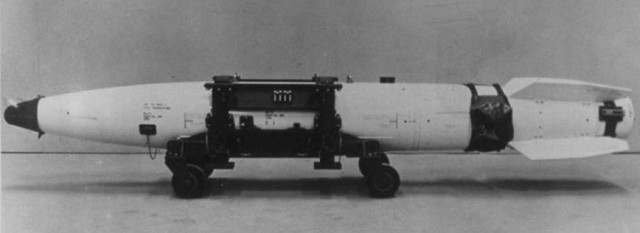
This, of course, does not include the many, many, many times the United States has intentionally tested nuclear weapons throughout the Pacific, often while forcibly relocating local communities away for their now-test-site homes or, occasionally, not. This also doesn’t include the rare lost nuclear submarine, who’s payloads and whether or not they carried nuclear ordinance are mostly still classified. And, of course, it doesn’t include the Soviets or any other non-US nuclear nation.
For the most part, the 1950s and 60s were a hell of a time for losing track of nuclear weapons. By the time the 70s rolled around we had decided that maybe we should be a bit more careful with these things. But by then, we had accidentally dropped at least ten nukes into the ocean in eight different incidents. And we had lost one in a Carolina swamp. And we had almost accidentally nuked Greenland.
Who the heck thought these things were a good idea?
These narratives come from the declassified DoD Narrative Summaries of Accidents Involving US Nuclear Weapons. It covers only the time between 1950 and 1980. Later accidents are likely still classified. Huge thanks to Martin Pfeiffer, who pointed me towards this report and tweets about people and atomic issues at @NuclearAnthro. You should probably just stop reading now and go contribute to their Patreon: Martin Pfeiffer is creating Anthropologically informed nuclear weapons research and fun!
Non-nuclear detonations.
- Pacific Ocean, near British Columbia (February 13, 1950): A B-36 Flying a simulated combat mission encountered mechanical trouble and flew out over the ocean to jettison its payload, which detonated. The weapon had a dummy warhead installed and only carried conventional explosives. The aircraft wreck was found three years later during an unrelated search for the downed plane of a Texas oil tycoon.
- Rivière-du-Loup, Quebec, Canada (November 10, 1950): A B-50 Superfortress experiencing engine trouble jettisoned its weapon over water near Quebec. Though it didn’t carry a plutonium core, the conventional explosive detonation scattered about 45kg of uranium from the neutron reflector.
Nukes lost at sea.
- Mediterranean Sea (March 10, 1956): A B-47 Stratojet vanished during refueling operations over the Mediterranean Sea carrying two “capsules of nuclear weapons material in carrying cases”. Neither the aircraft nor the capsules were ever found.
- Atlantic Ocean, near US East Coast (July 28, 1957): A C-124 experienced mechanical trouble and two unarmed weapons were jettisoned over of the coast of New Jersey. Neither detonated and both were subsequently lost at sea.
- Savannah River, Georgia (February 5, 1958): A B-47 on a simulated combat mission collided with another aircraft. Unable to land with the unarmed weapon, it jettisoned the device several miles east of the Savannah River. Though news reports claimed it was recovered last year, the weapon has not been found.
- Pacific Ocean, near Oregon Coast (September 25, 1959): A Navy P-5M aircraft crashed in the Pacific Ocean near the Oregon coast carrying an unarmed nuclear depth charge. Neither plane nor weapon have ever been found.
- Pacific Ocean, undisclosed (December 5, 1965): An A-4 Skyhawk carrying a 1-megaton warhead rolled of the deck of an aircraft carrier in the Sea of Japan. The weapon and the plane are presumably still sitting on the seafloor, 5000m below.
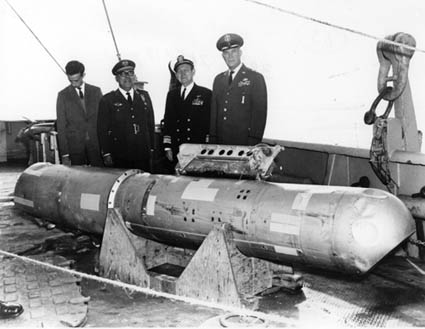
- Mediterranean Sea, near Spanish Coast (January 17, 1966): This is probably the most notorious at-sea Broken Arrow incident. A B-52 collided with its refueling plane and crashed near Palomares, Spain. It carried 4 nuclear weapons. One was recovered on land, two exploded on impact, and the other one was lost in deep water. The subsequent search involving the DSV Alvin was one of the major proving-missions to help justify large-scale funding for deep-ocean research submersibles. Fifty-years late, the US is still cleaning up contamination from the crash.
Other notable incidents.
- Carolina swamp, Goldsboro, North Carolina (January 24, 1961): So, we lost part of a nuke in a swamp in North Carolina. But it’s cool, because the Air Force now has an easement.
- Thule, Greenland (January 21, 1968): We kind of once just almost nuked Greenland. Woops.
It’s important to remember that while there is a perverse absurdity to how bad we are at the basics of having and transporting nuclear weapons, almost all of these incidents involve the loss of human life and are a tragic reminder of the cost of carelessness.
For those keeping count, at least two nuclear capsules, four unarmed weapons, and one armed nuclear weapon are currently sitting at the bottom of the sea.
If you enjoy Southern Fried Science, consider contributing to our Patreon campaign. For just $5 per month, you can support the SFS Writers Fund, which helps compensate your favorite ocean science and conservation bloggers for their efforts.