Skip to content

Southern Fried Science

Over 15 years of ocean science and conservation online

  • Home
  • About SFS
  • Authors
  • Support SFS

Do richer nations pollute less? An evaluation of the Kuznets curve

Posted on November 27, 2011December 9, 2011 By David Shiffman 2 Comments on Do richer nations pollute less? An evaluation of the Kuznets curve
Conservation

We’ve often heard that “the solution to pollution is dilution”, but according to one theory, the best way to reduce pollution in the first place may be to encourage economic growth. This is best modeled by a simple theoretical figure called a “Kuznets Curve”. According to the Kuznets curve, extremely poor nations pollute relatively little, partially because they lack the technology and resources for large-scale industry. Moderately wealthy nations have the technology for large-scale industry, but not the resources for pollution-reduction measures. The wealthiest nations are able to create large-scale industry and can also afford to purchase pollution reduction technology for their industries (or alternative industries entirely).
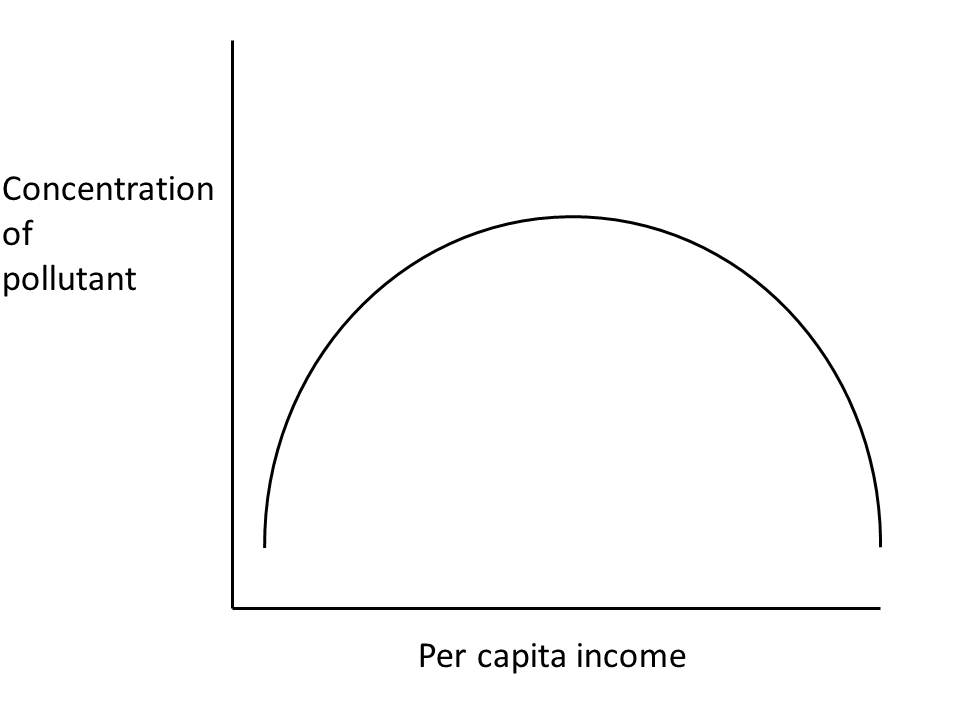
A simple Kuznets curve (credit: David Shiffman)

If true, the Kuznets curve allows us to reduce both poverty and pollution. Unfortunately, evidence for the Kuznets curve is limited and inconsistent. It actually works fairly well for certain pollutants, like sulfur dioxide. Relatively poor nations lack the technology to produce sulfur dioxide in the first place, and relatively wealthy nations can afford to utilize alternative technologies that don’t produce as much sulfur dioxide (a known threat to public health).
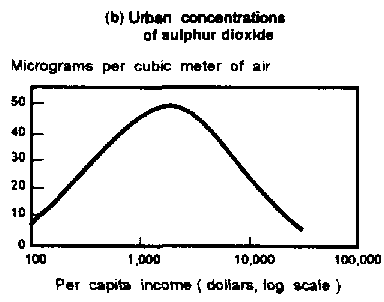
Source: World Bank's World Development Report, 1992

 The Kuznets curve breaks down when you analyze other pollutants, particularly those associated with consumption, like household trash or CO2 emissions. For these pollutants, poorer countries produce less, and the wealthier a country is, the more they produce. It is certainly possible that if per capita income increases enough, we will start to see reductions in household waste and CO2 emissions, but it isn’t really feasible to assume that every nation in the world will see per capita income that’s drastically higher than what the richest countries currently enjoy.
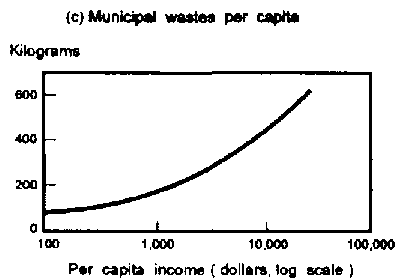
Source: World Bank 1992 World Development Report

While there is some evidence supporting the Kuznets curve for certain pollutants, making everyone richer does not seem to be a silver bullet for pollution reduction. In fact, increased per capita income may even increase certain environmental problems associated with consumption, such as climate change. Reducing poverty and protecting the environment by reducing pollution are both worthy goals, but fixing one won’t necessarily fix the other. Saving the world, as it turns out, is complicated.

Share this:

  • Click to share on Bluesky (Opens in new window) Bluesky
  • Click to share on Facebook (Opens in new window) Facebook
  • Click to share on Reddit (Opens in new window) Reddit
  • Click to share on Threads (Opens in new window) Threads
  • Click to share on WhatsApp (Opens in new window) WhatsApp
  • Click to share on Mastodon (Opens in new window) Mastodon

Related

Tags: environmental economics kuznets curve

Post navigation

❮ Previous Post: Are Neutrinos really faster than light? Irish folk rock parody band weighs in.
Next Post: Wording Matters: Conservation vs. Preservation ❯

2 thoughts on “Do richer nations pollute less? An evaluation of the Kuznets curve”

  1. Emmett says:
    November 27, 2011 at 8:37 pm

    Good points David. For some additional insights on this problem see here:

    http://naturalpatriot.org/2007/12/21/declining-ocean-health-its-the-economy-stupid/

  2. Steve says:
    December 8, 2011 at 11:41 pm

    Litter can be called a pollutant, but not trash. If we just dumped our trash in the street, you might have a case. We don’t. We dispose of it in a way that doesn’t cause disease and health problems or even aesthetic problems. CO2 is not a pollutant. It’s a naturally occurring gas necessary for plant life – that’s like calling a flood pollution from too much water.

Comments are closed.

Popular Posts

Shark scientists want their research to help save threatened species, but don’t know how. Our new paper can help.Shark scientists want their research to help save threatened species, but don’t know how. Our new paper can help.December 1, 2025David Shiffman
Norway and Cook Islands put their deep-sea mining plans on pause.Norway and Cook Islands put their deep-sea mining plans on pause.December 3, 2025Andrew Thaler
What Ocean Ramsey does is not shark science or conservation: some brief thoughts on "the Shark Whisperer" documentaryWhat Ocean Ramsey does is not shark science or conservation: some brief thoughts on "the Shark Whisperer" documentaryJuly 2, 2025David Shiffman
What we know we don't know: impacts of deep-sea mining on whales, dolphins, sharks, turtles, and other migratory species.What we know we don't know: impacts of deep-sea mining on whales, dolphins, sharks, turtles, and other migratory species.November 20, 2025Andrew Thaler
2025: My year in writing, public speaking, and media interviews2025: My year in writing, public speaking, and media interviewsDecember 3, 2025David Shiffman
The Trouble with Teacup PigsThe Trouble with Teacup PigsOctober 14, 2012Andrew Thaler
Urea and Shark OsmoregulationUrea and Shark OsmoregulationNovember 15, 2010David Shiffman
How tiny satellites are tracking marine wildlifeDecember 1, 2025Andrew Thaler
Shark of Darkness: Wrath of Submarine is a fake documentaryShark of Darkness: Wrath of Submarine is a fake documentaryAugust 10, 2014Michelle Jewell
Quick Tips for Graduate Student Life - Write a Book ReviewJanuary 23, 2014Andrew Thaler
Subscribe to our RSS Feed for updates whenever new articles are published.

We recommend Feedly for RSS management. It's like Google Reader, except it still exists.

Southern Fried Science

  • Home
  • About SFS
  • Authors
  • Support SFS


If you enjoy Southern Fried Science, consider contributing to our Patreon campaign.

Copyright © 2025 Southern Fried Science.

Theme: Oceanly Premium by ScriptsTown