Skip to content

Southern Fried Science

Over 15 years of ocean science and conservation online

  • Home
  • About SFS
  • Authors
  • Support SFS

Fisherman catches cosmopolitan planktonic tunicate. You’ll never guess what various news agencies are calling it.

Posted on January 22, 2014January 22, 2014 By Andrew Thaler 3 Comments on Fisherman catches cosmopolitan planktonic tunicate. You’ll never guess what various news agencies are calling it.
Science

“Translucent fish leaves New Zealand fisherman stunned” ~UK Metro

“Shrimp-like Translucent Sea Creature Found off Northland’s East Coast” ~Science World Report

“Now that’s a jelly fish! Stunned fisherman catches wobbly shrimp-like creature” ~Daily Mail

And another half-dozen variations on translucent, fish, shrimp, and baffled.
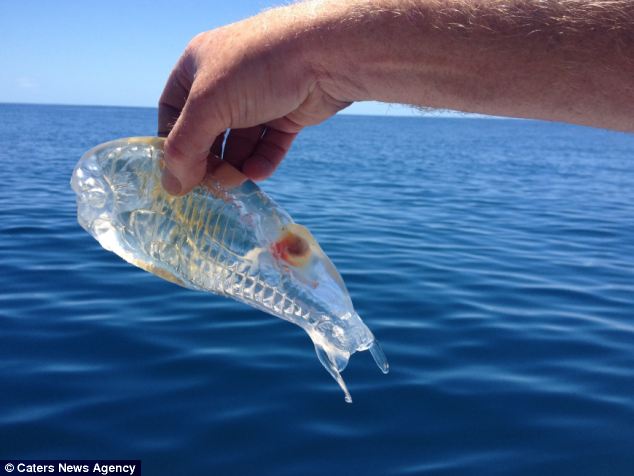
article-2543194-1AD845CC00000578-850_634x476This creature, whose image has gone viral in the last few days, is a salp. Salps are pelagic tunicates that drift through the open ocean, sometimes solitary, but often in large aggregations. It both swims and feed by pumping water through its body, filtering out plankton and expelling a jet of water from an organ called the excurrent siphon. In the water they look quite majestic.

Salps are among the most basal chordates, meaning they’re more closely related to us then they are to jellyfish or shrimp. Though understandable, mistaking a salp for a jellyfish has a Taxonomy Fail Index of 139.3, which is the highest I’ve seen in a mainstream publication.

While several news sources have at least provided a tentative identification of Salpa maxima, I disagree. I think it is far more likely that this is the solitary form of Thetys vagina, on of the largest salps in the Pacific Ocean. It has very prominent posterior projections (the narrow bit is actually the back on the animal). Though the images have no scale bars, it appears close to the 30-cm size common to this species. Most telling, however, is the number of muscle bands. In solitary form, Salpa maxima has fewer than 10 muscle bands, while Thetys vagina has more than 20, many of which are clearly visible in the photograph above.

Share this:

  • Share on Bluesky (Opens in new window) Bluesky
  • Share on Facebook (Opens in new window) Facebook
  • Share on Reddit (Opens in new window) Reddit
  • Share on Threads (Opens in new window) Threads
  • Share on WhatsApp (Opens in new window) WhatsApp
  • Share on Mastodon (Opens in new window) Mastodon

Related

Tags: salp salps tunicate tunicates

Post navigation

❮ Previous Post: Quick Tips for Graduate Student Life – Ask for Free Textbooks
Next Post: Quick Tips for Graduate Student Life – Write a Book Review ❯

You may also like

Science
Grampa Hagfish: say hello to your greatest uncle
October 20, 2010
Science
#TaxonomyFail: Salps, Jellyfish, and the Diablo Canyon Nuclear Power Plant
May 1, 2012

3 thoughts on “Fisherman catches cosmopolitan planktonic tunicate. You’ll never guess what various news agencies are calling it.”

  1. Capt Jill says:
    January 22, 2014 at 1:28 pm

    thanks for clearing that up! 🙂

  2. A Brady says:
    January 23, 2014 at 7:43 pm

    No bones: not a fish.

  3. Andrew David Thaler says:
    January 23, 2014 at 8:36 pm

    Actually, cartilaginous fishes like sharks, skates, and rays have no bones and are fish. So you can be a fish and not have bones.

    In this case, however, the salp is clearly a salp.

Comments are closed.

Popular Posts

The story of the pride flag made from NASA imagery: Bluesky's most-liked imageThe story of the pride flag made from NASA imagery: Bluesky's most-liked imageSeptember 27, 2024David Shiffman
"Why Sustainable Seafood Matters" is now available for preorder! Here's what it's about, and why I decided to write it."Why Sustainable Seafood Matters" is now available for preorder! Here's what it's about, and why I decided to write it.June 8, 2026David Shiffman
Tackling the least important debate in deep-sea mining: the desultory hyphenTackling the least important debate in deep-sea mining: the desultory hyphenJune 8, 2026Andrew Thaler
The evolution of the International Whaling Commission – from  whaling quotas to whale conservationThe evolution of the International Whaling Commission – from  whaling quotas to whale conservationJune 10, 2026Chris Parsons
What Ocean Ramsey does is not shark science or conservation: some brief thoughts on "the Shark Whisperer" documentaryWhat Ocean Ramsey does is not shark science or conservation: some brief thoughts on "the Shark Whisperer" documentaryJuly 2, 2025David Shiffman
Deep-sea Mining, Domestic Cats, Star Trek, and Ocean Exploration: Andrew's mid-year podcast round-up.Deep-sea Mining, Domestic Cats, Star Trek, and Ocean Exploration: Andrew's mid-year podcast round-up.June 6, 2026Andrew Thaler
Shark of Darkness: Wrath of Submarine is a fake documentaryShark of Darkness: Wrath of Submarine is a fake documentaryAugust 10, 2014Michelle Jewell
Isn’t ironic, don’t you think: dismantling the Ocean Observatories Initiative on World Oceans DayIsn’t ironic, don’t you think: dismantling the Ocean Observatories Initiative on World Oceans DayJune 9, 2026Southern Fried Science
What is a Sand Shark?What is a Sand Shark?November 12, 2017Chuck Bangley
That's not a blobfish: Deep Sea Social Media is Flooded by AI SlopThat's not a blobfish: Deep Sea Social Media is Flooded by AI SlopDecember 19, 2025Andrew Thaler
Subscribe to our RSS Feed for updates whenever new articles are published.

We recommend Feedly for RSS management. It's like Google Reader, except it still exists.

Southern Fried Science

  • Home
  • About SFS
  • Authors
  • Support SFS


If you enjoy Southern Fried Science, consider contributing to our Patreon campaign.

Copyright © 2026 Southern Fried Science.

Theme: Oceanly Premium by ScriptsTown