Skip to content

Southern Fried Science

Over 15 years of ocean science and conservation online

  • Home
  • About SFS
  • Authors
  • Support SFS

Fun Science Friday – BP Oil Spill Impacts Dolphins

Posted on January 3, 2014January 7, 2014 By Kersey Sturdivant 2 Comments on Fun Science Friday – BP Oil Spill Impacts Dolphins
Uncategorized

Happy Fun Science Friday!

Though this post does not present such a happy story, given the recent discussion about dolphin photobombing, this week’s FSF is topically related.  In the spring of 2010 the Deepwater Horizon oil rig experienced catastrophic failure resulting in the worst oil spill in human history. The Gulf of Mexico (GoM) was the unfortunate host of this catastrophe and the GoM community is still feeling the ecological, social, and economic consequences of this disaster.
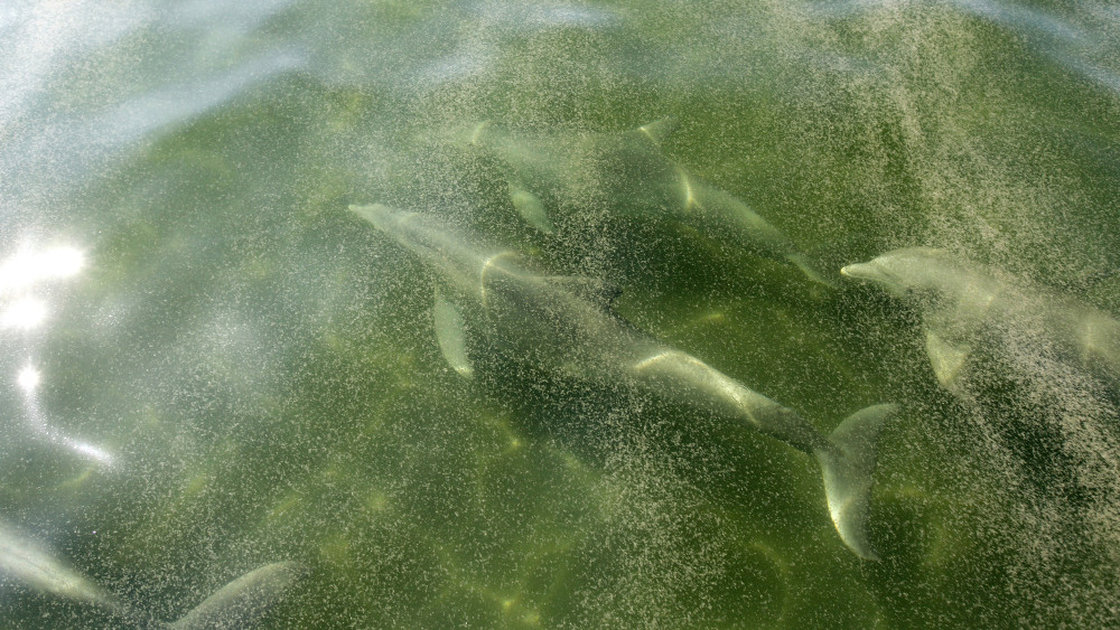
Pod of bottlenose dolphins swimming underneath oily water of Chandeleur Sound, La., May 6, 2010. Photo Credit: Alex Brandon/AP
Pod of bottlenose dolphins swimming underneath oily water of Chandeleur Sound, La., May 6, 2010.
Photo Credit: Alex Brandon/AP

One such impact that received little TV coverage during the spill was the uncharacteristic spike in dolphin deaths. A few months following the BP spill there was an unprecedented spike in dead dolphins washing ashore along the Gulf Coast; 67 dead dolphins by February of 2011, with more than half (35) of the dead dolphins being calves. This is in stark contrast to years preceding the spill when one or two dead dolphins per year were normally documented to wash ashore.  Despite the spike in dolphin deaths, there was no definitive evidence linking the dead cetaceans to the oil spill as a number of other factors could have been responsible for the deaths, including infectious disease or the abnormally cold winter proceeding the spill.

However, recent work by Lori Schwacke, of the National Oceanic and Atmospheric Administration, and her colleagues, have for the first time confirmed that bottlenose dolphins are impacted by the BP oil spill. Their study showed that dolphins in Barataria Bay, Louisiana (an area heavily exposed to oil) were much sicker compared to those in Sarasota, Florida (an area not affected by the spill). Dolphins in Barataria had symptoms consistent with exposure to petroleum hydrocarbons; 25% were emaciated, they were 5 times more likely to have lung disease, and a number had severe tooth loss (a healthy dolphin has between 76 and 100 teeth).
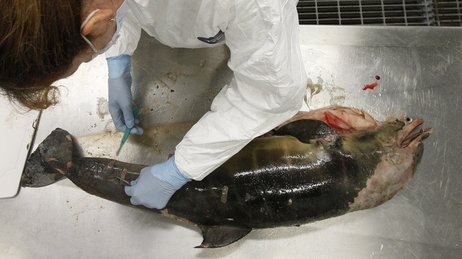
Skin sample taken from a dead bottlenose dolphin that was found on Ono Island, Ala., and brought for examination to Gulfport, Miss. Photo credit: Patrick Semansky/AP
Skin sample taken from a dead bottlenose dolphin that was found on Ono Island, Ala., and brought for examination to Gulfport, Miss.
Photo credit: Patrick Semansky/AP

As was stated from the study, “The severity of disease, poor body condition, and high prevalence of abnormalities seen in the [Barataria Bay, LA] dolphins is in stark contrast with the overall health status from the …  reference site [Sarasota, FL], as well as with health conditions previously documented in bottlenose dolphins from other U.S. coastal sites.”

A grim reminder that despite the visual absence of BP oil in the GoM, the effects for the largest spill in history are still being felt.

Read the full article published in the journal of Environmental Science and Technology.

I feel compelled to state that one of my research grants is funded through money set aside by BP to do research in the Gulf of Mexico to assess impacts of the oil spill on that region.

Share this:

  • Click to share on Bluesky (Opens in new window) Bluesky
  • Click to share on Facebook (Opens in new window) Facebook
  • Click to share on Reddit (Opens in new window) Reddit
  • Click to share on Threads (Opens in new window) Threads
  • Click to share on WhatsApp (Opens in new window) WhatsApp
  • Click to share on Mastodon (Opens in new window) Mastodon

Related

Tags: BP bp oil spill dolphins

Post navigation

❮ Previous Post: 3 sharks that were on twitter before being a shark on twitter was cool
Next Post: First Bluefin Tuna sells for $70,000 at Tsukiji Fish Auction (UPDATED) ❯

You may also like

Weekly Salvage
We Robot, a horrible hagfish massacre, deep, delicious sandwiches, fish slime harvests, and more! Monday Morning Salvage: September 10, 2018.
September 10, 2018
Weekly Salvage
#IAmSeaGrant, Octopus Beats Dolphins, Deep-sea Mining, and more! Monday Morning Salvage: May 29, 2017
May 29, 2017
Weekly Salvage
#JacquesWeek, Lionfish tax, coral that glows, accelerating climate change, and more! Monday Morning Salvage: July 10, 2017
July 10, 2017
Conservation
Chronicle of a Death Forestalled: the Gulf of Mexico oil spill that didn’t happen
May 2, 2011

2 thoughts on “Fun Science Friday – BP Oil Spill Impacts Dolphins”

  1. Drew Scerbo says:
    January 4, 2014 at 3:16 am

    I appreciate you keeping this subject in the public’s eye. Here in Texas, we never have a year where only one or two dolphins wash up, but since the DWH incident, we’ve had a constant unusual mortality event in marine mammals.
    Its worth mentioning that dolphins are not all residential and that indivisuals and pods that get sick in and around the DWH spill zone may travel and wash up on the coasts of TX, LA, MS, AL or even FL. It’s important for us to get as much information from every standing and necropsy to fully measure the impact its had and will have. This is (unfortunately) far from over.

    One nit-pick. Bottlenose dolphins (Tursiops truncatus) have between 76-100 teeth (most average about 88 [+/- 4] as adults), but we mave MANY more species of dolphin in the Gulf of Mexico and the average number of teeth they have can range from 6 – 200 depending upon which species it is. Kogia (not really a dolphin, but is a small toothed whale) can have 6 – 9 and Spinners (Genus Stenella) can have ~250. Again, I’m nit-picking, but I wanted it to be clear that tooth loss can be substantial on those with very few teeth to lose.

    Nice job,

    -DS

  2. Kersey Sturdivant says:
    January 7, 2014 at 1:07 pm

    Thanks for your interest and comments. Your nitpicking was well received. 🙂

Comments are closed.

Popular Posts

Shark scientists want their research to help save threatened species, but don’t know how. Our new paper can help.Shark scientists want their research to help save threatened species, but don’t know how. Our new paper can help.December 1, 2025David Shiffman
Norway and Cook Islands put their deep-sea mining plans on pause.Norway and Cook Islands put their deep-sea mining plans on pause.December 3, 2025Andrew Thaler
What Ocean Ramsey does is not shark science or conservation: some brief thoughts on "the Shark Whisperer" documentaryWhat Ocean Ramsey does is not shark science or conservation: some brief thoughts on "the Shark Whisperer" documentaryJuly 2, 2025David Shiffman
The Trouble with Teacup PigsThe Trouble with Teacup PigsOctober 14, 2012Andrew Thaler
What we know we don't know: impacts of deep-sea mining on whales, dolphins, sharks, turtles, and other migratory species.What we know we don't know: impacts of deep-sea mining on whales, dolphins, sharks, turtles, and other migratory species.November 20, 2025Andrew Thaler
2025: My year in writing, public speaking, and media interviews2025: My year in writing, public speaking, and media interviewsDecember 3, 2025David Shiffman
Urea and Shark OsmoregulationUrea and Shark OsmoregulationNovember 15, 2010David Shiffman
Shark of Darkness: Wrath of Submarine is a fake documentaryShark of Darkness: Wrath of Submarine is a fake documentaryAugust 10, 2014Michelle Jewell
How tiny satellites are tracking marine wildlifeDecember 1, 2025Andrew Thaler
Build a dirt cheap, tough-as-nails field computer in a Pelican caseBuild a dirt cheap, tough-as-nails field computer in a Pelican caseJuly 21, 2015Andrew Thaler
Subscribe to our RSS Feed for updates whenever new articles are published.

We recommend Feedly for RSS management. It's like Google Reader, except it still exists.

Southern Fried Science

  • Home
  • About SFS
  • Authors
  • Support SFS


If you enjoy Southern Fried Science, consider contributing to our Patreon campaign.

Copyright © 2025 Southern Fried Science.

Theme: Oceanly Premium by ScriptsTown