Skip to content

Southern Fried Science

Over 15 years of ocean science and conservation online

  • Home
  • About SFS
  • Authors
  • Support SFS

Fun Science FRIEDay – The Universe Sings a Song, and Humans Can Finally Listen

Posted on February 12, 2016February 12, 2016 By Kersey Sturdivant
Science
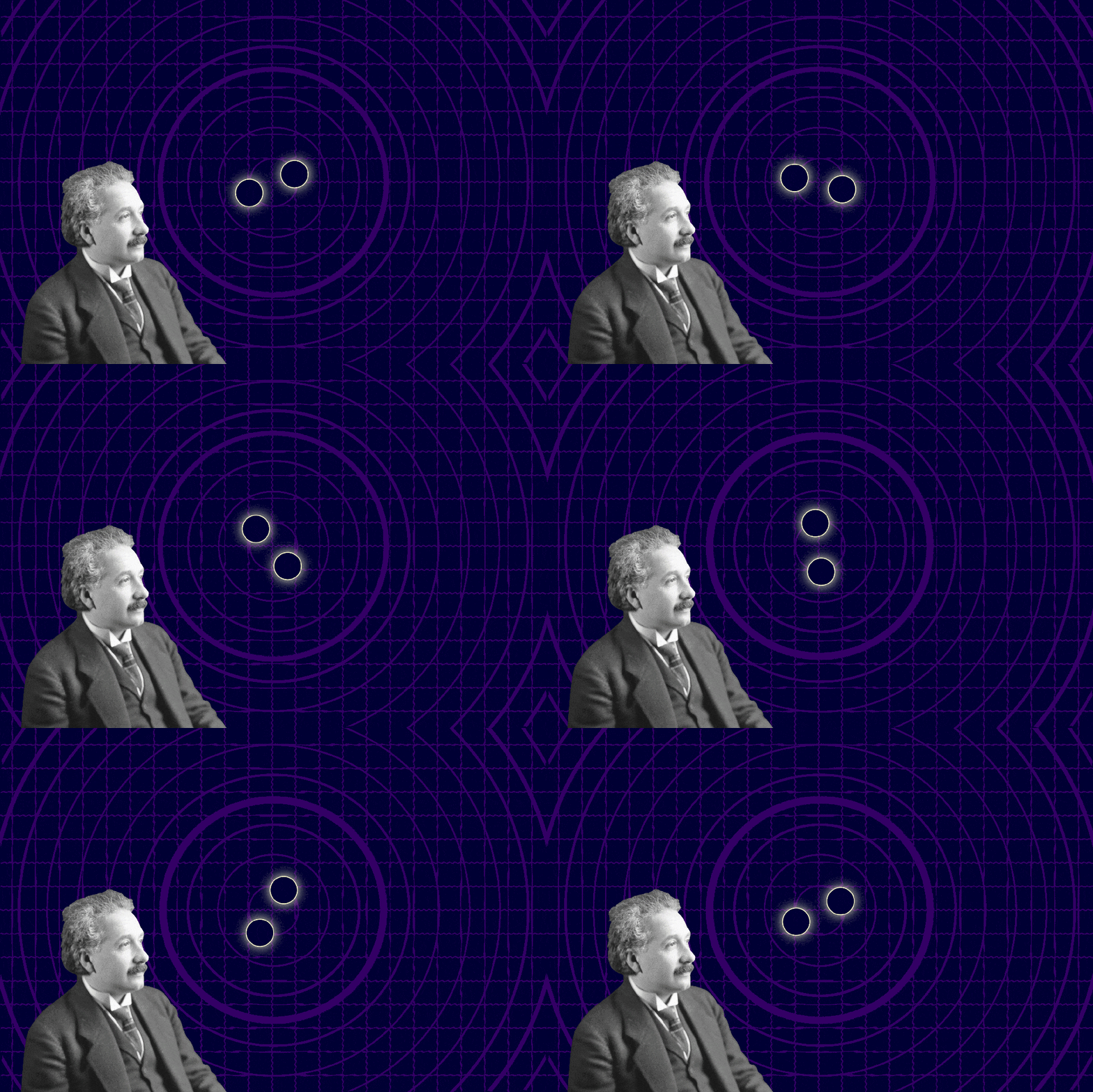
(Photo Credit: Underwood & Underwood / Corbis / Kara Gordon / The Atlantic)

The  interwebs have been going crazy the past few days with the recent announcement that scientists have for the first time detected gravitational waves, the ripples in the fabric of space-time that Einstein predicted a century ago. In terms of scientific advancement, to quote Joe Biden, “This is a big fucking deal!” Bigger than the discovery of the subatomic Higgs boson particle (i.e., the god particle), and it has been suggested this discovery is comparable only to “Galileo taking up the telescope and looking at the planets.” – Penn State physics theorist Abhay Ashtekar
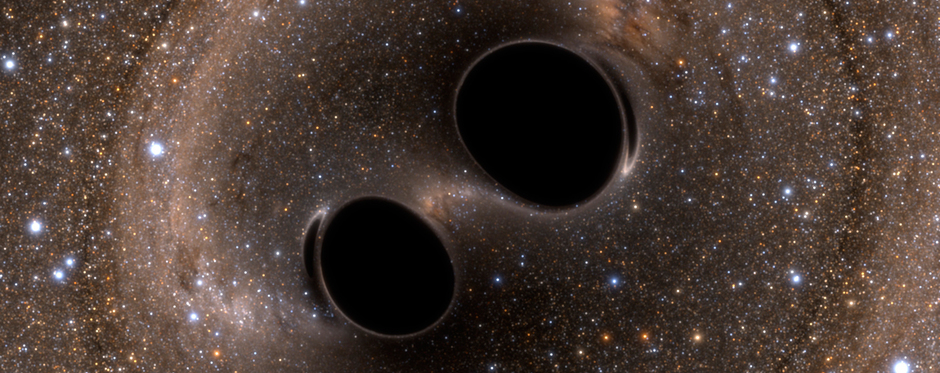
Photo credit: The Laser Interferometer Gravitational-Wave Observatory

So how did this happen, and why is this discovery so huge? Previously humans have used light of varying wavelengths to describe our universe. Visible light first revealed the starry nether space, infrared allowed us to peer further back in time and see older, more distant stars. Radio waves revealed the afterglow of the universe’s violent birth, and X-rays showcased the supernova deaths of massive stars. But now, scientists will be able to sense the universe in a whole new way: through sound. That is because you don’t visualize gravity waves, you hear them. Gravity waves are the ballads of the universe, and for the first time in human history we are able to hear that song.
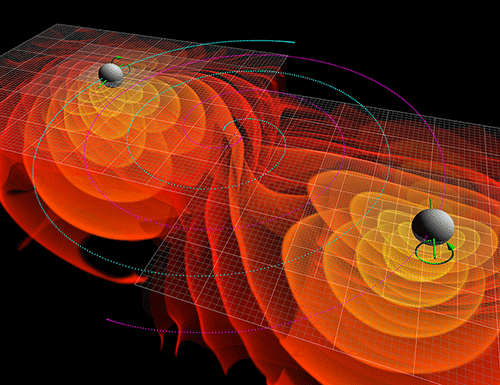
Observation of Gravitational Waves from a Binary Black Hole Merger (Photo credit: B. P. Abbott et al. 2016 - LIGO Scientific Collaboration and Virgo Collaboration)
Observation of Gravitational Waves from a Binary Black Hole Merger
(Photo credit: B. P. Abbott et al. 2016 – LIGO Scientific Collaboration and Virgo Collaboration)

Gravitational waves, which Einstein predicted as part of his general theory of relativity, occur as objects accelerate/decelerate through space, analogous to a boat moving through the water and the resulting ripples it produces across the water’s surface. Every object produces a gravitational wave, but they are so tiny that until now it has been nearly impossible to detect them. The current discovery was the result of the collision of two black holes (a rare but powerful event in space). As the two black holes collided with each other, they distorted spacetime, generating a cycle of waves, strong enough for the Laser Interferometer Gravitational-Wave Observatory (LIGO) to detect 1.3 billion light-years away. And to answer your question, yes, we detected the sound of something that occurred over a billion years ago. So what does the universe sound like you ask, oddly enough, like a bird chirping. Go figure.

To learn more about gravity waves and why they are important, check out LIGO’s informative website. Also The Atlantic has an awesome in-depth piece about what this discovery means, and with this recent discovery people are already theorizing about what we should listen to next!

You can read the original article about this amazing discovery in the journal of Physical Review Letters where they go into detail about how they were able to make their detection.

Science, why you so cool?! Happy FSF all!!!


Share this:

  • Click to share on Bluesky (Opens in new window) Bluesky
  • Click to share on Facebook (Opens in new window) Facebook
  • Click to share on Reddit (Opens in new window) Reddit
  • Click to share on Threads (Opens in new window) Threads
  • Click to share on WhatsApp (Opens in new window) WhatsApp
  • Click to share on Mastodon (Opens in new window) Mastodon

Related

Tags: black hole Einstein gravitational gravity waves Higgs boson LIGO scientific discovery

Post navigation

❮ Previous Post: How I prepare a peer review
Next Post: Six ways the new Old Spice ad violates the Marine Mammal Protection Act ❯

You may also like

Education
The Importance of Scientific Discovery and Communication for a General Science Audience
June 3, 2016
Science
Fun Science FRIEDay – Theory of Relative… easiness??
November 20, 2015

Popular Posts

Shark scientists want their research to help save threatened species, but don’t know how. Our new paper can help.Shark scientists want their research to help save threatened species, but don’t know how. Our new paper can help.December 1, 2025David Shiffman
Norway and Cook Islands put their deep-sea mining plans on pause.Norway and Cook Islands put their deep-sea mining plans on pause.December 3, 2025Andrew Thaler
What Ocean Ramsey does is not shark science or conservation: some brief thoughts on "the Shark Whisperer" documentaryWhat Ocean Ramsey does is not shark science or conservation: some brief thoughts on "the Shark Whisperer" documentaryJuly 2, 2025David Shiffman
What we know we don't know: impacts of deep-sea mining on whales, dolphins, sharks, turtles, and other migratory species.What we know we don't know: impacts of deep-sea mining on whales, dolphins, sharks, turtles, and other migratory species.November 20, 2025Andrew Thaler
2025: My year in writing, public speaking, and media interviews2025: My year in writing, public speaking, and media interviewsDecember 3, 2025David Shiffman
The Trouble with Teacup PigsThe Trouble with Teacup PigsOctober 14, 2012Andrew Thaler
Urea and Shark OsmoregulationUrea and Shark OsmoregulationNovember 15, 2010David Shiffman
How tiny satellites are tracking marine wildlifeDecember 1, 2025Andrew Thaler
Shark of Darkness: Wrath of Submarine is a fake documentaryShark of Darkness: Wrath of Submarine is a fake documentaryAugust 10, 2014Michelle Jewell
"Twitter sucks now and all the cool kids are moving to Bluesky:" Our new survey shows that scientists no longer find Twitter professionally useful or pleasant"Twitter sucks now and all the cool kids are moving to Bluesky:" Our new survey shows that scientists no longer find Twitter professionally useful or pleasantAugust 19, 2025David Shiffman
Subscribe to our RSS Feed for updates whenever new articles are published.

We recommend Feedly for RSS management. It's like Google Reader, except it still exists.

Southern Fried Science

  • Home
  • About SFS
  • Authors
  • Support SFS


If you enjoy Southern Fried Science, consider contributing to our Patreon campaign.

Copyright © 2025 Southern Fried Science.

Theme: Oceanly Premium by ScriptsTown