Skip to content

Southern Fried Science

Over 15 years of ocean science and conservation online

  • Home
  • About SFS
  • Authors
  • Support SFS

Fun Science FRIEDay – Those Genes Look Tasty

Posted on February 6, 2015February 6, 2015 By Kersey Sturdivant
Uncategorized

In a very basic sense there is a general dichotomy in the grouping of organisms on this planet as either a plant or as an animal. Myself, like most of the rest of you, belong to the animal group, but there are those organisms out there that exists on the boundary; one in particular is the sea slug, Elysia chlorotica.
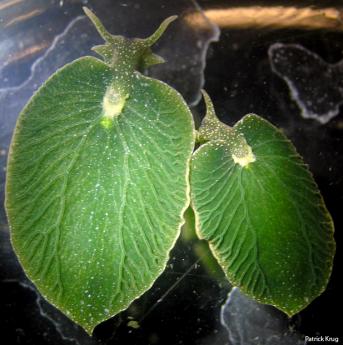
 

The sea slug Elysia chlorotica (Photo credit: Patrick Krug)

This sea slug is unique because it harvests the chloroplasts from the algae it eats and incorporates them into its own body. As a quick reminder, chloroplasts are the cells in plants that allow for photosynthesis, the process of converting light energy into chemical energy and storing it in the bonds of sugar. By stealing cells from plants this sea slug gains the rare ability as an animal that can photosynthesize.

It has been known for quite some time that this sea slug incorporates chloroplasts from the algae it eats, giving it its rich green color, but recently the mechanism of how that occurs was unraveled. Julie Schwartz, from the University of South Florida, and a team of researchers presented direct evidence that this unique sea slug’s chromosomes contains genes from the algae it eats! This is important because those genes help sustain photosynthetic processes inside the slug, essentially allowing it to repurpose the chloroplasts for its own use.

This unique ability has human applicability as well. We know virus do a pretty good job of hijacking genes, but this is one of the only known examples of functional gene transfer in multicellular organism, and the process this sea slug uses to pull it off could offer insight into gene therapy in humans to correct genetically based diseases.

You can read more about the specifics regarding how this unique animal is able to get plant cells to work in its favor in the journal Biological Bulletin.

Nature, you so cool!

Share this:

  • Click to share on Bluesky (Opens in new window) Bluesky
  • Click to share on Facebook (Opens in new window) Facebook
  • Click to share on Reddit (Opens in new window) Reddit
  • Click to share on Threads (Opens in new window) Threads
  • Click to share on WhatsApp (Opens in new window) WhatsApp
  • Click to share on Mastodon (Opens in new window) Mastodon

Related

Tags: chloroplast Elysia chlorotica gene photosynthesis sea slug

Post navigation

❮ Previous Post: Happy Fun Science FRIEDay – Change you DNA… One Step at a Time!
Next Post: Bioshock Oceanographic: How deep is Rapture? ❯

You may also like

Science
The Ocean Question: What is your favorite marine organism and why?
April 26, 2012

Popular Posts

Shark scientists want their research to help save threatened species, but don’t know how. Our new paper can help.Shark scientists want their research to help save threatened species, but don’t know how. Our new paper can help.December 1, 2025David Shiffman
Norway and Cook Islands put their deep-sea mining plans on pause.Norway and Cook Islands put their deep-sea mining plans on pause.December 3, 2025Andrew Thaler
What Ocean Ramsey does is not shark science or conservation: some brief thoughts on "the Shark Whisperer" documentaryWhat Ocean Ramsey does is not shark science or conservation: some brief thoughts on "the Shark Whisperer" documentaryJuly 2, 2025David Shiffman
What we know we don't know: impacts of deep-sea mining on whales, dolphins, sharks, turtles, and other migratory species.What we know we don't know: impacts of deep-sea mining on whales, dolphins, sharks, turtles, and other migratory species.November 20, 2025Andrew Thaler
2025: My year in writing, public speaking, and media interviews2025: My year in writing, public speaking, and media interviewsDecember 3, 2025David Shiffman
The Trouble with Teacup PigsThe Trouble with Teacup PigsOctober 14, 2012Andrew Thaler
Urea and Shark OsmoregulationUrea and Shark OsmoregulationNovember 15, 2010David Shiffman
How tiny satellites are tracking marine wildlifeDecember 1, 2025Andrew Thaler
Shark of Darkness: Wrath of Submarine is a fake documentaryShark of Darkness: Wrath of Submarine is a fake documentaryAugust 10, 2014Michelle Jewell
"Twitter sucks now and all the cool kids are moving to Bluesky:" Our new survey shows that scientists no longer find Twitter professionally useful or pleasant"Twitter sucks now and all the cool kids are moving to Bluesky:" Our new survey shows that scientists no longer find Twitter professionally useful or pleasantAugust 19, 2025David Shiffman
Subscribe to our RSS Feed for updates whenever new articles are published.

We recommend Feedly for RSS management. It's like Google Reader, except it still exists.

Southern Fried Science

  • Home
  • About SFS
  • Authors
  • Support SFS


If you enjoy Southern Fried Science, consider contributing to our Patreon campaign.

Copyright © 2025 Southern Fried Science.

Theme: Oceanly Premium by ScriptsTown