
 National Geographic’s Great Migrations, a seven part series which premieres November 7th, calls itself a collection of “the most moving stories on Earth”. It focuses on some amazing animals from around the world and the incredible journeys they take to survive. This series was a massive undertaking, with the National Geographic crew spending 2 years traveling more than 420,000 miles over 20 countries. The end result is visually spectacular, full of fascinating science and rich in never-before-told stories of animal behavior. The series itself is an great educational resource, and the website has plenty to offer teachers (particularly the Science page and the Teacher Resources page).
While many of the best-known migrations involve land animals or birds, some marine migrations are also pretty darn great.
I was thrilled to learn that two of the migrations discussed in this series involve sharks. The first shark migration story appears in hour 3, “Feast or Famine”.
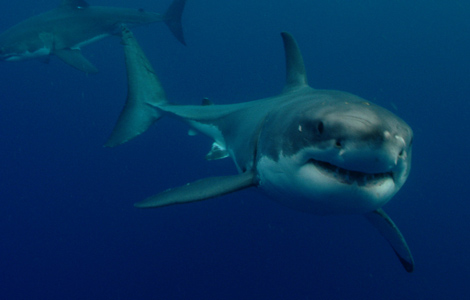
Many great white sharks travel over 3,000 miles to Guadalupe Island each year in search of food each year. Great Migrations does a good job of conveying how impressive and mysterious this behavior is, saying “somehow they always know where their prey are gathering from oceans away”. They are following the migratory path of another marine wanderer, the elephant seal. The episode has some amazing footage of a great white eating an elephant seal.
I’m always nervous when the media portrays the impressive hunting behavior of these sharks, but National Geographic went out of their way to make people not fear great whites. Yes, some vaguely-ominous music plays as the shark eats the seal, but the exact same music is playing when a bald eagle eats a fish or when a little cardinalfish eats a jellyfish. The Great White Shark page on National Geographic’s website talks all about how these animals are a threatened species and how people shouldn’t be afraid of them, and the great white shark profile on the Great Migrations site is full of scientific information about them. As usual, National Geographic’s shark coverage promotes science and conservation instead of fear.
It is worth noting that there is a great white migration more impressive than the Guadalupe trip- a single female tagged off the coast of South Africa was later found in Australia. For those of you who are geographically challenged, that’s over 12,000 miles. This was not discussed in the series, but is mentioned on the accompanying poster and was the focus of an entire National Geographic special called “Great White Odyssey”.
The next shark migration, which appeared in hour 4 (Race to Survive) was that of a whale shark.
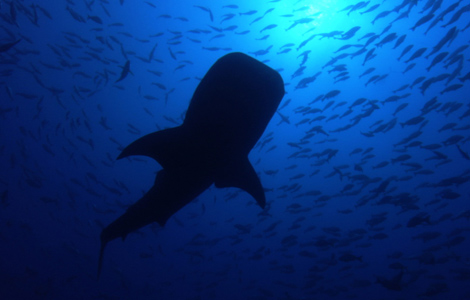
These animals, the largest living fish, are harmless to humans (they eat nothing but plankton). The whale shark segment focused on whale sharks migrating to Belize to feast on snapper eggs. It had some cool footage of mass-spawning snapper, and beautiful images of the gentle giant whale sharks. The science portion of this segment was a lighter than the great white story, but that’s in keeping with the current state of our own knowledge about these animals. The whale shark profile summarizes this very well:
“It is difficult to observe whale sharks in the wild, and most of the sightings are of juvenile males in coastal areas, where they gather to feed . But adult whale sharks’ precise movements remain mysterious, they are believed to spend much of their time in the ocean deep, far from shore, and to go on long, multi-year journeys, during which they visit cold-water areas that are richer in food. Most of the knowledge about whale shark migration is from acoustic tracking. Scientists hope to learn more by tagging individuals and following them via satellite.”
I hadn’t turned off my media-portrayal-of-sharks alarm after the great white segment, and I noted that the series refers to these animals as “a true sea monster”. I guess that’s fair because of their enormous size, but the connotation most people have of sea monsters is usually not something that eats tiny crustacean and fish larvae. It’s a small point, and if this is the only thing that someone as hyper-sensitive as me can find to critique, Great Migrations is a fantastic show. The profile also notes that:
“While whale sharks’ massive bodies might make them seem like scary super-predators, they pose no danger to humans or large mammals or fish. Instead, they dine upon upon krill and squid, and small fish such as sardines, anchovies, and mackerel. … The whale shark itself is preyed upon by human fishermen. Whale sharks are caught and sold for food when tuna, marlin, or other large high-priced fish are scarce.”
Online, at least, Great Migrations notes that whale sharks are no threat to people and are in fact in trouble because of human actions.
It was nice to see sharks on TV not in the context of shark attacks, but in the context of their incredible navigation abilities.
Great Migrations also has other tales of ocean migrations. It told cool stories of the walrus, sperm whale, albatross, rockhopper penguin, and many more. There were also some stories about animals that live on land (if you’re into that sort of thing). This series premieres November 7th on the National Geographic channel. Be sure to check it out.

~WhySharksmatter
Disclaimer: National Geographic sent me a DVD copy of the complete series, along with an associated coffee table book and poster.
I would have liked it if they had covered the greatest of all migrations – the diurnal vertical migration of billions of tons of plankton from the depths to the surface every single night of the year. It may be less than 1000ft for most, but in number of body lengths its easily the equal of the reindeer or the wildebeest.
And this from a shark guy!
Actually, they did cover DVM, I just didn’t include it in my review
Nice coverage, have yet to see this, the predation footage is some of the best I have ever seen.