Skip to content

Southern Fried Science

Over 15 years of ocean science and conservation online

  • Home
  • About SFS
  • Authors
  • Support SFS

Isn’t ironic, don’t you think: dismantling the Ocean Observatories Initiative on World Oceans Day

Posted on June 9, 2026June 9, 2026 By Southern Fried Science No Comments on Isn’t ironic, don’t you think: dismantling the Ocean Observatories Initiative on World Oceans Day
Climate change, Featured, Policy, Science

The National Science Foundation (NSF) is pulling the plug on the Ocean Observatories Initiative (OOI), systematically dismantling one of the world’s most advanced deep-sea monitoring networks. This aggressive “descoping” plan means hundreds of high-tech instruments are actively being hauled out of the water.

The timing of this infrastructure rollback carries a painful, bitter irony. The deconstruction sequence officially kicked off right alongside World Oceans Day, a global event meant to honor and protect marine environments. The fact that this is happening at the midpoint if the UN Oceans Decade is an ironic double whammy. While the international community pledged to safeguard the seas, the United States began blinding itself beneath the waves.

What we are losing

Built at an initial cost of $368 million, the OOI was engineered to give humanity a continuous, 24/7 pulse on the underwater world. Unlike satellite systems that can only scratch the ocean’s surface, the OOI’s network of over 900 sensors, moorings, and autonomous gliders dive deep into the water column.

Over the last ten years, this open-access data repository has fueled more than 500 scientific publications, providing foundational insights into several critical domains:

  • Instruments deployed in the brutal waters of the Irminger Sea off Greenland have been essential for tracking the Atlantic Meridional Overturning Circulation (AMOC). This massive conveyor belt regulates global climates, and OOI data gave us front-row seats to check if it was on the brink of a catastrophic slowdown.
  • Along the West Coast, the Endurance Array monitored low-oxygen (hypoxic) zones and ocean acidification in real time. Commercial crabbing and fishing fleets relied heavily on this data to map changing ocean chemistry and protect local livelihoods.
  • The Pioneer Array and Station Papa caught subsurface shifts that satellites missed entirely, tracking the deep thermal patterns of devastating marine heatwaves.

The physical removal of these instruments is the direct result of a crushing 80% budget reduction proposal by the current administration, which slashed the initiative’s annual operational funding from $39 million down to just $8 million. The NSF has framed the dismantling as a “nimbler approach” to lifecycle management. However, the reality is a catastrophic loss in essential ocean science data:

LocationCritical Data Lost
Endurance ArrayOff Oregon & Washington coastsUpwelling, hypoxia, and Pacific El Niño shifts
Pioneer ArrayMid-Atlantic Bight / Coastal areasShelf-break exchange and nutrient transport
Irminger Sea ArraySouth of GreenlandDeep-ocean convection and AMOC circulation stability
Station Papa ArrayGulf of AlaskaHigh-latitude carbon cycle and North Pacific ecosystems

The lone survivor of this multi-year purge is the cabled seafloor network managed by the University of Washington, which will keep monitoring seismic and volcanic activity. The rest of the observation systems will be systematically hauled onto decks and shipped back to warehouses.

Flying blind in changing climate

The true tragedy of closing these observatories is the permanent gap it introduces into our long-term climate records. The ocean is experiencing rapid, unprecedented changes. By denying our ability to track these shifts beneath the surface means we are choosing to navigate an increasingly volatile planet completely blind. For a community of marine scientists trying to celebrate ocean conservation this week, the screech of winch lines hauling multi-million dollar data buoys out of the Atlantic is a deafening reminder of radically the US Government’s commitment to ocean science has changed in just over a year.

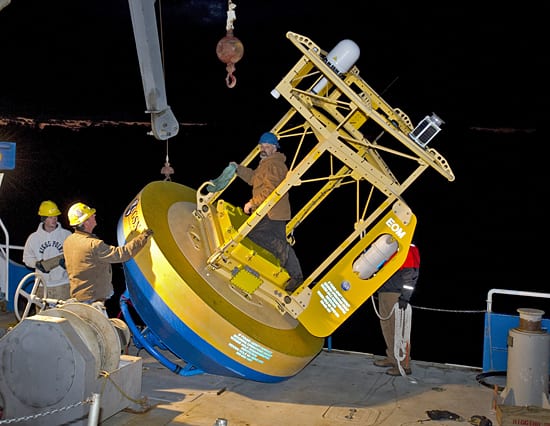
(Photo credit: An OOI buoy; Woods Hole Oceanographic Institution)
Share this:

  • Share on Bluesky (Opens in new window) Bluesky
  • Share on Facebook (Opens in new window) Facebook
  • Share on Reddit (Opens in new window) Reddit
  • Share on Threads (Opens in new window) Threads
  • Share on WhatsApp (Opens in new window) WhatsApp
  • Share on Mastodon (Opens in new window) Mastodon

Related

Tags: ocean observations initiative oceanography ooi UN Ocean Decade world oceans day

Post navigation

❮ Previous Post: Tackling the least important debate in deep-sea mining: the desultory hyphen

You may also like

Oceanography for Everyone
Fun Science FRIEDay – Open-Acess Science for the Masses
July 15, 2016
Exploration
How to fix the UN Decade of Ocean Science
April 9, 2026
Academic life
Oceanography’s Diversity Deficit
February 27, 2024
Weekly Salvage
Chasing Genius, aquatic brain blobs, hurricanes, bats, and more! Monday Morning Salvage: September 4, 2017
September 4, 2017

Leave a Reply

Your email address will not be published. Required fields are marked *

This site uses Akismet to reduce spam. Learn how your comment data is processed.

Popular Posts

The story of the pride flag made from NASA imagery: Bluesky's most-liked imageThe story of the pride flag made from NASA imagery: Bluesky's most-liked imageSeptember 27, 2024David Shiffman
"Why Sustainable Seafood Matters" is now available for preorder! Here's what it's about, and why I decided to write it."Why Sustainable Seafood Matters" is now available for preorder! Here's what it's about, and why I decided to write it.June 8, 2026David Shiffman
What Ocean Ramsey does is not shark science or conservation: some brief thoughts on "the Shark Whisperer" documentaryWhat Ocean Ramsey does is not shark science or conservation: some brief thoughts on "the Shark Whisperer" documentaryJuly 2, 2025David Shiffman
I just told 850 shark scientists a hard truth: We’re not communicating shark conservation correctly.I just told 850 shark scientists a hard truth: We’re not communicating shark conservation correctly.June 1, 2026David Shiffman
Shark of Darkness: Wrath of Submarine is a fake documentaryShark of Darkness: Wrath of Submarine is a fake documentaryAugust 10, 2014Michelle Jewell
Deep-sea Mining, Domestic Cats, Star Trek, and Ocean Exploration: Andrew's mid-year podcast round-up.Deep-sea Mining, Domestic Cats, Star Trek, and Ocean Exploration: Andrew's mid-year podcast round-up.June 6, 2026Andrew Thaler
Why ocean science is still one of the worst-funded scientific fields worldwideWhy ocean science is still one of the worst-funded scientific fields worldwideJune 3, 2026Chris Parsons
That's not a blobfish: Deep Sea Social Media is Flooded by AI SlopThat's not a blobfish: Deep Sea Social Media is Flooded by AI SlopDecember 19, 2025Andrew Thaler
What is a Sand Shark?What is a Sand Shark?November 12, 2017Chuck Bangley
Tackling the least important debate in deep-sea mining: the desultory hyphenTackling the least important debate in deep-sea mining: the desultory hyphenJune 8, 2026Andrew Thaler
Subscribe to our RSS Feed for updates whenever new articles are published.

We recommend Feedly for RSS management. It's like Google Reader, except it still exists.

Southern Fried Science

  • Home
  • About SFS
  • Authors
  • Support SFS


If you enjoy Southern Fried Science, consider contributing to our Patreon campaign.

Copyright © 2026 Southern Fried Science.

Theme: Oceanly Premium by ScriptsTown