Skip to content

Southern Fried Science

Over 15 years of ocean science and conservation online

  • Home
  • About SFS
  • Authors
  • Support SFS

Monday Morning Salvage: February 6, 2017

Posted on February 6, 2017 By Andrew Thaler
Uncategorized

Bringing you the best of marine science and conservation from the last week.

Flotsam (what we’re obsessed with right now)

  • The ridiculous, extensible jaw and neck joint of a Barbeled Dragonfish.
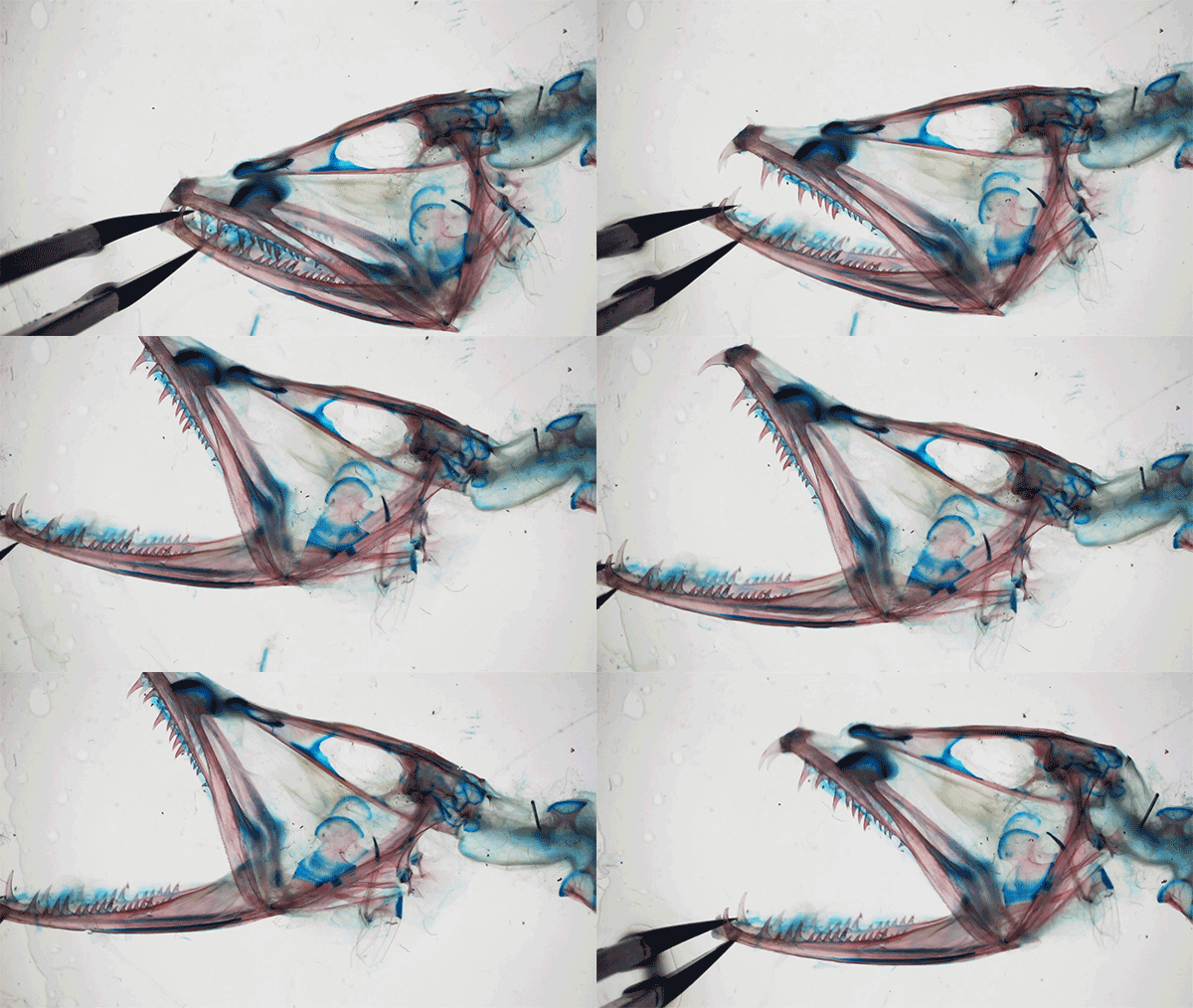
  • Deep-Sea Fishes That Are Built to Eat Big.

Jetsam (what we’re enjoying from around the web)

  • Majestically breaching humpback whales are probably yelling. At you, probably. You know what you did.
  • Lead bullets still dominate the U.S. ammunition market despite ample evidence showing that they pose real environmental and health risks. Bullet Proof from Lynne Peeples.
  • The Mystery of the 19th-Century Maine Marine Monster by Rachel Fritts.
  • #TeamSkynet for life. Swarm of underwater robots helps scientists study ocean dynamics.
  • The 7 Wonderful Pikes, Pickerels, and Muskies of the World, from our friends over at the Fisheries Blog.
  • Finally, Deep Sea News asks the all important question: How do bone-eating worms eat bones?

Lagan (what we’re reading from the peer-reviewed literature)

  • Aylesworth and friends (2017) Seahorses (Hippocampus spp.) as a case study for locating cryptic and data-poor marine fishes for conservation. Animal Conservation. doi:10.1111/acv.12332.
  • Haas and friends (2017) The contemporary economic value of elasmobranchs in The Bahamas: Reaping the rewards of 25 years of stewardship and conservation. Biological Conservation. doi.org:10.1016/j.biocon.2017.01.007.
  • Redfern and friends (2017) Predicting cetacean distributions in data-poor marine ecosystems. Diversity and Distributions. doi:10.1111/ddi.12537.
  • Schakner and friends (2017) Can fear conditioning repel California sea lions from fishing activities? Animal Conservation. doi:10.1111/acv.12329
  • Lubchenco (2017) Environmental science in a post-truth world. Frontiers in Ecology and the Environment. doi:10.1002/fee.1454.

Driftwood (what we’re reading on dead trees)

  • It continues to be ominously hilarious that the International Seabed Authority refers to themselves as “The Authority” international seabed as “The Area”. The Authority want your comments on The Area. Developing a Regulatory Framework for Mineral Exploitation in the Area.

Derelicts (favorites from the deep archive)

  • Sizing Sizing Ocean Giants: Patterns of #scicomm outreach in a marine megapaper.

Feel free to share your own Flotsam, Jetsam, Lagan, Driftwood, and Derelicts in the comments below. And, of as always, if you enjoy Southern Fried Science, consider contributing to my Patreon campaign to help us keep the servers humming.

Share this:

  • Click to share on Bluesky (Opens in new window) Bluesky
  • Click to share on Facebook (Opens in new window) Facebook
  • Click to share on Reddit (Opens in new window) Reddit
  • Click to share on Threads (Opens in new window) Threads
  • Click to share on WhatsApp (Opens in new window) WhatsApp
  • Click to share on Mastodon (Opens in new window) Mastodon

Related

Tags: bahamas cetacean deep-sea mining dragon fish humpback whales muskie oarfishj osedax pickerel pike post-fact robots sea lions seahorses sharks Sizing Ocean Giants

Post navigation

❮ Previous Post: New achievement milestones for academic life
Next Post: A Reading List for Environmental Resistance ❯

You may also like

Weekly Salvage
I want you to have amazing adventures with underwater robots, protecting the oceans like national parks, songs of a ice and warming, cannibals, and more! Monday Morning Salvage: October 22, 2018.
October 22, 2018
News
Norway moves one step closer to deep-sea mining
January 9, 2024
Weekly Salvage
How to help Houston, GameBoy SONAR, buy a lighthouse, and more! Monday Morning Salvage: August 28, 2017
August 28, 2017
Science
No, the deep-sea mining debate is not “gone”
April 20, 2023

Popular Posts

Shark scientists want their research to help save threatened species, but don’t know how. Our new paper can help.Shark scientists want their research to help save threatened species, but don’t know how. Our new paper can help.December 1, 2025David Shiffman
Norway and Cook Islands put their deep-sea mining plans on pause.Norway and Cook Islands put their deep-sea mining plans on pause.December 3, 2025Andrew Thaler
What Ocean Ramsey does is not shark science or conservation: some brief thoughts on "the Shark Whisperer" documentaryWhat Ocean Ramsey does is not shark science or conservation: some brief thoughts on "the Shark Whisperer" documentaryJuly 2, 2025David Shiffman
The Trouble with Teacup PigsThe Trouble with Teacup PigsOctober 14, 2012Andrew Thaler
What we know we don't know: impacts of deep-sea mining on whales, dolphins, sharks, turtles, and other migratory species.What we know we don't know: impacts of deep-sea mining on whales, dolphins, sharks, turtles, and other migratory species.November 20, 2025Andrew Thaler
2025: My year in writing, public speaking, and media interviews2025: My year in writing, public speaking, and media interviewsDecember 3, 2025David Shiffman
Urea and Shark OsmoregulationUrea and Shark OsmoregulationNovember 15, 2010David Shiffman
Shark of Darkness: Wrath of Submarine is a fake documentaryShark of Darkness: Wrath of Submarine is a fake documentaryAugust 10, 2014Michelle Jewell
How tiny satellites are tracking marine wildlifeDecember 1, 2025Andrew Thaler
Build a dirt cheap, tough-as-nails field computer in a Pelican caseBuild a dirt cheap, tough-as-nails field computer in a Pelican caseJuly 21, 2015Andrew Thaler
Subscribe to our RSS Feed for updates whenever new articles are published.

We recommend Feedly for RSS management. It's like Google Reader, except it still exists.

Southern Fried Science

  • Home
  • About SFS
  • Authors
  • Support SFS


If you enjoy Southern Fried Science, consider contributing to our Patreon campaign.

Copyright © 2025 Southern Fried Science.

Theme: Oceanly Premium by ScriptsTown