
The high seas are a black hole for ocean conservation. They lie beyond the jurisdiction of any single country and are largely open for unregulated exploitation. Even as we begin moving towards a pragmatic high seas conservation framework, we should keep in mind that many territorial waters are still left unprotected and open to illegal … Read More “Weekly dose of TED – Kristina Gjerde: Making law on the high seas” »
According to the National Science Foundation, social scientists might be useful in a multitude of new ways, especially in long-term research. Following on the heels of astronomy and astrophysics, NSF recently sought suggestions for planning the research agenda of social scientists for the next decade. Working on a relatively short time frame, there were three guiding principles for setting this new agenda:
– “big underlying questions” that thus far have been underappreciated
– capacity issues: which stages of the educational process need the most help?
– infrastructure issues, eg. setting up longitudinal surveys on important topics
In response to this challenge, a team at Harvard came up with the “top ten social science research issues“, recently published in Nature. A few of us sitting on the social-ecological divide have noted that there is a distinct lack of environmental issues in the list. In all fairness, the original challenge emphasized that existing research programs would be supported and showcased recent funding for the social aspects of environmental issues as a prime example of ways this research is already headed in a favorable direction. The more optimistic of this bunch note that each of the ten social issues is actually intricately linked with the need for a healthy environment and therefore the environmental link is an underlying grand challenge, if you will.
I have a confession to make. Targeted advertising works. There I was, planning out a long trip to India, thinking, I need some new pants. I get progressively wider with each passing year, and I was not looking forward to flying for 36 hours in a pair of 32-inch pants on a 34-inch waist. And then, like a primal scream from the ether, on the sidebar of The Thoughtful Animal, was an ad for Scott E Vest travel clothes. And, in my shame, I clicked it.
I’ve found that I enjoy certain types of music more when I don’t listen to the words too closely. However, a mild addiction to karaoke and a lifelong inability to “just let it go” has made it impossible for me to avoid knowing the lyrics.
We’ve been known to criticize how science is portrayed in movies and television shows here on Southern Fried Science. Pop music is far from innocent when it comes to scientific misunderstandings, and it seems only fair that I criticize that genre as well. Here are some recent examples that have been driving me crazy.

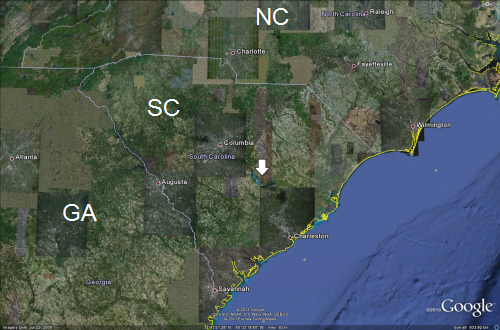
The wet, temperate understory of a longleaf pine savanna, is not the first place one would thing to search for some of nature’s most fearsome predators. These maritime ecosystems stretch down the Atlantic seaboard, from southern Virginia to northern Georgia, but are most common in North and South Carolina. Boomerang-shaped bays, called Carolina bays, formed behind ancient sand dunes, provide the foundation for these biodiversity rich regions. More than 50 endangered species are native to the Carolina lonfleaf pine savannas, including the Cape Fear Threetoothed land snail and the iconic Red-cockaded Woodpecker, but among the most evocative inhabitants of these pocosin wild-lands are the many-jawed monsters of the the understory – the Venus Flytrap.
Read More “Biodiversity Wednesday: Flesh eaters of the Savanna” »
From the Guardian: Japan has temporarily suspended its annual whale hunt in the Antarctic after anti-whaling activists obstructed its fleet’s mother ship. Officials in Tokyo have conceded that this year’s mission, which had again been the target of international criticism, had not gone as well as hoped and the fleet may be called home early, … Read More “Japan temporarily suspends Antarctic whale hunt” »
Modern shark researchers have access to a variety of high-tech tools. Acoustic tags with noises specific to each individual shark signal a receiver (or network of receivers) every time the shark passes nearby. Some tags have three-dimensional accelerometers, allowing researchers to study the small scale movement patterns and behaviors of sharks. Others, which are placed in the stomach, measure pH before, during, and after digestion. The most advanced technology on the market, however, is undoubtedly the satellite tag.
In this week’s edition of Shark Science Monday, Shark Advocates International President Sonja Fordham explains international conservation and management policies. If you have a question for Sonja, please leave it as a comment and I’ll make sure it gets to her.
After reading some of the reviews from our Readers’ Survey, many people list these among their favorite posts, while many others consider them their least favorite. So, we’ve decided to change the posting schedule for Finding Melville’s Whale. From now on, one or two new entries will appear every Sunday, instead of Tuesdays and Thursdays. We … Read More “Finding Melville’s Whale: The Whiteness of the Whale (Chapter 42)” »
The droughts that shook the east African nations in the mid-1970’s and again in the 1980’s decimated the traditional nomadic clans of Somalia, leaving them without live stock to feed their families. Tens of thousands of the dispossessed, primarily of the Hawiye clan, were relocated to coastal areas. Fishing communities took root and began to flourish. With over 3000 km of coastline, rich with rock lobster and large pelagic fish, these communities grew, perhaps even thrived. Then, as is often the narrative of African nations, came civil war.
Read More “Nothing to plunder – the evolution of Somalia’s pirate nation” »