When the International Astronomical Union changed its definition of what constitutes a planet in our solar system in 2006, demoting hapless Pluto to a dwarf planet, the decision sparked fierce scientific debate and an outcry from the public. But after all was said and done, we earthlings now have a better understanding of our celestial neighborhood, with eight perfectly nice authentic planets, and a greater appreciation of what it takes to be in that exclusive club.
Now, the ocean science community may be facing its own “Pluto Moment.”
The International Union for Conservation of Nature (IUCN)—keeper of the Red List, the most comprehensive source on the conservation status of life on Earth—also sets the global standard for marine protected areas (MPAs). The IUCN has numerous subcategories of MPAs, from fully protected areas to those that allow some fishing or other activity, but in the group’s eyes all MPAs must be created with the primary goal of conserving biodiversity.
The U.N. Environment Program and IUCN collect information on all marine protected areas—whether or not they meet the IUCN standards for marine protected areas—and add them to the World Database on Protected Areas (WDPA). This database measures progress toward the U.N. target of protecting at least 10 percent of the ocean by 2020, an ambitious goal that’s written into both U.N. Sustainable Development Goal 14 and the Convention on Biological Diversity’s Aichi Target 11. Hitting the target would mean protecting an area of ocean more than twice the size of North and South America combined. And outside of the U.N. framework, IUCN has made a bolder recommendation: safeguarding at least 30 percent of the ocean in highly protected MPAs.
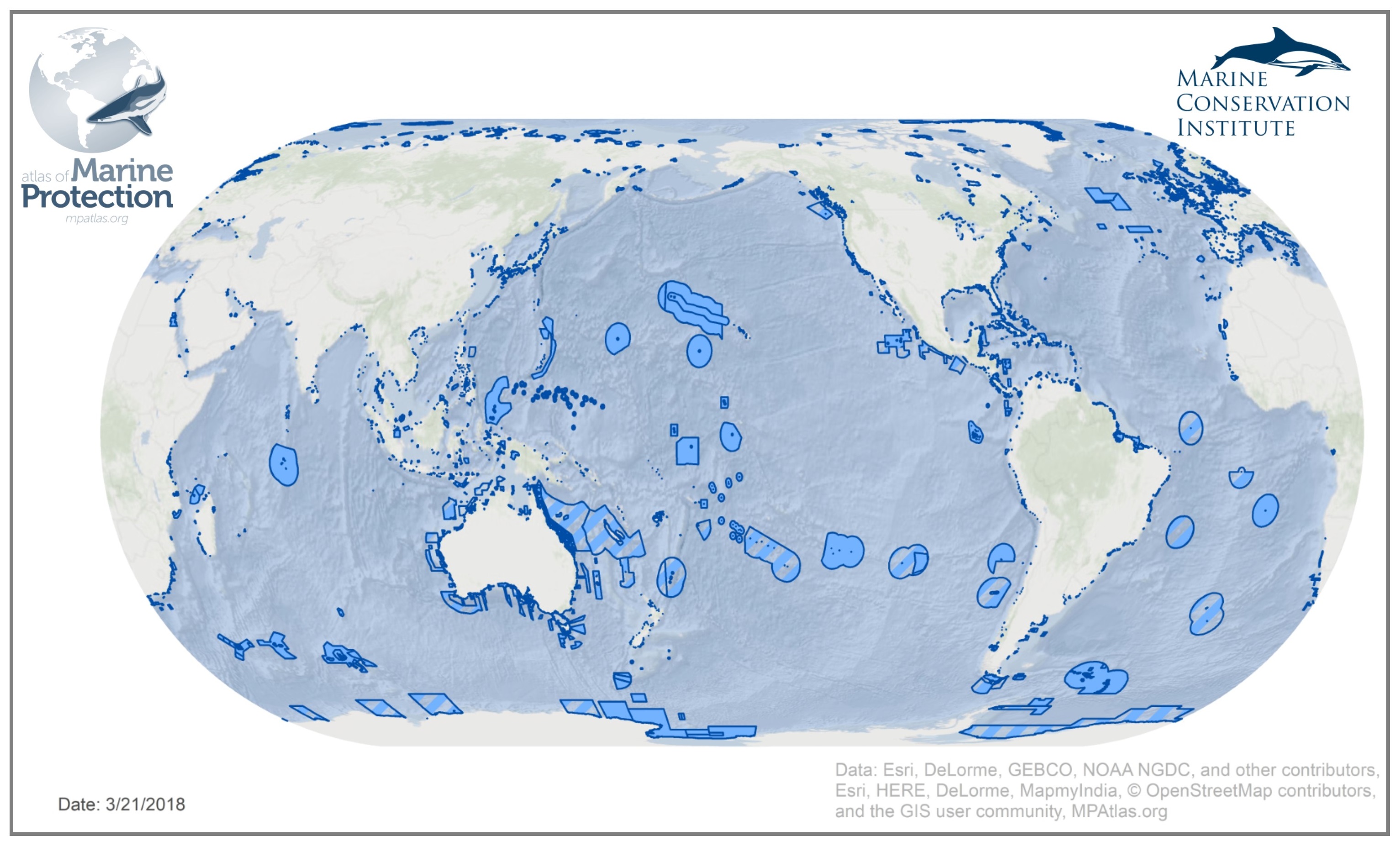
Which brings us back to Pluto. The WDPA tells us that about 7 percent of the ocean is protected, but just as planetary experts finally told us that Pluto is not really a planet, some ocean experts – myself included – are saying the real figure for protected ocean is well below that. In fact, the Marine Conservation Institute’s Atlas of Marine Protection—which audits WDPA data against IUCN’s standards—says that just about 3.6 percent of the ocean is under some form of protection, while only 2 percent is considered fully protected. Because it has taken decades to get even to our current total, the likelihood of reaching 10 percent in the next two years is slim.
Why the discrepancy? In recent years some governments have established marine “protected” areas that would be described more accurately as “management” or “multiple-use” areas. Levels of biodiversity protection within MPAs vary widely, from high to zero conservation benefits, and some countries even allow small-scale commercial fishing in protected areas. However, industrial scale fishing is incompatible with marine protected areas.
And yet we must try. As a Pacific Islander—I’m from Saipan—I grew up knowing that a healthy ocean benefits people; my identity and culture are linked to the ocean. An adage on the island is that the ocean does not divide us; it connects us. It is our highway to the rest of the world, our primary food source, and the basis of our economy. And that’s true in many places around the world. That’s why it’s so important that governments and marine management bodies understand how effective a tool MPAs can be for protecting and rebuilding our ocean’s health.
Studies show that MPAs, when they’re well-designed and well-managed, benefit ocean health and result in more and bigger fish, more biomass, and higher biodiversity than areas of similar size that are not protected. New research also indicates that MPAs could safeguard ecosystems and, by extension, large parts of our society—especially coastal communities—from an array of climate-related disturbances. Data also show that protected areas are most effective when they are well-enforced, large, isolated, and long-standing, and don’t allow any fishing or other resource extraction.
To help governments better manage existing MPAs and increase the likelihood that new ones will succeed, IUCN held a public comment period for suggestions on how to better communicate its global standards for these regions. IUCN will use that input to clarify its MPA definitions— resolving the question of how much of the ocean is protected—and to shift the building momentum for ocean conservation toward creating more fully protected areas.
To help IUCN in that effort, I recently collaborated with several U.K.-based researchers and colleagues with the Pew Bertarelli Ocean Legacy Project to recommend improvements for MPA classifications and reporting by ensuring that the primary focus of any protected area is the conservation of biodiversity. A classification system that recognizes the distinction between multiple-use and strongly protected areas will allow for easier and more accurate evaluation of the conservation gains derived from MPAs.
For the planet to realize the benefits of marine protection, governments must implement MPAs that confer conservation benefits. Undoubtedly, some leaders will protest when IUCN officially clarifies its definitions—but, as with Pluto, when the clamor dies down we’ll all have a truer sense of where things stand. In the case of our ocean, that means a better sense of what it takes to create an ecologically beneficial MPA—and a measure of how much work remains to be done to steer our ocean toward a sustainable future.