 A member of the American Society of Ichthyologists and Herpetologists (ASIH) and the American Elasmobranch Society (AES), Joshua Moyer is an ichthyologist specializing in the evolution, biodiversity, and morphology of sharks and their relatives. Joshua has co-authored multiple scientific articles about shark teeth and routinely lectures in courses on marine biology, vertebrate biology, and evolution. He earned his Masters of Science in Ecology and Evolutionary Biology at Cornell University and is an instructor in the massively open online course (MOOC) in shark biology offered by Cornell and the University of Queensland through edX.org. Follow him on twitter!
What is a shark without its teeth? For that matter, what is any animal without the ability to process and ingest its food? So important are teeth to the way many jawed vertebrates survive, that you can tell a great deal about an animal just by looking at its teeth, or in some cases, lack thereof. Sharks are no different. By asking a series of questions, you can look at shark teeth and begin to piece together a more complete picture of the shark whose teeth you’re studying.
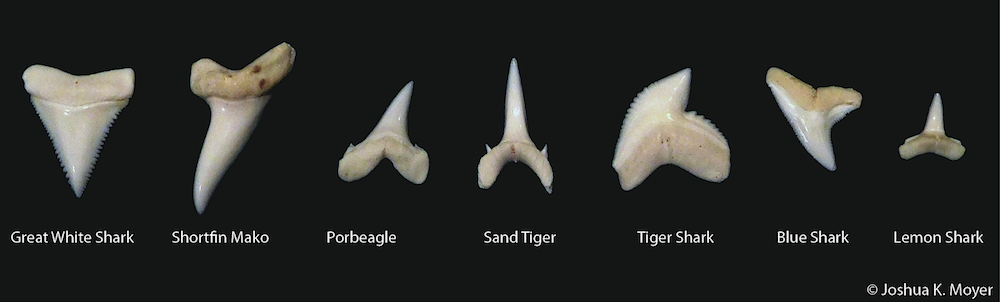
In his 1896 essay “The Tall Office Building Artistically Considered” American architect Louis Henry Sullivan remarked, “form ever follows function.” Although, in a strictly Darwinian understanding of evolution form precedes function, shark teeth do highlight a truth observed by many people across many disciplines: in the world around us, form and function are intimately linked. Shark teeth come in a variety of forms (Fig. 1) and are typically categorized by function. Large serrated teeth, like those of the Tiger Shark (Galeocerdo cuvier) are widely regarded as “cutting type” teeth. Others, like the teeth of a Porbeagle (Lamna nasus) are long and pointed with tiny cusplets on either side that function like the tines of a fork to pierce and hold prey.
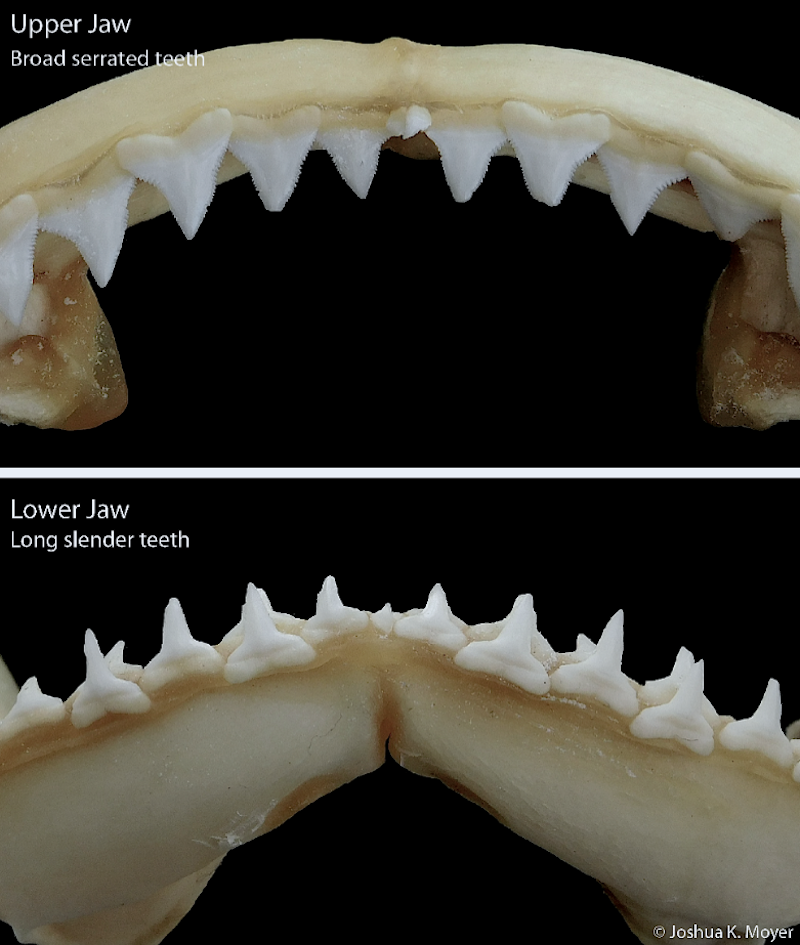
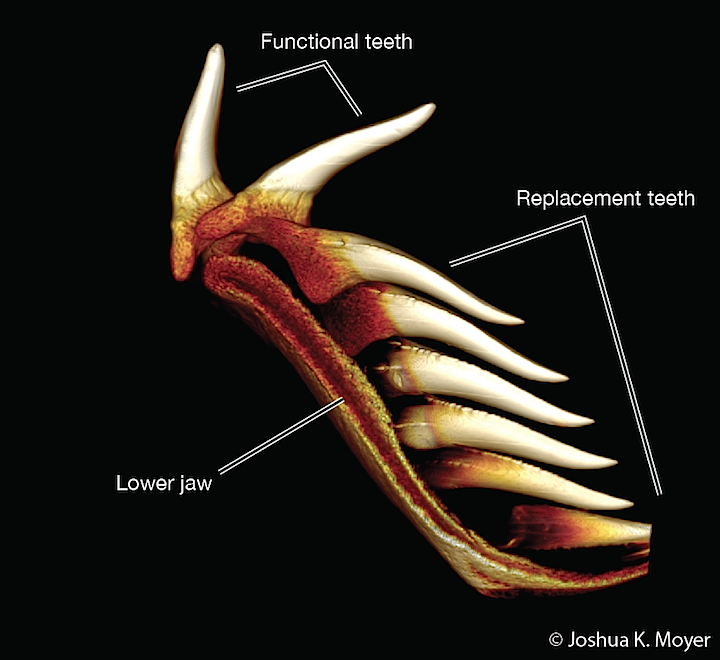
In many sharks of the family Carcharhinidae, we see what could best be described as a “knife and fork” dentition (Fig. 2). Teeth in the upper jaw are triangular and serrated, and teeth in the lower jaw are more slender and pointed. The next time you’re watching a documentary, or if you’re lucky enough to be in the ocean, and you see a carcharhinid shark, such as a Bull Shark, Reef Shark, or Tiger Shark take a bite of something large, watch as it shakes its head back and forth. In doing so, the shark is taking advantage of the pointed teeth in its lower jaw while cutting off a chunk of food with the serrated teeth in its upper jaw. This head shaking may be violent, and teeth are frequently lost as the shark processes its prey, but that’s not a problem. Sharks have what is called a polyphyodont dentition, meaning they have multiple generations of teeth. When a functional tooth is lost, another tooth moves from the lingual, or inside, side of the jaw to take the place of the lost tooth (Fig. 3).
Knowing the trends in tooth shape within and between shark species may seem like trivial knowledge at first, but consider that the vast majority of fossil shark species are known only from teeth. Sharks belong to the class of fishes known as Chondrichthyes (chondr = cartilage, ichthyes = fish), which means, as the name implies, sharks don’t have any bones. Rather, they have skeletons made of cartilage covered by a thin layer of calcium. While this light and flexible skeleton offers certain advantages for the shark, it poses a problem for paleontologists who study ancient sharks: it does not fossilize well. Fortunately, shark teeth fossilize very well. Shark teeth are made of hard substances called enameloid (similar to but not exactly the same as the enamel in your teeth) and one or two types of dentine (another hard tissue found in most vertebrate teeth). Being able to look at a fossilized shark tooth and infer what that shark may have eaten, how large it was, and how it used its teeth can give you a glimpse of an animal that may not have been seen on Earth for millions of years.
Take those bits of information and compare them to what is known about modern sharks, such as how tooth shape may change over the course of a shark’s life or patterns of tooth morphology among closely related species, and the body of knowledge concerning the heritage of modern sharks and the biology of extinct sharks grows. Not only do shark teeth highlight the connection between form and function, but they also illustrate a cardinal rule in the studies of evolution, morphology, and paleontology: to really understand an organism, you need to look at its evolutionary history by comparing modern and fossil animals side by side.
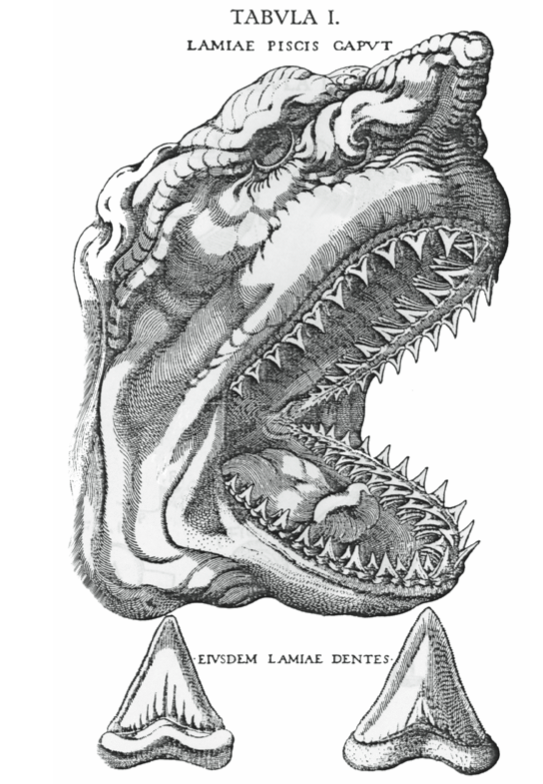
Over the course of the roughly 400 million years that sharks have inhabited Earth’s oceans countless shark teeth have been shed, making shark teeth one of the most commonly collected fossils in the world, but not everyone who found a fossilized shark tooth knew what they had. Throughout the Middle Ages, fossilized shark teeth were widely thought to be the tongues of dragons or giant lizards – resulting in the name “tongue stone” or glossopetrae – and prior to the 1600s the thought that these curious objects may actually be the teeth of sharks that had lived in the past was almost unheard of. It wasn’t until the mid 1660s that Nicolaus Steno observed and documented the similarities between the teeth of sharks caught by fishermen and the so-called tongue stones (Fig. 4).
So where does that leave us today? We certainly have come a long way since the days of Steno, but there are still fundamental questions regarding shark teeth that are active avenues of research. For example, what anatomical features of shark teeth are informative in the study of shark evolution and relationships between species? Features like serrations likely evolved more than once, so finding a shark tooth and noting that it has serrations is not enough to support the claim that the shark the tooth is from is closely related to other sharks with serrated teeth. Separating informative from uninformative traits is a key challenge in evolutionary biology. Another avenue of research is the functional morphology of shark teeth. How can we look at a tooth shape influenced by eons of evolution and mimic it or apply it to an area of human endeavor, such as the manufacturing of more efficient or precise cutting tools?
We are fortunate to live in world where technology is improved each and every day. With each improvement comes a new way of looking at the world, a new way of appreciating and understanding it. By applying new technologies ranging from high-resolution micro-CT scanning and imaging to software allowing us to simulate millions of years of evolution on our desktop, we are poised to learn new and fascinating things about the evolution and biology of sharks. Their teeth are captivating reminders of how much we have yet to learn, and I hope you’ve enjoyed this brief foray into the world of shark teeth.