Skip to content

Southern Fried Science

Over 15 years of ocean science and conservation online

  • Home
  • About SFS
  • Authors
  • Support SFS

Tag: climate change

Release the Kraken! Fleet now available in paperback!

Posted on December 6, 2013December 13, 2013 By Andrew Thaler
Popular Culture

Are you ready to join the crew of Miss Amy? Come explore a future ocean in my maritime science fiction adventure! Fleet: The Complete Collection (Amazon eBook) Fleet: The Complete Collection (Amazon paperback) Fleet: The Complete Collection (Createspace paperback)  

The last climate change refugees fight for survival in this grim view of our future ocean – Fleet: The Complete Collection

Posted on November 29, 2013 By Andrew Thaler
Popular Culture

Fleet: The Complete Collection  “The sea is big. The sea is cruel. She takes more than she gives. That’s how it’s always been.” The world has changed. Coastal cities lie abandoned as the encroaching sea rises, drowning and reshaping the land. Violent plagues, impervious to antibiotics, sweep across the planet, erasing entire communities in a … Read More “The last climate change refugees fight for survival in this grim view of our future ocean – Fleet: The Complete Collection” »

Science in the Fleet: The Promise of Technology as a Panacea for Human Impacts

Posted on October 7, 2013October 27, 2013 By Andrew Thaler
Popular Culture, Science

FleetCover1-REACHToday marks the release of Fleet: Wide Open, part 2 of my serial maritime science fiction adventure. With half the story revealed, we now see the roll technology plays in both the history and the day-to-day operations of the fleet. Specifically, we see three major technological advances that seem as though they would have been major solutions to the environmental problems facing the fleet, yet somehow, the world continues to fall apart.

In our world and the world of the fleet, we often hold up technological innovation as a panacea for global problems. It’s easy to look towards the next big advancement as the solution to our current woes — from alternative energy sources to groundbreaking trash removal devices — but what is often lost in the hype is the human component. Yes, technology is a necessary component of global environmental solutions. You can even look at the arc of human advancement as one long series of bootstrap-hoists — we need to utilize dirty tech to access environmentally sustainable tech (i.e. you can’t develop the ability to produce solar panels without first harnessing the energy locked in fossil fuels). But technology alone is useless without also changing human behavior. This creates a major problem, as technological innovation is often used as a tool to bypass human behavior entirely, the assumption being that it doesn’t matter what the individual does, so long as the tech is in place to mitigate it.

The horse piles of New York

Around the turn of the last century, New York City was in crisis. Horses, the primary means of transportation for people and products within the city have an unfortunate byproduct — feces, lots and lots of feces. At its peak, more than 60,000 horses were depositing upwards of 500 tones of manure every day. The horse crisis itself was the result of a major technological innovation — more efficient fertilizer based on mass produced phosphate. Where once there was a major economic incentive to collect the manure and resell it as fertilizer, now there was also no incentive. And so, the mountains of feces piled up. It got so bad that one editorial expounded that, by the 1930’s piles of horse manure would stand three stories tall and the city would be awash in an unending tide of feces.

Read More “Science in the Fleet: The Promise of Technology as a Panacea for Human Impacts” »
Climate Change is Moving Fish Around

Posted on September 30, 2013October 27, 2013 By Chuck Bangley 2 Comments on Climate Change is Moving Fish Around
Uncategorized

Back in the day, I worked as an intern at Rhode Island Marine Fisheries, where my job was basically to provide general field work help with whatever survey needed an extra pair of hands (yes, it was an awesome job).  One of these was a beach seining survey looking at juvenile fishes using Rhode Island’s coastal salt ponds as nursery habitat.  Among the usual silversides, mummichogs, and juvenile flounder, two of the ponds were also home to entire schools of something that I was only familiar with due to having relatives in Virginia: spot.  These little Scianids, a member of the same family as Atlantic croaker and red drum, are caught in droves in the waters of Virginia and the Carolinas but traditionally have been rare north of the Chesapeake Bay.  They were one of the more common species we caught in these two Rhode Island salt ponds, and occurred so consistently that we could actually observe them growing over the course of the summer.  It isn’t unheard of for stray tropical fishes to get swept into Narragansett Bay on Gulf Stream eddies, where they’re either collected by aquarists or die during their first winter.  However, these were populations of spot that we were seeing.  I don’t know if these fish survived their first winter or have come back since I moved down to North Carolina, but even at the very beginning of my interest in fisheries ecology I knew this was odd.

Read More “Climate Change is Moving Fish Around” »

Sick of fictional mermaid documentaries? Try some dystopian maritime science fiction, instead!

Posted on September 2, 2013October 27, 2013 By Andrew Thaler 4 Comments on Sick of fictional mermaid documentaries? Try some dystopian maritime science fiction, instead!
Popular Culture

Welcome to the Fleet! It’s the near future, the rising tides have swallowed much of the world’s coastlines, and the last survivors of a deadly plague are scattered across a new and vastly different ocean. But all is not well in the Reach. The fish are dwindling, the currents are shifting, and secrets long thought … Read More “Sick of fictional mermaid documentaries? Try some dystopian maritime science fiction, instead!” »

Herring Wars: Quotas, Conflicts, and Climate Change in the North Atlantic

Posted on July 25, 2013October 27, 2013 By Andrew Thaler 4 Comments on Herring Wars: Quotas, Conflicts, and Climate Change in the North Atlantic
Conservation, Science
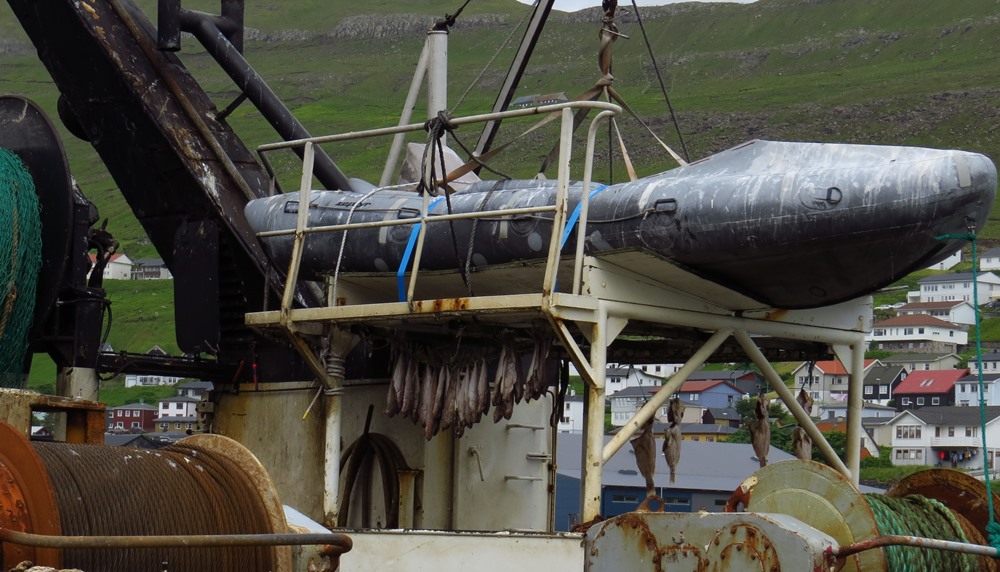
Herring and other fish hung out to dry on a trawler in Klaksvík. Photo by ADT.

A small collection of islands in the North Sea, a few hundred miles south of the Arctic Circle, is preparing for war. The European Union, under the auspices of an international fisheries management agreement, is ready to levy heavy trade sanctions against the Faroe Islands, an independent protectorate of Denmark. The Faroes, with a population of less than 50,000, intends to fight these sanctions, defy EU authority, and defend their economic independence. The object of contention is the right to fish Atlanto-Scandian Herring; the driving force behind this dispute–dramatic shifts in fish distribution brought on by warming seas and altered currents. This may be the first international conflict directly attributable to climate change. It will not be the last. Regardless of the outcome, this confrontation will set a precedent for future climate conflicts. Welcome to the Herring War.

Despite their uninspiring name, herring are a rather handsome fish. Atlantic herring, Clupea harengus, are relatively small with a classically “fishy” (fusiform) body shape. They are among the most abundant fish in the ocean, forming schools that can number in the billions. Along with other planktivorous fishes, such as menhaden, that convert phyto- and zooplankton into higher trophic-level biomass, herring are critical to ocean food-webs. They are considered to be among the most important fish in the sea. Herring are the dominant prey species for many large, pelagic predators like tuna, sharks, marine mammals, salmon, and sea birds, among others. Their dominant predator, unsurprisingly, is us.

Read More “Herring Wars: Quotas, Conflicts, and Climate Change in the North Atlantic” »

World’s leading experts say there’s a problem with false balance in conservation journalism; Steve disagrees

Posted on July 4, 2013July 16, 2013 By David Shiffman 20 Comments on World’s leading experts say there’s a problem with false balance in conservation journalism; Steve disagrees
Science

davesquare

False balance in the media occurs when a journalist  gives equal coverage, and therefore the perception of equal validity, to both sides of a story. While this sounds preferable to today’s hyper-politicized media, sometimes both sides of a story aren’t equally valid. For example, when the overwhelming consensus of the expert medical community says that vaccines do not cause autism but a famous former actress says they do,  giving both sides equal coverage can be not only frustrating, but harmful to public health. The same is true of early reporting on whether cigarettes are bad for you. Giving equal coverage of the global community of expert climate scientists and spokespeople  for the oil and gas industry who claim that climate science isn’t “settled” can also be problematic, as can coverage of other scientific topics.

Image via http://undsci.berkeley.edu/article/sciencetoolkit_04

Though it is discussed less frequently in this context,  overfishing and marine conservation issues can also feature some fairly egregious examples of false balance. Coverage of a proposal to list great hammerhead sharks under the Endangered Species Act in yesterday’s South Florida Sun-Sentinel provides a useful case study.

Read More “World’s leading experts say there’s a problem with false balance in conservation journalism; Steve disagrees” »

An open letter to my newborn niece

Posted on September 29, 2012September 29, 2012 By Andrew Thaler 4 Comments on An open letter to my newborn niece
Science

Dear Tinsley,

Welcome to the world. I know it must feel like a very small world right now–just big enough to keep you safe and sheltered and loved–but trust me, as you keep growing, so will the world. Even after you stop growing, it will keep getting bigger. This big, old world that you have suddenly appeared in is huge and strange and beautiful and mysterious. There is more to discover in this world than all of us who have ever lived, working together, can ever know. Even before you can speak, you will think things and know things that no one has ever thought or known before. That is wonderful.

We are explorers. Not just your aunt and uncle, or your family, but all of us: this whole, gigantic group of people that call ourselves “humanity”. Today, there are over 7 billion of us and every last one, every person you will ever meet, can trace their heritage back, through thousands of millennia, to a small tribe of primates somewhere on the African savannah  We were explorers then, too. This tribe made its way across Europe and Asia. They sailed across the Pacific to Australia and a thousand tiny islands. They marched across the Bering Sea–land once connected Alaska to Russia–and traveled all the way down to the tip of South America. And, no matter how far they traveled, no matter how much they explored, the world just kept getting bigger.

We’re still exploring, today. We’ve built an enormous machine called the Large Hadron Collider–some say it’s the most complicated machine humanity has ever built—that allows us to explore the tiniest things in the universe: the sub-atomic particles that hold our world (and every world) together. We’ve even begun to explore beyond our own world. We have massive telescopes that allow us to explore distant galaxies. We’ve built probes that have left our own solar system. We have satellites orbiting Jupiter and Saturn. This summer, we landed a robot on Mars. It has already discovered that Mars was once more like our own world than we previously believed. We named that robot “Curiosity”.

Read More “An open letter to my newborn niece” »

Romney mocked climate change and conservation. Really. That happened. In 2012.

Posted on September 3, 2012September 3, 2012 By David Shiffman 5 Comments on Romney mocked climate change and conservation. Really. That happened. In 2012.
Conservation

A few weeks ago, the Southern Fried Scientist asked what plans (if any) Mitt Romney had regarding the U.S. National Ocean Policy. Last Thursday night, voters may have gotten our first clue. During the most widely-viewed and important political speech of his life, a speech widely criticized for lacking any kind of policy details, Romney mocked President Obama for trying to do something about sea level rise and the declining state of our environment.

He said, ““President Obama promised to slow the rise of the oceans…[big pause for audience laughter]… and to heal the planet. My promise is to help you and your family.” Check out the clip:

There are essentially two ways to interpret the remark and the audience’s reaction. This was one of the biggest laugh lines of the whole convention, so it may have been intended as harmless humor, but why did the audience find it funny? Remember this is the same audience that booed a gay soldier and called for a hypothetical uninsured cancer patient to die a few months ago.

Read More “Romney mocked climate change and conservation. Really. That happened. In 2012.” »

Climate Change Anecdotes Volume 1: Sea Ice and Nuclear Reactors

Posted on August 28, 2012August 29, 2012 By Andrew Thaler 6 Comments on Climate Change Anecdotes Volume 1: Sea Ice and Nuclear Reactors
Science

anecdote 

noun.

1. a short account of a particular incident or event, especiallyof an interesting or amusing nature.

2. a short, obscure historical or biographical account.

Dictionary.com

Climate Change

noun.

A change of climate which is attributed directly or indirectly to human activity that alters the composition of the global atmosphere and which is in addition to natural climate variability observed over comparable time periods.

United Nations Framework Convention on Climate Change

Climate change is real and human activity is the cause. The theory that we are fundamentally altering our planet’s climate is supported by overwhelming evidence. Prominent global warming skeptics have, in the face of such evidence, acknowledged that climate change is happening, and that humans are the cause.

And still climate change denial continues to persist.

In the last decade, we have passed a threshold where the reality of climate change is no longer a hypothesis buried in bar graphs or something to be assessed by minute changes in careful measurements, but an observable phenomenon. Rather than anticipating the effects of human impacts on the climate, we must now live them. Thanks to a well-organized and well-funded climate denial industry, we missed our chance to change course. If the last decade was the hurricane warning, than this decade is landfall.

Read More “Climate Change Anecdotes Volume 1: Sea Ice and Nuclear Reactors” »

Posts pagination

Previous 1 … 9 10 11 12 Next

Popular Posts

Shark scientists want their research to help save threatened species, but don’t know how. Our new paper can help.Shark scientists want their research to help save threatened species, but don’t know how. Our new paper can help.December 1, 2025David Shiffman
Norway and Cook Islands put their deep-sea mining plans on pause.Norway and Cook Islands put their deep-sea mining plans on pause.December 3, 2025Andrew Thaler
What Ocean Ramsey does is not shark science or conservation: some brief thoughts on "the Shark Whisperer" documentaryWhat Ocean Ramsey does is not shark science or conservation: some brief thoughts on "the Shark Whisperer" documentaryJuly 2, 2025David Shiffman
2025: My year in writing, public speaking, and media interviews2025: My year in writing, public speaking, and media interviewsDecember 3, 2025David Shiffman
What we know we don't know: impacts of deep-sea mining on whales, dolphins, sharks, turtles, and other migratory species.What we know we don't know: impacts of deep-sea mining on whales, dolphins, sharks, turtles, and other migratory species.November 20, 2025Andrew Thaler
The Trouble with Teacup PigsThe Trouble with Teacup PigsOctober 14, 2012Andrew Thaler
Urea and Shark OsmoregulationUrea and Shark OsmoregulationNovember 15, 2010David Shiffman
How tiny satellites are tracking marine wildlifeDecember 1, 2025Andrew Thaler
Shark of Darkness: Wrath of Submarine is a fake documentaryShark of Darkness: Wrath of Submarine is a fake documentaryAugust 10, 2014Michelle Jewell
Build a dirt cheap, tough-as-nails field computer in a Pelican caseBuild a dirt cheap, tough-as-nails field computer in a Pelican caseJuly 21, 2015Andrew Thaler
Subscribe to our RSS Feed for updates whenever new articles are published.

We recommend Feedly for RSS management. It's like Google Reader, except it still exists.

Southern Fried Science

  • Home
  • About SFS
  • Authors
  • Support SFS


If you enjoy Southern Fried Science, consider contributing to our Patreon campaign.

Copyright © 2025 Southern Fried Science.

Theme: Oceanly Premium by ScriptsTown