

The focus on community and informal rules that were found to frequently structure successful commons management made apparent that the word ‘policy’ needed to be expanded. Policy scholars now look beyond the official written laws, reports, and regulations that are often written by a central government to multi-scalar rules that govern the structure and behavior in a system (Ostrom 2005). They include non-written cultural norms, religious prescriptions, and community ethics that are often more strongly followed that written, formal rules (Berkes 2008). Along with a more broadly defined concept of policy, commons scholars also introduced a more broad definition of institution within which these policies are made and enforced. Much like policies, institutions can be governmental as well as religious, moral, or cultural. Hanna and Jentoft (1996) give an appropriately broad definition for natural resource institutions: “institutions represent the arrangements which people devise to control their use of the natural environment”. Ostrom (2005) promotes an institutional analysis in order to encompass these new conceptions of policy and institution. Her work recently earned the Nobel prize and is rapidly becoming the most used framework for policy analysis.
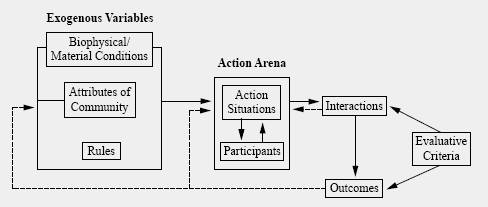 Ostrom’s Institutional Analysis and Design (IAD) Framework is not specific for natural resources or even commons problems, but serves as a place to begin policy analysis for all sorts of policy problems, including education, gender relations, crime, and natural resources. A short description here does not fully describe the IAD framework – for that, refer to Ostrom’s 2005 book. To highlight a few pertinent features, the framework is centered around a decision-making arena called the action arena rather than on the formation of a particular policy. Inputs to the action arena include exogenous variables describing the biophysical characteristics, community factors, and existing rules relating the action arena in play. This action arena then interacts with action arenas at other levels of governance (operational, collective choice, constitutional, and super-constitutional) to form an outcome. The outcome is evaluated by some defined set of criteria and the process feeds back to become iterative. The main benefit of the framework is to allow for comparative studies between empirical studies by scholars around the world in many disciplines.
Read More “State of the Field: A New Type of Policy Analysis” »