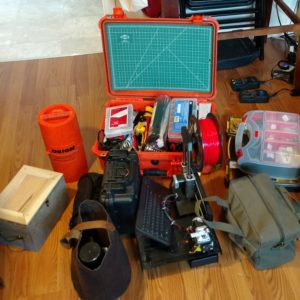
All electronics kits are not created equal. Between the OpenROV, Oceanography for Everyone, and hack-a-thons around the world, my work has taken me out of the lab and into the field, fantail, and classroom to build instruments, hack oceanographic equipment, and train next generation of open-science oceanographers. This has placed a huge new demand on my standard kit, a collection of electronics and hardware tools and components that allow a creative maker to build anything, anywhere. Portability is key, but portability comes with it’s own challenges, especially for that most vital of electronics tools, the humble, powerful soldering iron.
A good soldering iron is absolutely critical to the kinds of projects and workshops I run. Without it, we can to the delicate electronics work necessary for getting a piece of equipment working in the field. But traveling with soldering irons is a nightmare. These high-wattage devices don’t always play nice with local electrical infrastructure. Even using the *right* power converters we’ve blown fuses and burned out power supplies. In the best case scenarios, the irons just don’t produce enough heat to get the job done. In remote regions, local options are often non-existent. When we go, we bring everything with us.
There are portable soldering irons, but they have their own problems. Gas-powered irons require a fuel source that may not be easily obtained and are not always welcome on flights. They also lack the fine control we need. Electric options tend to be of the “cold heat” variety, which is a poor tool for circuit board work and can generate a current that burns out components and shorts your project. Heat-based electric soldering irons are weak, short-lived, and often utterly ineffective. I resigned myself to lugging large soldering stations around the world, hoping for the best when it comes to finding an adequate power supply.
And then I discovered the Hakko FX-901.
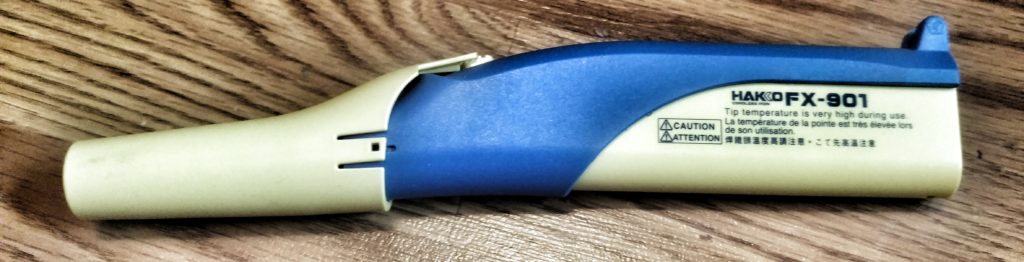
We don’t really do a ton of gear reviews on this site (although there was a time where field equipment review was part of our site’s charm), so for me to write a whole post about one piece of gear is kind of a big deal.
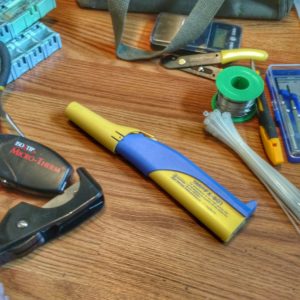
This is a damn good soldering iron. It holds up rivals my benchtop station for everything but the tiniest projects. Over the last month I’ve run it through it’s paces, on everything from big wiring jobs to surface mounting components. It’s comfortable and maneuverable. The tip is excellent (no surprise coming from Hakko) and switching between tips is easy. For most people, it could easily serve as your only soldering iron.
But the portability is where it really shines. It runs for 2 hours on AA batteries, and happily takes rechargeable MiMH batteries. It heats up in less than a minute, but only has one heat setting (600°F), but that’s plenty hot. On non-rechargeable batteries, it starts off a bit hotter and slowly tapers off. On rechargeables, it’s very consistent until the batteries are drained. The batteries slide out of a magazine, making power swaps quick.
The cap locks the iron in the off position, preventing it from turning on while getting jostled during travel. It’s small enough to fit in a pocket, but I like to keep everything in a small canvas mechanics bag.
The Hakko FX-901 isn’t going to outperform a good bench unit, but for most jobs, it’s just fine and it dramatically reduces the amount of gear I have to lug around. AA batteries are readily available pretty much everyone, so plugging into iffy power supplies is no longer a problem. It’s beefy enough for all but the heaviest wires (you probably won’t be pumping out enough heat for 12-gauge wire). At a hair over $30, it’s hard to argue with the price (though the replacement tips cost almost as much as the iron).
If you’re looking for a good iron for light soldering and travel, it’s hard to argue with the portable, powerful Hakko FX-901.
Hey Team Ocean! Southern Fried Science is entirely supported by contributions from our readers. Head over to Patreon to help keep our servers running and fund new and novel ocean outreach projects. Even a dollar or two a month will go a long way towards keeping our website online and producing the high-quality marine science and conservation content you love.