In the Last of Us, the most gruesome live-action adaptation of a video game about people being turned into fungus since 1993’s Super Mario Bros, a mutated species of Cordyceps destroys society by converting humans into mindless, sporulating mushroom people.
Cordyceps, a fungus that most commonly parasitizes ants, is real. It really does hijack its host’s nervous system, alter its behavior, and turn it into a spore-producing zombie. The outcome is strangely beautiful.
Though the current darling of gritty, realistic, science-based zombie fiction, Cordyceps is such a lightweight in the world of brain-breaking parasites that tech bros brew it into their adaptogenic coffee.
If you want to meet a truly unsettling zombie-making parasite, allow me to introduce you to Sacculina.
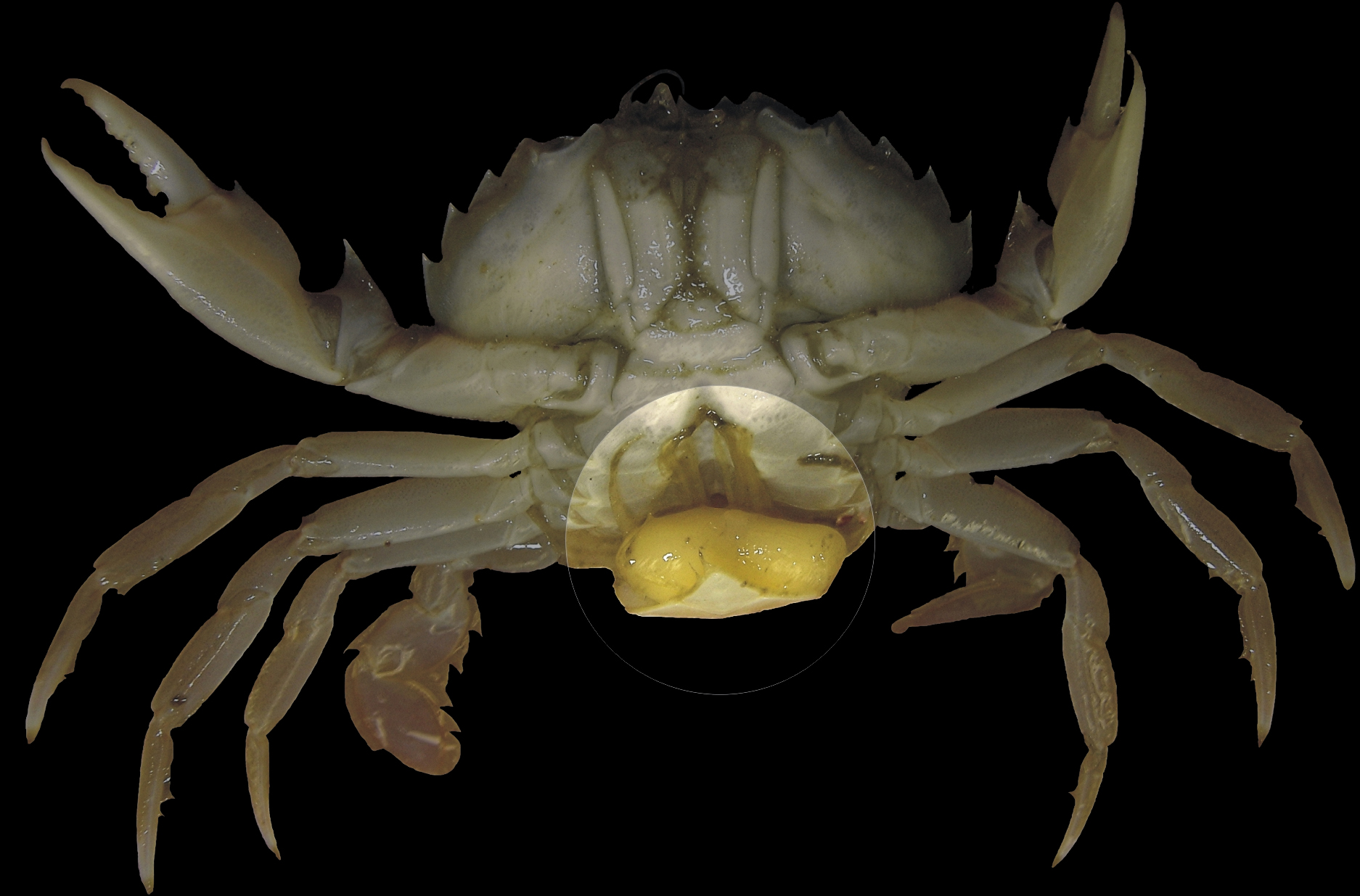
Sacculina is a genus of barnacle that parasitizes crabs. While most parasitic barnacles are perfectly happy growing on the carapace of a crab, Sacculina takes this partnership to the extreme.
Female Sacculina larvae drift through the ocean, until they encounter a crab. The larva then settles on the crab and searches for a joint in the crab’s carapace. Once it finds a gap in the arthropod’s armor, it transforms into a kentrogon, a specialized phase of the barnacle life cycle that possess a stylet–an organic syringe-like structure–which allows Sacculina to inject itself into the crab, and not much else. At this point, the hard shell attached to the crab’s carapace falls off and the barnacle continues to grown within its host.
It gets so much weirder from here.
Sacculina need to reproduce, but, as far as the barnacle is concerned, its host does not. As it grows inside the crab’s body, the parasite emerges from the host’s abdomen, where a healthy crab’s gonads would usually be located and where a gravid crab would incubate its eggs in a large cluster called a sponge. To make way for the sac of Sacculina, called an externa, the barnacle destroys the host’s genitals, rendering the crab sterile.
Male Sacculina are not quite so imposing. Rather than parasitizing poor wayfaring crustaceans, it seeks out infected crabs, searches for female Sacculina already on those crabs, and then injects its own cells into a specialized pocket in the externa, creating a mass of sperm-producing cells inside the female barnacle. That pocket is, appropriately enough, called the testis.
Once infected, the host crab cannot molt, nor can it regrow lost appendages. Root-like tendrils grow throughout the crab’s body, wrapping around organs and extending into the nervous system. Nearly all of its nutrients are diverted to sustain the parasite.
And here’s where things get tricky.
Both barnacles and crabs are crustaceans, and they generally reproduce the same way. In order to pump its spawn into the water column, the barnacle is going to press gang what little remains of the crab’s reproductive structure into service. If it invaded a female crab, then it’s all gravy, but if Sacculina attached itself to a male crab, it has a problem.
It also has a solution.
From within the crab, Sacculina hijacks everything about its host’s physiology. It induces the crab to produce female hormones. The abdomen is widened and flattened, to serve as a better platform for the externa. The male crab begins to act like a female crab, engaging in mating displays and other reproductive behaviors. To get where it needs to go, the parasite, which at this point has likely absorbed several males into its body, induces a sex change in its host.
The crab then begins the very familiar process of spawning. It tends to the externa as if it were its own egg mass, climbs to a high point on the sea floor, and pumps its abdomen, pushing out clouds of baby parasites ready to drift through the seas and find their own crab to call home.
Nature is a wonder.
Featured image: Sacculina carcini © Hans Hillewaert / CC BY-SA 4.0
Southern Fried Science and the OpenCTD project are supported by funding from our Patreon Subscribers. If you value these resources, please consider contributing a few dollars to help keep the servers running and the coffee flowing.