As in-person negotiations on the future of exploitation in the deep ocean resume this week in Kingston Jamaica, we reflect back on the last two years of development as reported on our sister site, the Deep-sea Mining Observer. This article first appeared on November 19, 2021.
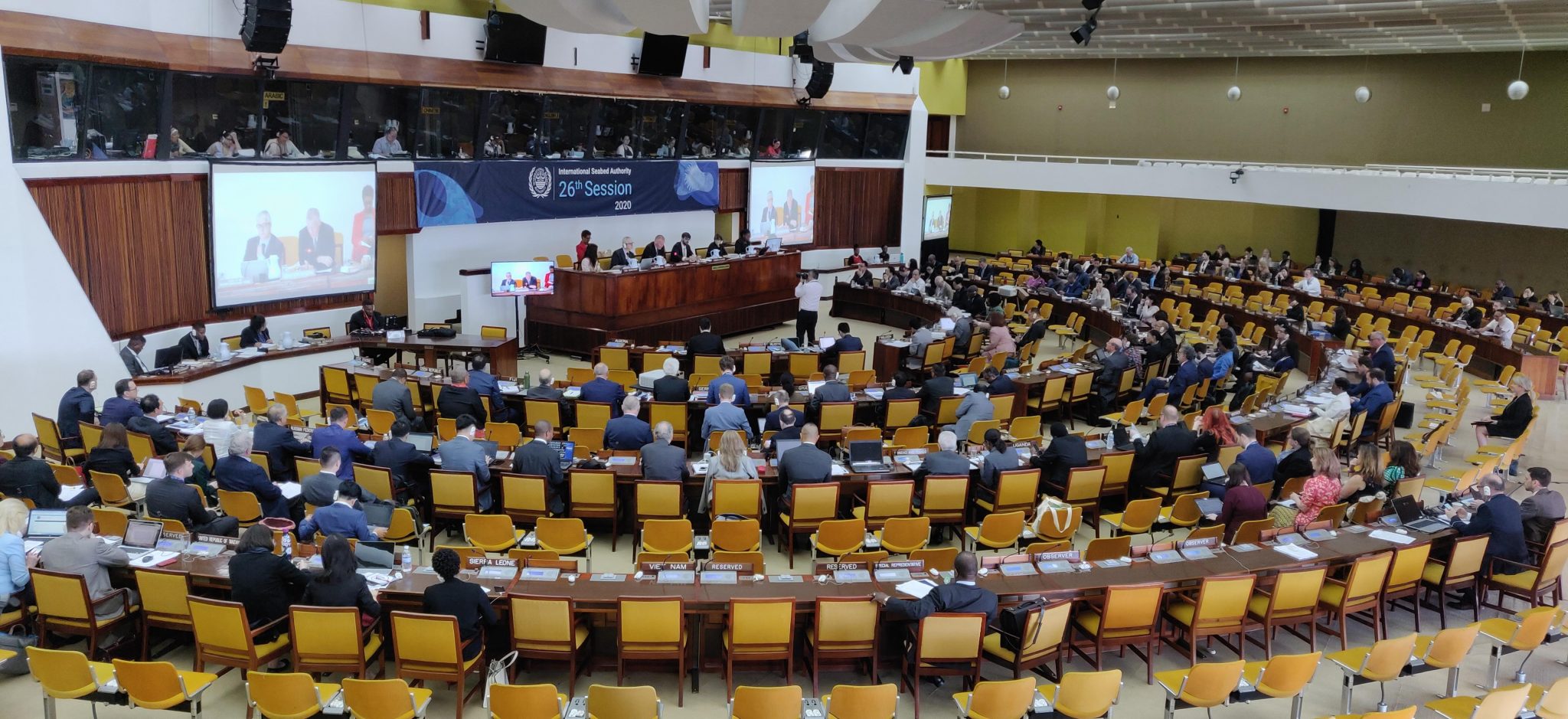
Throughout the 26th Session of the International Seabed Authority, during both the council meeting and via media interviews, deep-sea mining contractors have begun to talk about “the trigger”. The trigger is a protocol within UNCLOS which would allow sponsoring states to jumpstart the deep-sea mining process, placing a ticking clock on the development of the mining exploitation regulations. Annex I, Section 1(15) of the 1994 Agreement on the Implementation of Part XI of UNCLOS (colloquially referred to as “Article 15” or more informally, “the trigger”) allows a sponsoring state to expedite the current mining code negotiations by submitting a plan of work for a contractor that is imminently ready to begin production.
Article 15 lays out the conditions under which a sponsoring state could initiate deep-sea mining in the Area absent a finalized mining code. If a sponsoring state submits a plan of work for a commercial deep-sea mining operation, that action starts a two-year countdown. If there is no approved code by the two-year deadline, the contractor and sponsoring state can move forward with exploitation in accordance with their own submitted plan of work and a set of provisional regulations that have been approved by the Council.
“Without this provision,” says Pradeep Singh of the Institute for Advanced Sustainability Studies, “it was technically possible pursuant to UNCLOS for one or a few Council members to deploy filibuster tactics to frustrate or impede the adoption of key regulations. With the introduction of this provision and in the context of exploitation activities, it is possible for a member state of the Authority to request for exploitation regulations to be adopted by the Council within a prescribed period of two years from the date of the request, failing which, it would still have to consider any application submitted for exploitation activities despite the absence of the said regulations.”
Over the last year, mining contractors have explicitly discussed the trigger in the press. “It’s something that’s consistently under review – it’s not off the table, that’s for sure,” said Gerard Barron in an interview with China Dialogue.
Pulling the trigger would present its own challenges. Though often ascribed to the mining contractors, as generally the contractor is the entity that would best know whether or not they are ready to commence commercial exploitation, it is the contractor’s sponsoring state that would actually invoke Article 15, adding an additional layer of geopolitical nuance to the decision. A sponsoring state would need broad support from the 36-member council in order to successfully invoke Article 15.
Even if Article 15 is invoked, implementation is an entirely different challenge. “Article 15 of the Implementing Agreement, it has not been judicially interpreted,” says Dr. Philomène Verlaan of the University of Hawaii, “so what we have is its text, which is subject to the standard rules of treaty interpretation as set out in the Vienna Convention on the Law of Treaties, and those set out in the Law of the Sea Convention and the [Implementation Agreement] itself.” In other words, pulling the trigger doesn’t immediately start the clock so much as it starts deliberations and negotiations into how Article 15 will be implemented.
Not all stakeholders are convinced that pulling the trigger would be beneficial to deep-sea mining contractors. One observer indicated that by forcing the Council’s hand, contractors could end up with more restrictive regulations than would have otherwise been approved through the deliberative process. A two-year countdown doesn’t necessarily favor mining interests, and a rushed process could err too far in the direction of environmental regulations that are more stringent and a payment regime more taxing than those which would have emerged over a longer period of negotiation.
“By invoking the two-year trigger at this stage, an overzealous member state could risk the possibility of being isolated by a majority of Council members, and at the same time stands to be accused of not acting in good faith and perhaps even for undermining key provisions of UNCLOS, such as allowing for all efforts to achieve consensus at the Council to first be exhausted.” says Pradeep Singh. “It could also possibly backfire and result in a situation that disadvantages the applicant hoping to take advantage of the two-year trigger, such as the imposition of stricter conditions (including higher financial guarantees), the issuance of a provisional (and conditional) approval that could be reversed or significantly altered subsequently, or outrightly deciding to disapprove the application. The regulatory uncertainties and political differences that could potentially arise as a result of pulling the trigger, resulting in a half-baked process that would need to be revisited in future, are certainly not favourable for investors looking to back prospective applicants for exploitation contracts.”
While some contractors are dependent on investors who need to see forward progress before committing more capital, others have more stable revenue streams, and may be more willing to tolerate a slower process. Sponsoring states who already have developed terrestrial exploitation industries have fewer incentives to push for an expedited process.
“Given that concerns with the current draft largely fixates on the protection of the marine environment”, Singh continues, “it would appear to be rather perplexing for any member State to decide to trigger the provision at this stage. It would be a particularly questionable move if, for example, the member state that triggers the said provision is also one that claims there is a need to turn to deep seabed mining to generate metals now to support the green transition in order to improve the state of the global environment. If the intention is indeed to serve the environment, it would be inexplicable to rush through the process when clearly so much more is needed from a regulatory perspective to ensure the effective protection of the marine environment from the harmful effects of mining activities.”
The ISA declined to comment on a hypothetical implementation of Article 15.